 DATA CENTER
30-Day Data Center Handover and Dispute Checklist: Protecting Custody, Warranty Clocks, and Escrow
DIRECT ANSWER & VERIFICATION THRESHOLD:A 30-day data center handover checklist governs the critical post-IST window between Conditional Acceptance and Final Custody Transfer when disputed commissioning defects, incomplete as-built redlines, and unverified alarms remain open. Never convert a conditional sign-off into an unconditional handover through calendar inertia: separate Category A showstopper defects (zero acceptance; halt energization/custody) from Category B commercial defects backed by a 30-day hard cure deadline and a 150%–200% estimated-cost-to-cure security holdback, and require witnessed re-test evidence—never vendor invoices—to close any disputed line item.
Every delayed data center build hits the same 30-day pressure cooker. Sales has promised an AI tenant rack turn-up on the first of the month. The general contractor slides a "30-Day Conditional Handover Agreement" across the conference table claiming only minor punchlist touch-ups remain, and suggests signing custody today while "dispute items close out over the next 30 days."
Six weeks later, the warranty clock has already started running across the entire campus, the final retainage invoice has been released, and three unresolved items—a missing ATS interlock, un-redlined MV breaker settings, and a drifting CDU flow transmitter—sit permanently stuck in a finger-pointing email chain between three subcontractors who have already demobilized from site.
When open items enter a 30-day handover dispute window, verbal good faith evaporates on day one. Your 30-day handover checklist must tie every single open defect to a hard physical re-test, an explicit contractual security holdback, and an automatic warranty suspension on affected systems until witnessed closure occurs.
Separating Dispute Ops: Category A Showstoppers vs. Category B 30-Day Cure Items
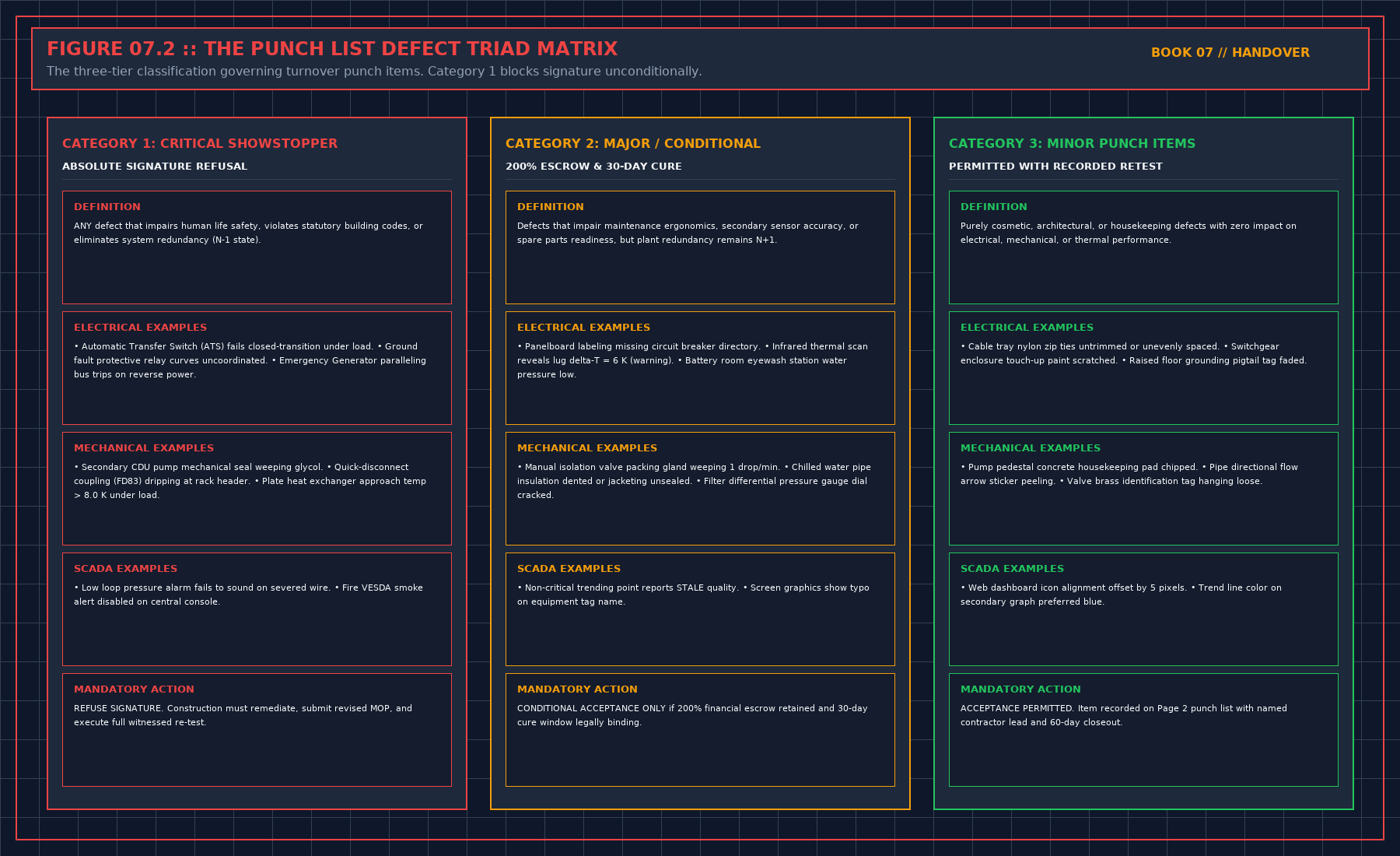
The single fastest way to lose leverage during a handover dispute is mixing life-safety and redundancy failures into the same spreadsheet tab as paint touch-ups. As codified in A handover signature is a sentence and our 50 Commissioning Refusal Gates Cheat Sheet, all punchlist entries must split into three immutable classes before any 30-day clock begins:
| Defect Tier | Physical Boundary Condition | 30-Day Dispute Eligibility | Contractual Financial Holdback |
|---|---|---|---|
| Category A (Showstopper) | Life safety, NFPA 70E arc-flash, LOTO breach, 2N/N+1 failure, missing L5 IST pass | INELIGIBLE — Zero Custody Transfer | 100% Milestone Payment Frozen |
| Category B (Conditional) | Non-critical redundancy impairment or missing redlines with verified workaround | 30-Day Hard Cure Window (Day 1–30) | 150%–200% Estimated Cost-to-Cure Escrow |
| Category C (Cosmetic) | Labeling, paint, ceiling tile trim, non-operational housekeeping | 30-Day Punchlist Closeout | Standard punchlist retainage |
Why 150%–200% Cost-to-Cure Escrow Security Covers Third-Party Remediation
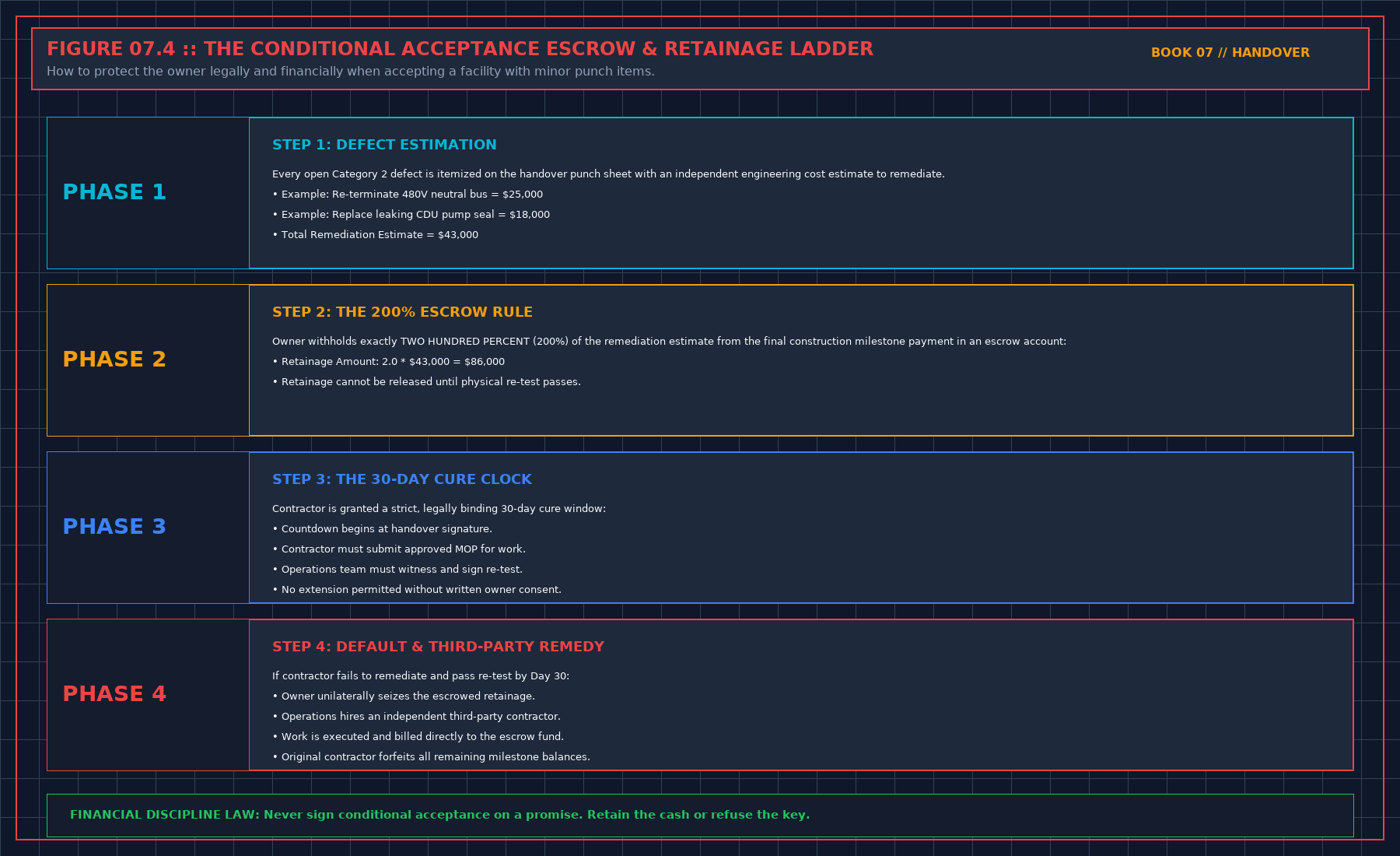
When negotiating a conditional handover escrow agreement for Category B items, structure the withheld sum strictly as remedial security to cover third-party re-procurement, engineering mobilization, and independent CxA re-witnessing costs (1.5× to 2.0× documented third-party replacement quote), released immediately upon witnessed defect closure. Framing a 200% holdback purely as a commercial cure security escrow—explicitly tied to actual replacement quotes and refundable immediately upon witnessed acceptance—keeps third-party remediation funded if the installing contractor abandons punchlist completion after Day 30.
The 30-Day Handover Dispute Checklist (Day 0 to Day 30 Gates)
Execute this strict chronological protocol during any conditional turnover or disputed closeout cycle—cross-referencing our Data Center Shift Handover Checklist so operations teams never inherit unverified engineering risk:
Gate 1: Day 0 — Conditional Signature & Scope Limitation
- Explicitly Restrict the Handover Sentence: Never sign generic "Substantial Completion" forms that start global warranty clocks across defective subsystems. Attach an executed Defect & Escrow Schedule naming exact tag IDs excluded from custody acceptance.
- Freeze All Live Field Testing Inside Meetings: If a contractor claims a disputed item "now works," never validate it verbally across a meeting table or via phone screen—see Do not test during the handover meeting. Schedule a formal witnessed re-test window.
- Verify Baseline Telemetry & Alarm Integrity: Audit the live BMS/EPMS point table for hidden
Out-of-Service,Shelved, orForced Manualoverrides before counting Day 1, as outlined in Data Center Alarm Suppression & Handover Refusal.
Gate 2: Days 1–15 — Root-Cause Remediation & Redline As-Builts
- Separate Commercial Paper from Technical Closure: A contractor's paid vendor invoice, service ticket, or "cleaned and inspected" email never closes a disputed punchlist line. Require calibrated test logs and CxA witness signatures per A Commercial Pack Is Not a Technical Pass.
- Audit As-Built Electrical & P&ID Redlines: Verify breaker trip curves, relay protection coordination studies, and valve tag numbers match field-verified walkdowns—not stale IFC "Issued for Construction" PDFs.
- Confirm Spare Parts & Calibration Certificates: Lock critical long-lead spares (CDU mechanical seals, STS fan trays, generator AVR boards) and NIST-traceable certificates inside the custody vault before releasing progress draws.
Gate 3: Days 16–30 — Witnessed Re-Test & Final Cure Decision
- Execute Witnessed Retest Under Representative Load: Re-run the failed Level 4 FPT or Level 5 IST script segment under independent CxA observation with raw 1-second telemetry logging.
- Invoke Automatic Day-30 Third-Party Cure Trigger: If any Category B defect remains open at
17:00on Day 30, issue formal notice exercising the escrow security fund to hire an independent specialist contractor—deducting actual third-party remediation and re-witnessing fees before settling remaining balance.
Quantifying True Escrow Exposure Before Signing Conditional Acceptance
Never guess a flat lump-sum holdback during Day-0 handover pressure. Compute the required security escrow (Esec) for every disputed Category B item from verifiable market inputs:
Where:
- Cmat = expedite replacement hardware / valve / sensor procurement cost
- Clabor = out-of-hours / weekend MOP switching and specialty trade installation labor
- CCxA = independent Commissioning Authority re-witnessing, load-bank rental, and report re-issuance
- Cmob = mobilization overhead and third-party vendor escalation contingency
- krisk ∈ [1.5, 2.0] = risk multiplier reflecting live-whitespace access constraints
For example, if replacing a defective motorized isolation valve on a live redundant header costs 15 units in parts/expedite, 20 units in weekend MOP labor, and 15 units in CxA re-testing (sum = 50 base cost units), applying krisk = 2.0 sets the contractual cure security escrow at 100 units—guaranteeing the contractor stays engaged to finish within the 30-day window rather than walking off incomplete scope.
For complete refusal letter templates, punchlist classification tables, and warranty-split clauses, explore the Volume 07 Refuse the Handover Field Manual and About Tristan Wang.
Frequently Asked Questions (FAQ)
What makes a 30-day handover checklist enforceable during a contractor dispute?
Enforceability requires three concrete bindings at Day 0: an unambiguous split between Category A showstoppers (no handover) and Category B conditional items, a 150%–200% estimated-cost-to-cure security escrow tied to each open tag, and a written requirement that closure requires independent witnessed re-test evidence rather than vendor tickets.
Should an owner accept verbal assurances in a handover meeting to clear a 30-day dispute item?
No. Any claim that a defect has been repaired must be verified through a scheduled, written re-test script executed on the physical floor under CxA observation with calibrated gauges and recorded timestamps.
When does the warranty clock start on equipment held inside a 30-day dispute window?
Conditional acceptance agreements must explicitly state that warranty coverage for any system containing an open Category A or Category B defect remains suspended until the date of witnessed final defect closure—not the earlier partial handover date.
The Book Bridge
The pressure to sign handover paperwork before defects close is highest exactly 30 days before tenant revenue starts. Complete legal-technical refusal templates, 200% cure security clauses, and as-built redline checklists are published in Refuse the Handover by Tristan.