 DATA CENTER
Carbon Media and Corrosion Coupon Analysis: Detecting Scrubber Breakthrough Before Hardware Fails
DIRECT ANSWER & VERIFICATION THRESHOLD:Carbon media corrosion coupon analysis pairs gas-phase chemical filtration bed testing with ANSI/ISA-71.04-2013 copper and silver reactivity monitoring to prove outside makeup air scrubbers are actively removing sulfur and chlorine gases before they enter the data hall. Never rely on static calendar media swaps or single-zone coupons inside the white space: install paired copper (Cu) and silver (Ag) coupons directly upstream (outdoor intake) and downstream (post-filter plenum) alongside a lot-matched travel blank, verify film speciation via ASTM B825 coulometric reduction, and replace spent carbon/permanganate media whenever downstream reactivity crosses Class G1 (Cu < 300 Å/30d, Ag < 200 Å/30d).
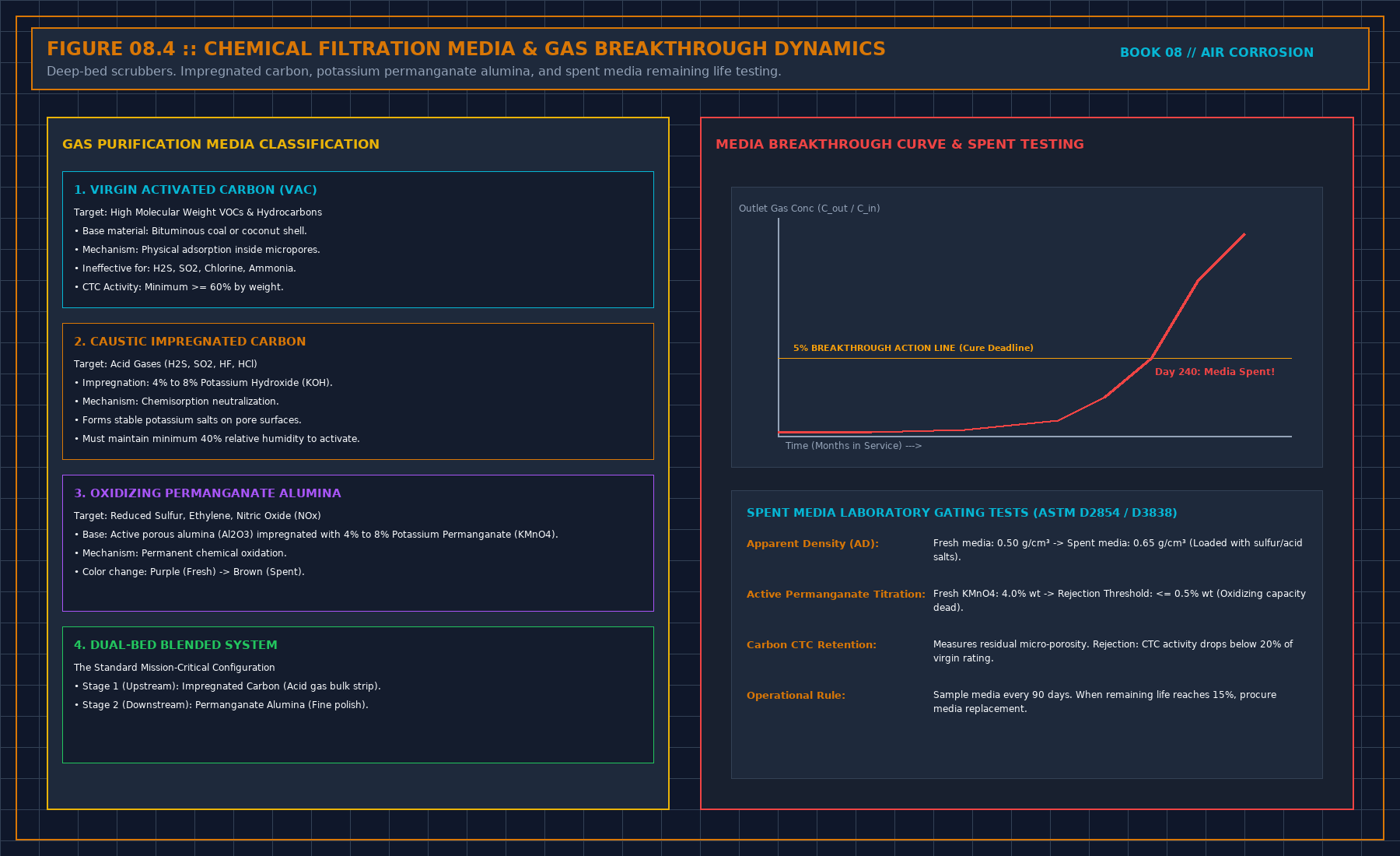
Walk into a hyperscale campus built near a coastal marsh, wastewater plant, or industrial corridor and look at the makeup air handling unit (MAHU) chemical filtration bank. The facility log shows brand-new pelletized carbon and potassium-permanganate alumina cartridges installed nine months ago, with a neat PM label claiming "Media Life: 24 Months."
Pull a 30-day corrosion coupon downstream of that media rack and read the lab's coulometric stripping scan. Silver sulfide (Ag2S) film thickness sits at 480 Å/30 days—nearly 2.5× above the ISA-71.04 Class G1 limit—even though the differential pressure gauge across the filter frame never budged by a single Pascal. Unlike particulate HEPA filters, gas-phase chemical media does not plug as it saturates. Once the mass-transfer adsorption wave reaches the downstream face, hydrogen sulfide (H2S) and sulfur dioxide (SO2) pass straight through the bed at full ambient concentration.
Waiting for an arbitrary 24-month calendar date or inspecting particulate Δ P tells you nothing about gaseous breakthrough. Only paired upstream/downstream carbon media corrosion coupon analysis exposes exhaustion before RoHS lead-free immersion-silver circuit boards begin growing conductive creep corrosion dendrites.
Why Dual-Stage Media Families Behave Differently
A common procurement mistake is treating "chemical media" as one homogeneous bag of black pellets. As detailed in A chemical filter is not a family, different corrosive gases require distinct chemisorption and physisorption chemistry:
- Activated Carbon (Physical Adsorption & Caustic Impregnated): Captures high-molecular-weight VOCs, hydrocarbons, chlorine (Cl2), and hydrogen chloride (HCl), plus some H2S when alkali-impregnated, though moisture shifts and non-targeted gases can displace weakly bound species.
- Potassium Permanganate (KMnO4) Impregnated Activated Alumina: Irreversibly oxidizes low-molecular-weight acidic and sulfur gases—specifically H2S, SO2, and NOx—locking them inside the alumina pore matrix as stable sulfates.
Because the outdoor atmospheric mix varies across seasons (crop burning, nearby diesel idling, cooling-tower drift, or landfill biogas), one bed stage frequently exhausts months before the other. A single mixed-bed sample or an unmonitored air handler hides which contaminant is breaking through.
The Upstream-to-Downstream Coupon Placement Topology
Do not hang a lone coupon inside a cold aisle and assume it verifies your chemical scrubber. By the time hall air dilutes outdoor leakage and internal recirculation, a leaking filter gasket or spent media bank may read artificially low at the cold aisle while dumping localized corrosion plumes straight onto the first rack row.
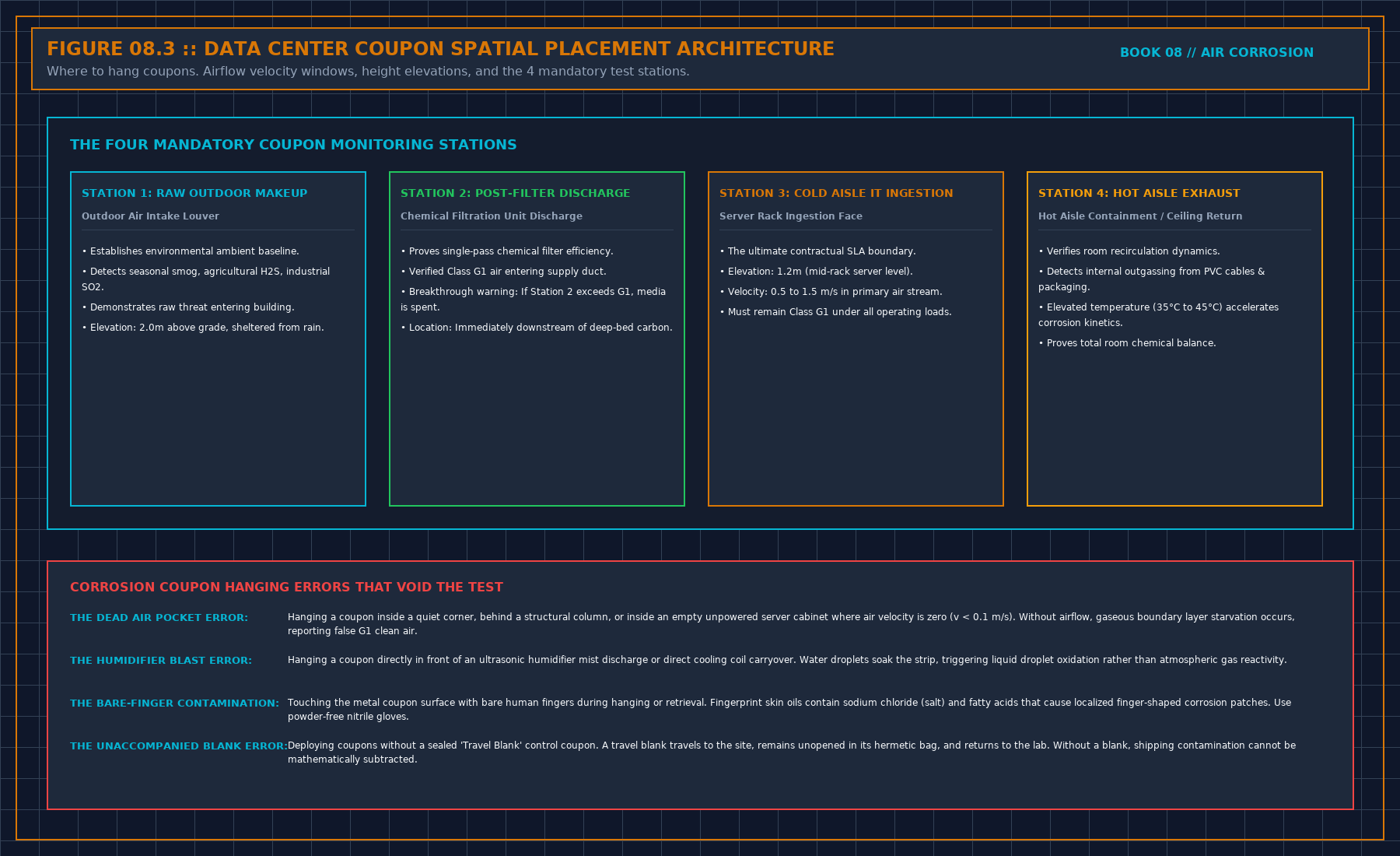
Deploy coupons across four diagnostic zones to isolate scrubber efficiency from building pressurization leaks:
| Coupon Station | Physical Mounting Point | Primary Diagnostic Purpose | Actionable Failure Trigger |
|---|---|---|---|
| Zone 1: Outdoor Intake | Weather louver upstream of chemical media | Quantifies raw ambient challenge (H2S, SO2, Cl2) | Sudden G3/GX spike drives media life recalculation |
| Zone 2: Post-Media Plenum | Downstream of chemical bank, upstream of fan/hall mix | Direct scrubber efficiency & media breakthrough test | Cu ≥ 300 Å or Ag ≥ 200 Å/30d -> Replace media |
| Zone 3: Rack Intake | Perforated front door of perimeter/NVL72 rack | Verifies actual IT inlet compliance (Class G1) | Exceeds G1 while Zone 2 passes -> Envelope/door infiltration |
| Zone 4: Travel Blank | Sealed nitrogen-purged vial stored with coupon batch | Controls for manufacturing film & shipping oxidation | Blank > 30 Å invalidates the entire batch report |
For detailed mounting height, airflow orientation (0.5--2.0 m/s parallel face flow, never dead pockets), and blank handling, review Why a corrosion test needs a blank coupon and Where you hang the coupon is the sentence.
Quantifying Scrubber Efficiency & ISA-71.04-2013 Normalized Rates
Under ANSI/ISA-71.04-2013, lab reports must normalize cumulative film thickness to a standard 30-day exposure period and separate copper and silver oxide/sulfide/chloride species via ASTM B825 cathodic coulometric reduction. Compute the 30-day normalized reactivity rate (R30) and media removal efficiency (ηmedia) directly from raw lab Ångström counts:
Where:
- Xfilm = measured total corrosive sulfide + chloride + oxide thickness (Å) on exposed coupon
- Xblank = baseline film thickness measured on the unexposed lot-matched travel blank (Å)
- Tdays = exact field hang duration in days (target
28 to 35 daysfor clean statistical normalization)
Worked Field Calculation: Suppose an outdoor Zone 1 silver coupon exposed for Tdays = 30 days shows Ag2S = 1,420 Å (Xblank = 20 Å), while the Zone 2 post-filter plenum silver coupon shows Ag2S = 285 Å (with copper at 210 Å):
Notice two critical traps exposed by those numbers:
- Copper alone passed at
210 Å(< 300 Å), yet silver failed at265 Å(> 200 Å). Relying on copper-only reactivity coupons hides H2S and Cl2 breakthrough threatening RoHS immersion-silver PCBs—see A calm copper coupon does not clear silver. - A scrubber running at
81%efficiency looks "mostly functional" on paper, yet because outdoor air entered at Class G3, the downstream air still breaches Class G1 (< 200 Å/30d). You must verify both media core pellets (lab residual potassium permanganate assay) and physical bypass gaskets around the filter rack frame.
Mandatory Coupon + Carbon Media Test Procedure
Run this five-step verification protocol alongside our canonical Data Center Corrosion Coupon Testing: ISA-71.04 Guide and What a corrosion coupon report must show:
- Pull Media Core Samples Alongside Coupons: Collect representative mid-bed media pellets from the trailing third of the cartridge depth and test remaining active KMnO4 percentage (
< 1.5%remaining or< 25%residual capacity triggers planned swap). - Inspect Bypass Seals Under Negative/Positive Fan Pressure: Smoke-pencil or measure Δ P across blank-off plates and frame gaskets. A
3 mmunsealed gap bypasses> 10%of raw outdoor gas straight past fresh media. - Require Paired Cu + Ag Coupons + Travel Blank: Never sign off a media verification report using single-metal copper strips or missing the unexposed field travel blank.
- Enforce Speciation Separation (ASTM B825): Confirm the laboratory report prints separate Ångström plateaus for Cu2S, Cu2O, Ag2S, AgCl, and unknowns—not a combined single conductivity number.
- Cross-Check Positive Hall Pressurization: Verify data hall static pressure stays at +5 to +15 Pa relative to adjacent corridors and outdoors so untreated gas cannot infiltrate around loading docks or cable sleeves.
For the full chemical breakthrough tables, laboratory report rejection templates, and RoHS hardware risk thresholds, consult the Volume 08 Corrosion Coupon Field Manual and About Tristan Howard.
Frequently Asked Questions (FAQ)
How often should carbon and permanganate media be tested with corrosion coupons?
Deploy 30-day ANSI/ISA-71.04-2013 copper and silver coupons quarterly in stable Class G1 halls, and continuously (back-to-back 30-day cycles plus real-time QCM transmitters) during the first 12 months after commissioning or in facilities located near coastal salt air, agriculture, landfills, or heavy industry.
Why can copper pass ISA-71.04 Class G1 while silver fails downstream of a carbon filter?
Silver reacts aggressively with trace hydrogen sulfide (H2S at low parts-per-billion) and elemental sulfur/chlorides that pass through spent or under-impregnated carbon media without producing equivalent copper sulfide film growth. Under ISA-71.04-2013, both metals must meet Class G1 independently (Cu < 300 Å/30d and Ag < 200 Å/30d).
Does filter differential pressure indicate when chemical carbon media is exhausted?
No. Differential pressure (Δ P) only measures particulate dust loading on pre-filters or media pores. A chemical gas-phase cartridge can become 100% chemically saturated and pass full ambient H2S concentrations into the data hall while showing completely clean differential pressure.
The Book Bridge
A clean pressure gauge across a chemical scrubber proves airflow—not clean chemistry. Complete ASTM B825 laboratory report audit rubrics, media breakthrough sampling protocols, and positive pressurization refusal gates are published in Judge a Corrosion Coupon by Tristan.