Data Center Shift Handover Checklist: 2N Power Redundancy Math, 6 Stations, and SOP/MOP/EOP
Direct Answer Block: A data center shift handover is a legally binding operational transfer between incoming and outgoing critical facility shift leads. It verifies that dual-path electrical redundancy remains uncompromised, that maintenance operations have active back-out plans, and that physical environmental boundaries (temperature, humidity, differential pressure) are physically inspected rather than inferred from monitoring dashboards. The shift lead signs only what was witnessed in the plant.
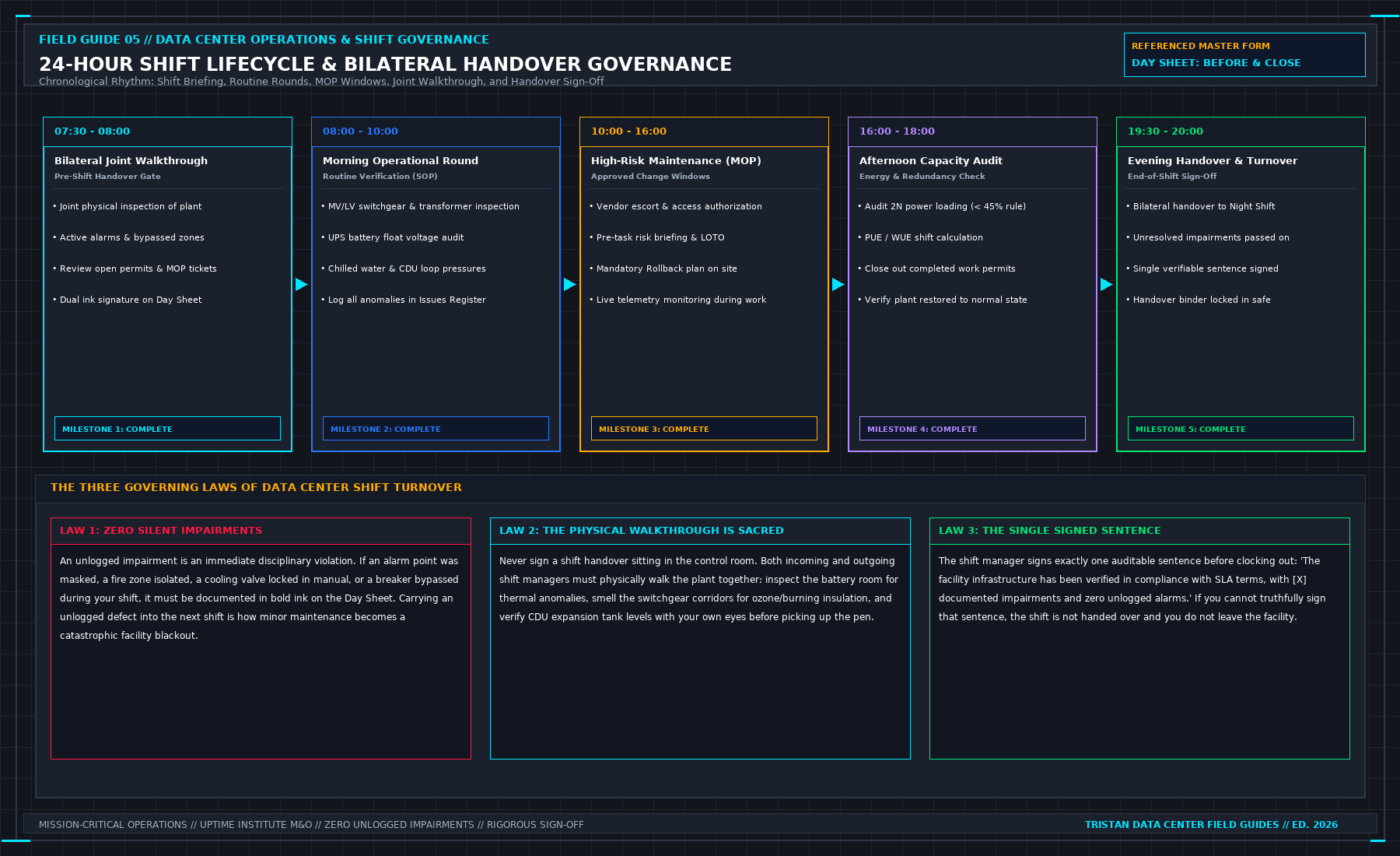
In critical facility operations, the dashboard is a seductively dangerous illusion. A software monitoring screen glowing green does not mean the data hall is safe.
Pressure sensors drift, telemetry points go stale, and BMS polling loops skip tripped breakers. If an outgoing shift manager signs a shift handover from an office chair without walking the physical plant, the incoming team inherits hidden catastrophic liabilities.
1. The 2N Power Redundancy Loading Equation
The single most critical calculation in daily electrical operations is verifying that neither side of a 2N redundant electrical path exceeds its safe single-path transfer envelope.
In a dual-bus 2N architecture (Path A and Path B), if Path A experiences a catastrophic transformer failure, busbar fault, or breaker trip, 100% of the critical IT load instantly transfers to Path B via static transfer switches (STS) or dual-corded server power supplies.
$$\begin{aligned}
P_{\text{transferred}} &= P_{\text{path\_A}} + P_{\text{path\_B}} \\
P_{\text{steady-state}} &\le 0.45 \times P_{\text{rated}}
\end{aligned}$$
+-------------------------------------------------------------+
|               2N ELECTRICAL REDUNDANCY BOUNDARY             |
+------------------------------+------------------------------+
|   PATH A (Utility 1)         |   PATH B (Utility 2)         |
|   Current Load: 42% (SAFE)   |   Current Load: 44% (SAFE)   |
|   Rated: 2,500 kVA           |   Rated: 2,500 kVA           |
+------------------------------+------------------------------+
                               |
                   [CATSTROPHIC BREAKER TRIP ON A]
                               |
                               v
+-------------------------------------------------------------+
|   PATH B IMMEDIATELY ABSORBS 100% OF PATH A LOAD:           |
|   New Load = 42% + 44% = 86% of Rated Capacity              |
|   Margin Remaining = 14% (Below Overcurrent Trip Curve)      |
+-------------------------------------------------------------+
The Cascade Blackout Trap
If operations teams allow steady-state loading on Path A to reach $55\%$ and Path B to reach $52\%$, both paths appear safely under their individual $100\%$ nameplates on the daily dashboard.
However, upon an unexpected breaker trip on Path A, Path B immediately attempts to carry $107\%$ of its rated capacity. Within seconds, Path B trips on long-time thermal overcurrent, collapsing the entire data center into a total blackout.
The Golden Shift Rule:
The steady-state load on any 2N power train must never exceed 45% of its rated continuous capacity (leaving a 10% safety margin for inrush transients, harmonic heating, and battery recharge demand). If either path exceeds 45%, log an immediate operational capacity alarm.
2. The Six Mandatory Physical Inspection Stations
A shift lead does not sign the handover sheet until walking the six physical plant stations:
- Station 1: Medium-Voltage Substation Yard & Transformers:
- Inspect transformer oil levels and temperature gauges ($<85^\circ\text{C}$).
- Listen for abnormal magnetostrictive core hum or arcing corona discharge.
- Verify medium-voltage Kirk-key interlocks and ground disconnect status.
- Station 2: Standby Diesel Generators & Fuel Transfer Plinths:
- Verify engine block jacket water heaters are active ($40\text{--}50^\circ\text{C}$) to guarantee 10-second emergency starts.
- Inspect starter battery charger float voltage ($27.2\text{--}27.6\,\text{V}$ for $24\,\text{V}$ systems).
- Check day tank fuel levels ($\ge 95\%$) and inspect fuel containment basins for hydrocarbon leaks.
- Station 3: Central Chiller Plant, Pumps & Cooling Towers:
- Verify differential pressure across chilled water strainers ($\Delta P < 35\,\text{kPa}$).
- Check pump mechanical seal drip pans (dry; zero continuous dripping).
- Verify cooling tower basin water levels, chemical biocide injection rates, and fan vibration monitors.
- Station 4: UPS Inverters, Static Bypass & Battery Suites:
- Confirm all UPS modules are operating in Double-Conversion On-Line Mode (never in unregulated Eco-Bypass).
- Measure ambient battery room temperature ($20\text{--}25^\circ\text{C}$; every $+10^\circ\text{C}$ rise halves VRLA battery service life).
- Check DC bus float voltage and inspect individual jar terminals for thermal discoloration or white sulfate crusting.
- Station 5: IT Whitespace & Liquid Cooling CDUs:
- Verify cold aisle supply air temperature ($18\text{--}27^\circ\text{C}$ per ASHRAE TC 9.9) and dew point ($<15^\circ\text{C}$).
- Inspect CDU primary and secondary supply/return pressure gauges and confirm zero liquid leakage on underfloor sensing cables.
- Confirm whitespace positive pressurization ($+15\text{--}+25\,\text{Pa}$) relative to office corridors.
- Station 6: Security Sally Ports & Pre-Action Fire Risers:
- Inspect double-interlock pre-action fire sprinkler risers: confirm air supervisory pressure ($25\text{--}35\,\text{psi}$) is holding.
- Verify VESDA laser air sampling units are in "Normal Scan" with zero flow alarms or obscured aspiration tubes.
- Check emergency exit doors for positive physical latching.
3. SOP, MOP, and EOP: The Operational Triad
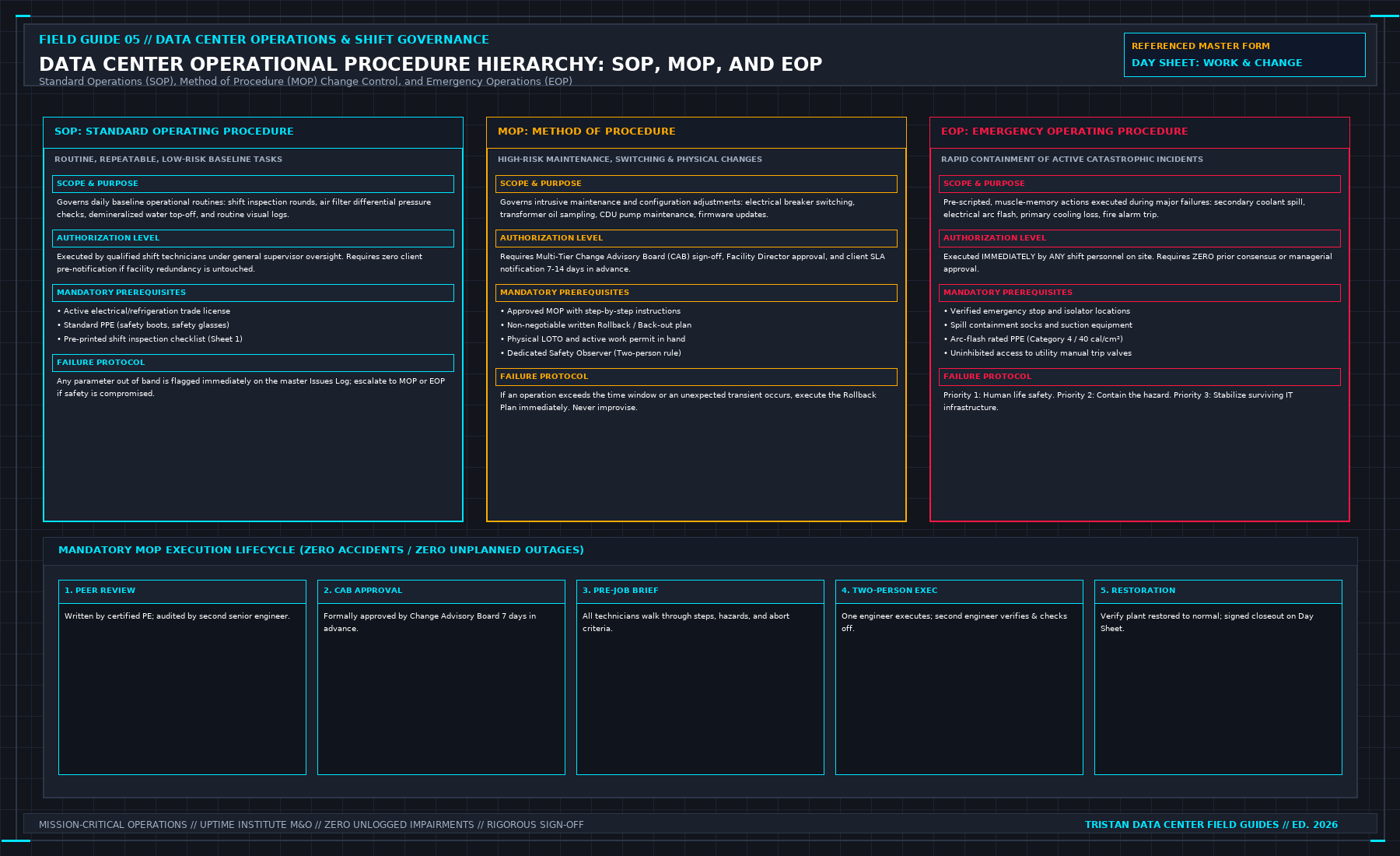
Every operational activity on the data center floor is governed by three distinct procedures:
| Document | Primary Focus | Author & Approval | Mandatory Clause |
|---|---|---|---|
| SOP (Standard Operating Procedure) | Standing, routine maintenance & shift walkthroughs | Shift Supervisor | Initial safe state & required PPE |
| MOP (Method of Procedure) | High-risk invasive switching or component replacement | Chief Engineer & Customer Rep | Step-by-step Back-Out Plan |
| EOP (Emergency Operating Procedure) | Rapid response to catastrophic failures (fire, flood, blackout) | Operations Director | First Safe Abort State |
The MOP Back-Out Rule
Every Method of Procedure (MOP) for invasive electrical or mechanical maintenance must contain a hard "Point of No Return" and an auditable Back-Out Procedure.
If an unexpected condition arises during switching, the team must not troubleshoot on the fly. They must immediately execute the pre-approved back-out sequence to restore the facility to its baseline safe state.
Frequently Asked Questions (FAQ)
What should an incoming shift lead do if a 2N power train load exceeds 45%?
The incoming shift lead must refuse to accept an unencumbered handover. The load imbalance must be formally recorded in the shift handover logbook, the critical facility manager (CFM) must be notified, and an immediate MOP must be drafted to rebalance IT rack dual-cord PDU loads across power trains.
Why is double-interlock pre-action fire suppression used in data centers?
Double-interlock pre-action systems require two independent sequential events before water enters the pipes over IT hardware: (1) an electronic smoke detector (VESDA) must trip, and (2) a sprinkler head thermal element must fuse from actual heat. If a pipe is accidentally damaged or a single smoke detector falsely alarms, water does not flood the servers.
Can an outgoing shift manager sign off on a shift if an open alarm exists?
Yes, but only if the alarm has been formally investigated, tagged with an open incident ticket, documented with physical root cause, and accepted in writing by the incoming lead. A raw, uninvestigated alarm or a red tile dismissed as "nuisance" invalidates the handover signature.
The Book Bridge
Operating a mission-critical data center requires absolute procedural discipline. The complete operational system—including the full 13-point Day Sheet, six-station walking inspection templates, MOP approval ladders, and emergency EOP decision matrices—is published in Run the Data Center Day: What the Manager Must Sign Before the Shift Ends by Tristan.
Run the Data Center Day ($12.99) — Coming Soon on Amazon Kindle & EPUB
Master the Complete Protocol: Run the Data Center Day: What the Manager Must Sign Before the Shift Ends
2N Redundancy Mathematics, 6 Inspection Stations, Shift Handovers, and SOP/MOP/EOP Protocols
Stop relying on contractor spreadsheets and vendor promises. This field guide provides the complete, auditable verification binder—including acceptance thresholds, physical equations, inspection checklists, and signed refusal templates.