An EOP stops at the first safe state
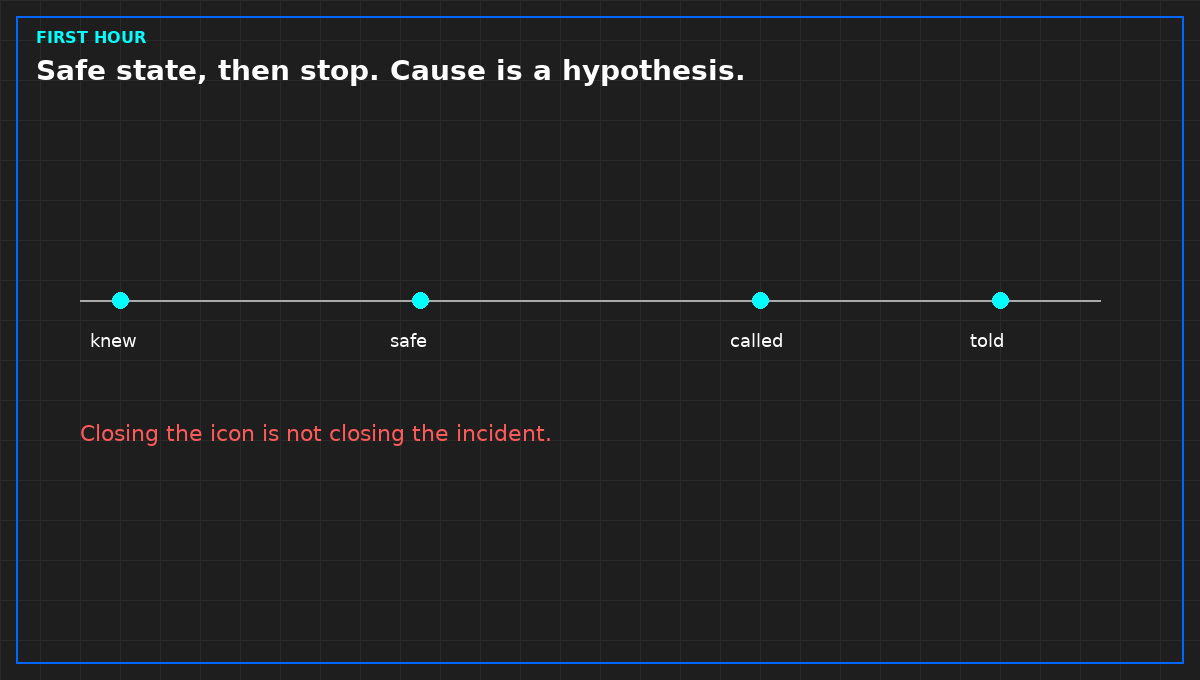
Original diagram. Not a site record.
An emergency procedure is what you do when you cannot wait for a method. It is short. It names the stop, the call, and the first safe state. Then it ends. The repair, the replacement, and the investigation are a method, written after the plant is safe, or they do not happen in the first minutes.
If the emergency paper is twenty pages of repair, it is not an emergency paper. Nobody will find the stop while the horn is on. Split it. The long part becomes a job. The short part stays at the panel.
In the first hour you write the minute you knew, what you saw, the minute of the safe state, who answered, and what you told the customer. You do not write the root cause. You do not know it. A cause offered in that minute is a hypothesis. It does not go in the customer notice.
The call is the name on the sheet, not the person you like and not a team. Teams do not wake up. The screen does not get to declare the emergency over because the tile went green. Recovery is the service, confirmed, not the icon.
Do not paste a client's emergency plan, a phone tree, or a course drill into a public note. Their hazards stay in their file. Your paper names the stop and the line where it hands off to a method. A permit does not outrank that stop. An expired permit is a stop of its own, not a suggestion to finish the wrench work.
From Run the Data Center Day, Tristan, Data Center Field Guides. No store link until the Kindle edition is listed.
Related: An alarm is not an incident.
Master the Complete Protocol: Design and Build a Liquid Load Bank for NVL72 Racks
A Field Guide to Interface Boundaries, P&ID Hydraulics, Thermal Envelopes, and Acceptance Sheets
Stop relying on contractor spreadsheets and vendor promises. This field guide provides the complete, auditable verification binder—including acceptance thresholds, physical equations, inspection checklists, and signed refusal templates.