Leaving water should fall as the fan speeds up
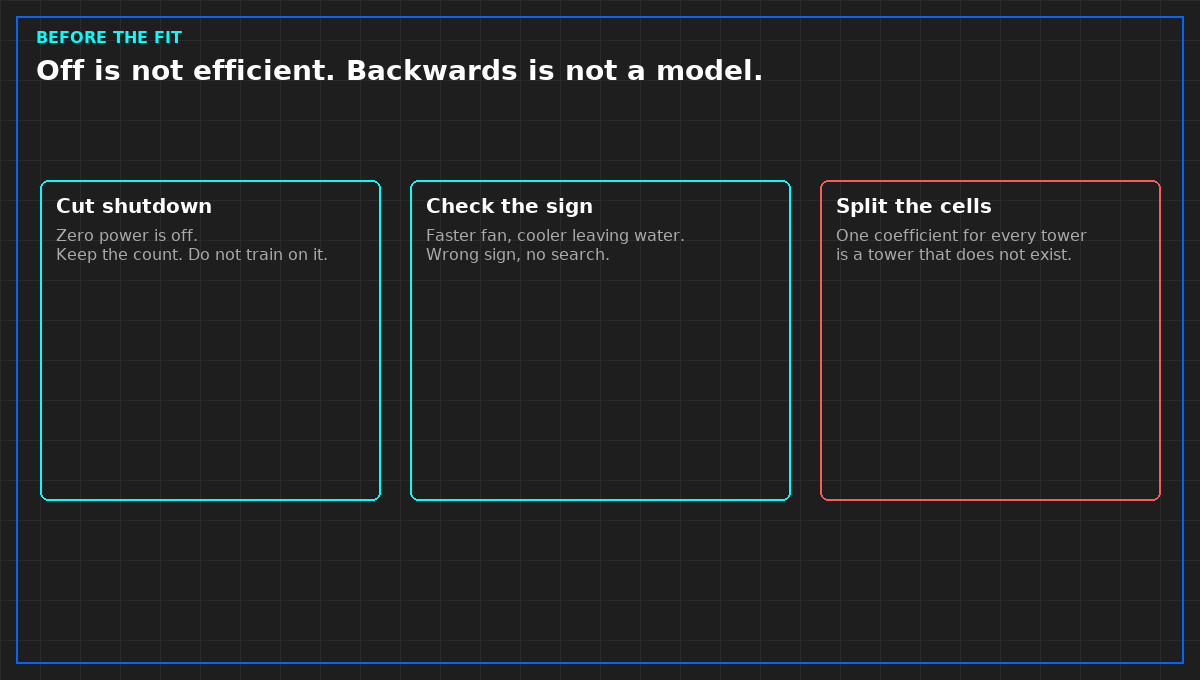
Original diagram. Not a site record.
Before a search is allowed to propose a fan speed, the fit has to obey the machine. More air across the fill should not make the leaving water warmer, all else held. If your predicted leaving temperature rises as fan speed rises, the prediction is wrong. Do not ask which speed minimizes power on a curve that has the physics backwards.
This check is not a tuned coefficient. It is a sign. Hold the conditions you are not allowed to move. Step the fan handle across speeds the archive actually contains. Read the predicted leaving temperature. It should not climb. If it climbs, stop. The fault may be the fit, a swapped sensor, a tower that is not the tower you named, or hours you failed to mark as off. Find which. Do not paper over it with a second model that is smoother.
A neural net is not excused. A line is not excused. If the flexible model can memorize a backwards tower, it will. The sign check is how you notice. A model that passes the sign check on the speeds you saw has still not earned the speeds you did not see.
Do not publish the curve, the site, or the kilowatts. The decision is the sign. Wrong sign, no search, no setpoint, no sentence about savings.
From When a Monitor May Speak, Tristan, Data Center Field Guides. No store link until the Kindle edition is listed.
Related: Fixed inputs are not fan handles.
Master the Complete Protocol: Design and Build a Liquid Load Bank for NVL72 Racks
A Field Guide to Interface Boundaries, P&ID Hydraulics, Thermal Envelopes, and Acceptance Sheets
Stop relying on contractor spreadsheets and vendor promises. This field guide provides the complete, auditable verification binder—including acceptance thresholds, physical equations, inspection checklists, and signed refusal templates.