A marketing multiple is not coolant flow
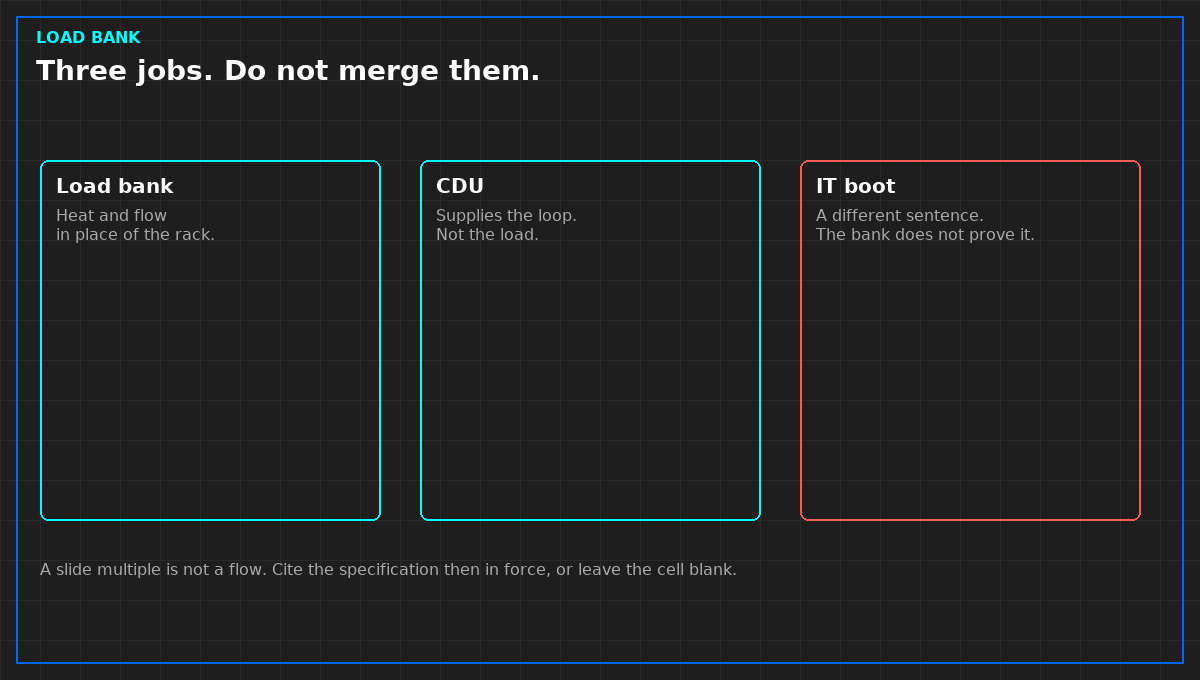
Original diagram. Not a site record.
Public briefs for high-density racks quote multiples: performance against an older platform, memory bandwidth, link bandwidth. Those numbers are not coolant flow, not heat rejection, and not a setpoint. They describe a different product claim. Putting one on a load bank sheet feels precise. It is the wrong unit.
The duty comes from the specification then in force for the test you are running. Cite that document by title and the date you read it. If you cannot cite it, the cell stays blank. A blank cell stops a fabricator. A borrowed multiple starts a fabricator on a fiction.
The same rule applies to a slide that says "up to" a flow or a temperature. "Up to" is not a test point. A test point is a value, a unit, a place in the loop, and the sentence it supports. One of those missing, and you do not have a duty. You have a range someone can pass by accident.
When the specification and a public page disagree, the specification wins for the build. The public page can stay in the reading list. It does not get a line on the acceptance sheet.
From Design and Build a Liquid Load Bank for NVL72 Racks, Tristan, Data Center Field Guides. No store link until the Kindle edition is listed.
Related: Two documents before you cut metal.
Master the Complete Protocol: Design and Build a Liquid Load Bank for NVL72 Racks
A Field Guide to Interface Boundaries, P&ID Hydraulics, Thermal Envelopes, and Acceptance Sheets
Stop relying on contractor spreadsheets and vendor promises. This field guide provides the complete, auditable verification binder—including acceptance thresholds, physical equations, inspection checklists, and signed refusal templates.