Two documents before you cut metal
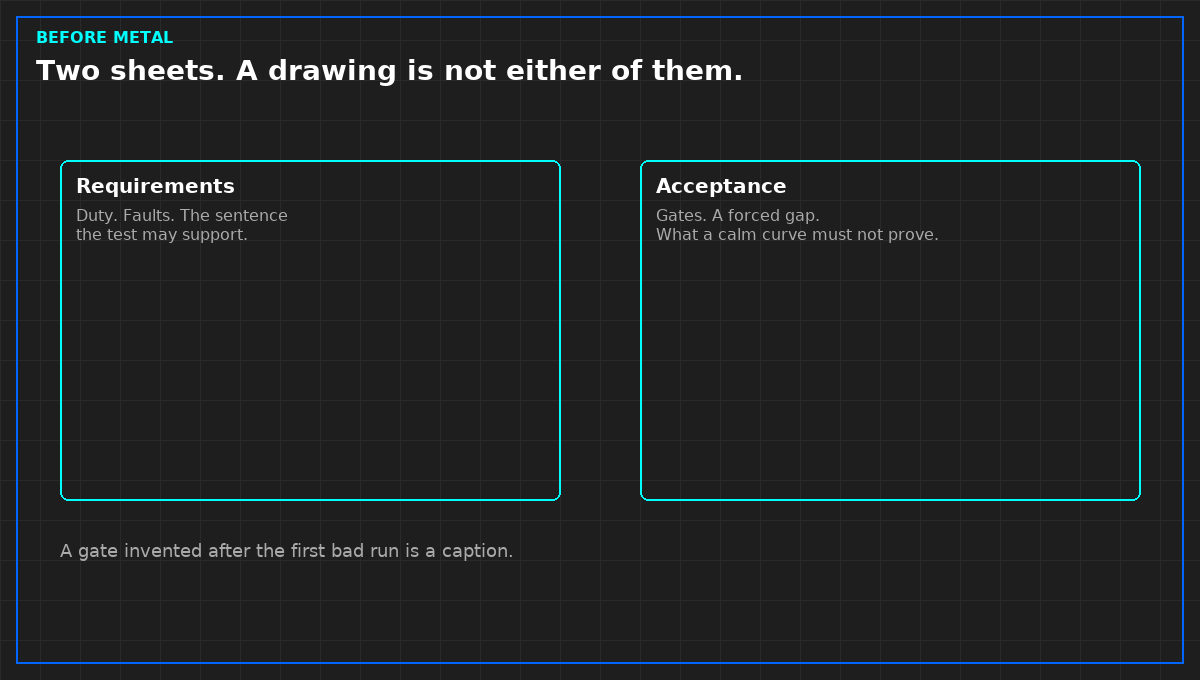
Original diagram. Not a site record.
A liquid load bank project fails in the meeting where someone says the drawings are the specification. Drawings show a shape. They do not say what the unit must prove, what it must refuse to prove, or which measurement will accept the prototype.
Two documents do that work. The requirements sheet names the duty: heat and flow in place of the rack, the faults the unit must survive, and the sentence the test is allowed to support. The acceptance sheet names the gates the prototype must pass before anyone trusts a curve from it. Both are filled before metal is cut. A gate invented after the first bad run is a caption, not a requirement.
Keep protection points and recording points apart. A trip contact is not a temperature. If the acceptance sheet lets a status bit stand in for the channel the heat story needs, the prototype can pass while the measurement you will quote is missing.
Do not paste a vendor paragraph into either sheet and call it yours. Their catalog is their claim. Your sheet is the claim you will be blamed for. Where a number is required, cite the specification then in force. Leave the cell blank rather than type a slide number.
From Design and Build a Liquid Load Bank for NVL72 Racks, Tristan, Data Center Field Guides. No store link until the Kindle edition is listed.
Related: What the prototype must not prove.
Master the Complete Protocol: Design and Build a Liquid Load Bank for NVL72 Racks
A Field Guide to Interface Boundaries, P&ID Hydraulics, Thermal Envelopes, and Acceptance Sheets
Stop relying on contractor spreadsheets and vendor promises. This field guide provides the complete, auditable verification binder—including acceptance thresholds, physical equations, inspection checklists, and signed refusal templates.