A Data Center Change Needs a Back-Out: MOP Point of No Return, LOTO Isolation, and Rollback Timing
Direct Answer Block: In mission-critical data center operations, no maintenance change, breaker switching sequence, or control setpoint modification is permitted without a pre-approved, timed back-out plan documented inside a Method of Procedure (MOP). Every change must explicitly define the initial baseline state, the target state, the exact Point of No Return (PONR), and the deterministic rollback time (trollback). If an unexpected telemetry alarm or state discrepancy occurs before the PONR, technicians must immediately execute the back-out sequence rather than troubleshooting live on compromised redundancy.
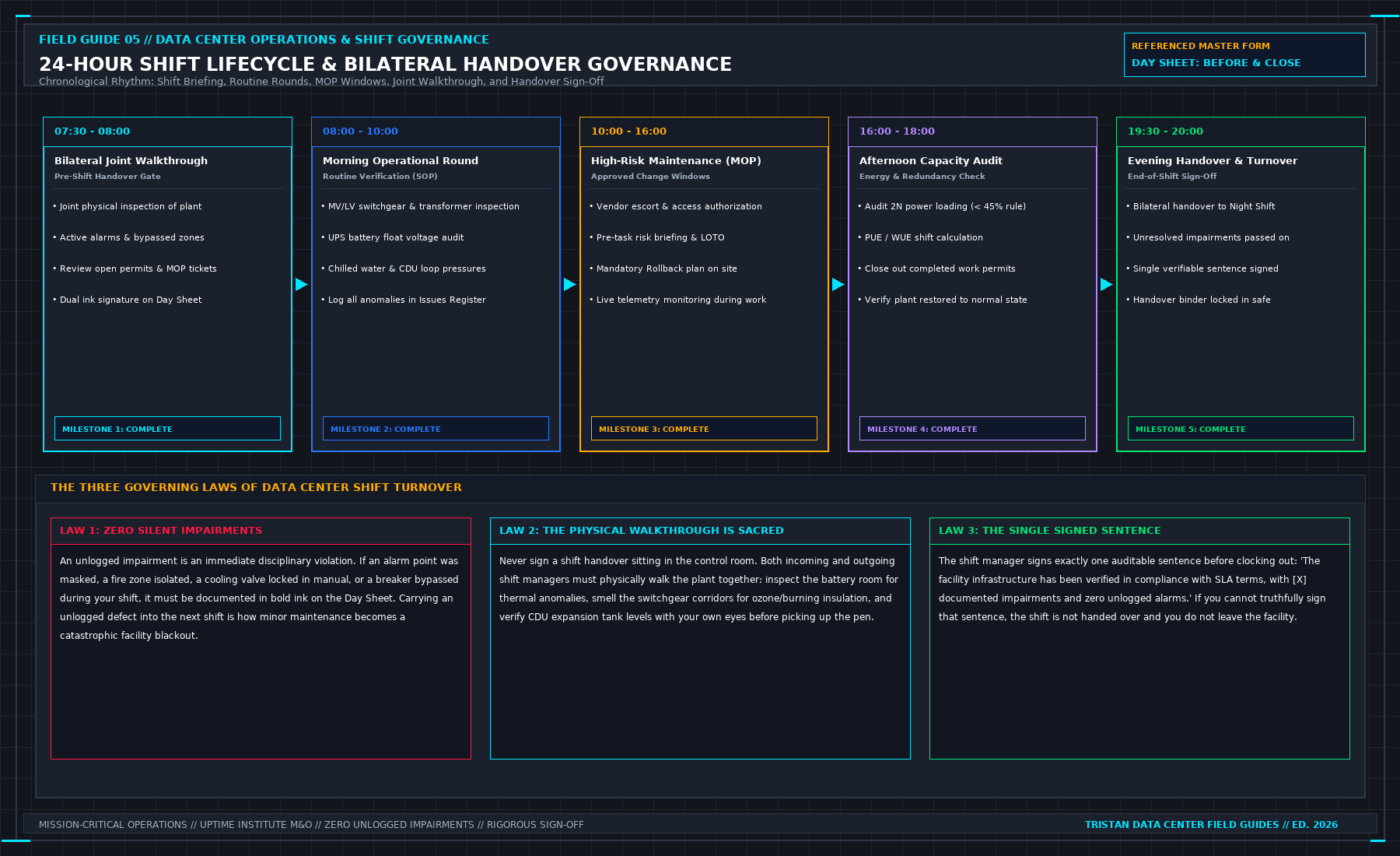
Work that alters the physical state of a critical plant is never merely a task on a daily checklist. Every invasive action—whether transferring a 2,500 kVA Uninterruptible Power Supply (UPS) to maintenance bypass, isolating a chilled water riser valve, or updating a programmable logic controller (PLC) deadband—is a formal state transition. It possesses an initial verified state, an intermediate degraded redundancy state, a target state, an authorizing signature, and an explicit way back.
If the honest engineering truth is that the back-out requires calling an original equipment manufacturer (OEM) field engineer once firmware flashing begins, that limitation must be written directly on the cover sheet of the Method of Procedure (MOP). A declared limitation is an operational boundary that the shift manager can schedule around; a blank or generic back-out section is an undocumented hazard that leads to human-error outages at 02:00 AM.
1. The Mathematics of Change Windows and Rollback Envelopes
The most common cause of maintenance-induced SLA breaches is exhausting the authorized maintenance window before completing the forward switching sequence, leaving no time to safely reverse the plant to its dual-corded baseline. To prevent window overruns, critical facility engineers govern every change window (Twindow) using the deterministic Point of No Return (PONR) timing inequality.
Where:
- tisolation is the time required to apply Lockout/Tagout (LOTO), transfer critical load to the redundant path or wrap-around maintenance bypass, and verify zero-energy state.
- texecution is the physical wrench or firmware modification window.
- tverification is the post-restoration dwell time required to confirm steady-state thermal, hydraulic, and electrical parameters on live points.
- trollback is the worst-case time required to execute the full back-out sequence and restore normal N+1 or 2N topology.
- tcutoff is the hard abort clock timestamp: if forward execution has not cleared its acceptance gate by tcutoff, the shift lead must call an immediate stop and initiate rollback.
AUTHORIZED MAINTENANCE WINDOW (4.0h)
| 00:00 - 00:45 | 00:45 - 02:15 | 02:15 (HARD | 02:15 - 04:00 |
|---|---|---|---|
| LOTO & Bypass Transfer (t_isolation) | Invasive Wrench / Firmware Work (t_execution) | ABORT CLOCK / PONR GATE) (t_cutoff) | Reserved for Rollback & Verification |
The Pre-Switch 2N Load Transfer Verification
Before opening any breaker or isolating a primary power path, the back-out plan depends on the surviving redundant path remaining strictly below its thermal and magnetic trip curve—even if an downstream server power supply experiences high-inrush re-transfer transients. The pre-isolation audit requires verifying that total combined active and reactive power across both paths satisfies the 2N transfer ceiling:
If either bus exceeds 45% steady-state load prior to switching, or if harmonic current distortion (THDi > 8%) reduces transformer k-factor derating margin, the change window must not open. A back-out plan is physically impossible if the surviving bus trips on long-time overcurrent the moment the primary bus is isolated.
2. Anatomy of an Auditable Back-Out Procedure
A back-out section that reads "Reverse steps 1 through 14" is an automatic rejection during change review. Non-linear stateful systems—such as double-conversion UPS modules, variable-frequency chilled water pumps, and automatic transfer switches (ATS)—cannot be safely restored simply by reading forward steps backward. Closing an output breaker before synchronizing inverter phase angle (Δ\phi ≤ 1.5^\circ) and voltage magnitude (Δ V ≤ 2%) against the bypass bus will blow the inverter SCR fuse bank and drop the critical load.
| MOP Back-Out Component | Unacceptable / Defective Entry | Auditable First-Principles Requirement |
|---|---|---|
| Abort Trigger Condition | "If problems occur during maintenance, abort work." | Explicit quantitative threshold: e.g., "Abort immediately if Bus B load exceeds 88%, Cold Aisle Temp > 26.5°C, or DC Link ripple > 1.5 Vrms." |
| Point of No Return (PONR) | Omitted or undefined in step table. | Exact step number identified: "Step 18 (Opening Main Tie Breaker 52-T1 / Erasing EEPROM Bank 0) is the PONR." |
| Pre-PONR Back-Out Steps | "Reverse previous steps to restore normal operation." | Explicit, numbered switching sequence with phase-sync checks, rotary switch positions, and expected meter values at each step. |
| Post-PONR Contingency | Blank or "Escalate to engineering team." | Named emergency operating procedure (EOP) handoff, physical spare part staging location on the floor, and OEM escalation contact on standby. |
| Post-Back-Out Verification | "Confirm alarms clear on BMS dashboard." | Witnessed local meter verification + live BMS point quality (0x00 Good) confirming service restoration across a 15-minute dwell. |
3. Visibility on the Shift Floor and the Monitoring Screen
A change window that exists only inside an email thread or an instant-messaging channel is an operational trap. If the technician standing in front of the switchgear and the operator watching the Building Management System (BMS) or Electrical Power Monitoring System (EPMS) cannot both see the active abnormal boundary, the first planned breaker operation will trigger an unmasked alarm storm, paging the on-call roster as an unplanned outage.
Before the first tool touches a panel:
- The Physical Boundary Mark: The isolated line-up, valve manifold, or control cabinet must carry physical LOTO locks, danger tags naming the technician in charge, and a printed copy of the signed MOP open to the active step.
- The Telemetry Maintenance Mask: The named points affected by the change must be placed into an explicit, time-bounded maintenance window inside the BMS/EPMS. The maintenance mask suppresses outgoing pager notifications for those specific points while continuing to log every raw state transition and timestamp to the historian.
- The Verbal Read-Back Protocol: At the pre-job tailboard briefing, the night-shift technician executing the work must read the abort trigger and the first three steps of the back-out sequence aloud without looking at a presentation slide deck. If the operator cannot articulate the exact physical stop condition and rollback action from the printed sheet at the panel, the shift managerwithholds the work permit. Speed or schedule pressure is never an acceptable justification for skipping the verbal read-back.
4. Separating Customer Hazard Files from Site Restoration Proof
In multi-tenant colocation and hyperscale environments, vendor or customer method statements frequently contain proprietary equipment layouts or generic corporate boilerplate. Never paste a vendor's unverified method statement directly into the facility's public operational logbook as a substitute for your plant's switching boundary.
Your facility record must document four non-negotiable facts:
- The Exact Abort Trigger: What physical meter reading or time cutoff forces a rollback.
- The Back-Out Path: The step-by-step sequence verified against your site's actual single-line diagram (SLD) and piping and instrumentation diagram (P&ID).
- The Point of No Return: Where self-recovery ends and component replacement or vendor intervention begins.
- Confirmed Service Restoration: Proof that the plant returned to its baseline redundancy state—verified by live local instrumentation and downstream customer feed metrics, never merely by observing that an alarm banner went quiet on a summary screen.
Frequently Asked Questions (FAQ)
Why is "Reverse previous steps" unacceptable as a data center MOP back-out plan?
Electrical and mechanical switching sequences are directionally asymmetric. Re-energizing a transformer, paralleling a UPS inverter back onto an active critical bus, or opening a chilled water isolation valve requires specific phase-synchronization checks, bypass slow-fill equalization, and inrush mitigation steps that do not exist during de-energization. Reversing steps verbatim causes out-of-phase parallels, water hammer, or protective relay trips.
What happens if an unexpected alarm occurs after passing the Point of No Return (PONR)?
Once the execution team passes the documented Point of No Return (for example, after physically unbolting a busway section or wiping a controller's primary flash memory), standard pre-PONR back-out steps are no longer valid. The team must immediately halt forward progress and execute the Post-PONR Contingency or transition to the designated Emergency Operating Procedure (EOP) to hold the plant in its first safe state while installing the pre-staged physical spare or executing the emergency bypass plan.
How do you verify that a plant is safely restored after executing a back-out?
Closing an alarm banner or confirming that a dashboard tile turned green does not prove restoration. Post-back-out verification requires checking physical local gauges (breaker mechanical position indicators, phase current ammeters, differential pressure transducers) alongside live BMS/EPMS telemetry points with verified fresh timestamps, held across a minimum 15-minute steady-state observation dwell.
From Run the Data Center Day, Tristan, Data Center Field Guides.
Related: Grouping alarms is not a cause.
Master the Complete Protocol: Run the Data Center Day: What the Manager Must Sign Before the Shift Ends
2N Redundancy Mathematics, 6 Inspection Stations, Shift Handovers, and SOP/MOP/EOP Protocols
Stop relying on contractor spreadsheets and vendor marketing claims. This field guide provides the complete, auditable verification binder—including physical equations, inspection stations, acceptance thresholds, and signed refusal templates.