 DATA CENTER
Data Center Grid Stability Due Diligence: What a Hyperscaler Must Verify Before Signing a Site
DIRECT ANSWER & VERIFICATION THRESHOLD:Before committing capital to a site, hyperscaler grid stability technical due diligence (TDD) verifies far more than a utility marketing letter: an evaluator must audit an executed Large Load Interconnection Agreement (LGIA) (never a non-binding "will-serve" letter), true physical transmission diversity across separate utility substations and non-shared ductbanks/right-of-ways, short-circuit ratio (SCR) and voltage flicker tolerance under dynamic GPU cluster step-loads, frequency/voltage ride-through settings matching local grid protection, and verified N-1 transformer capacity across extreme summer ambient derating.
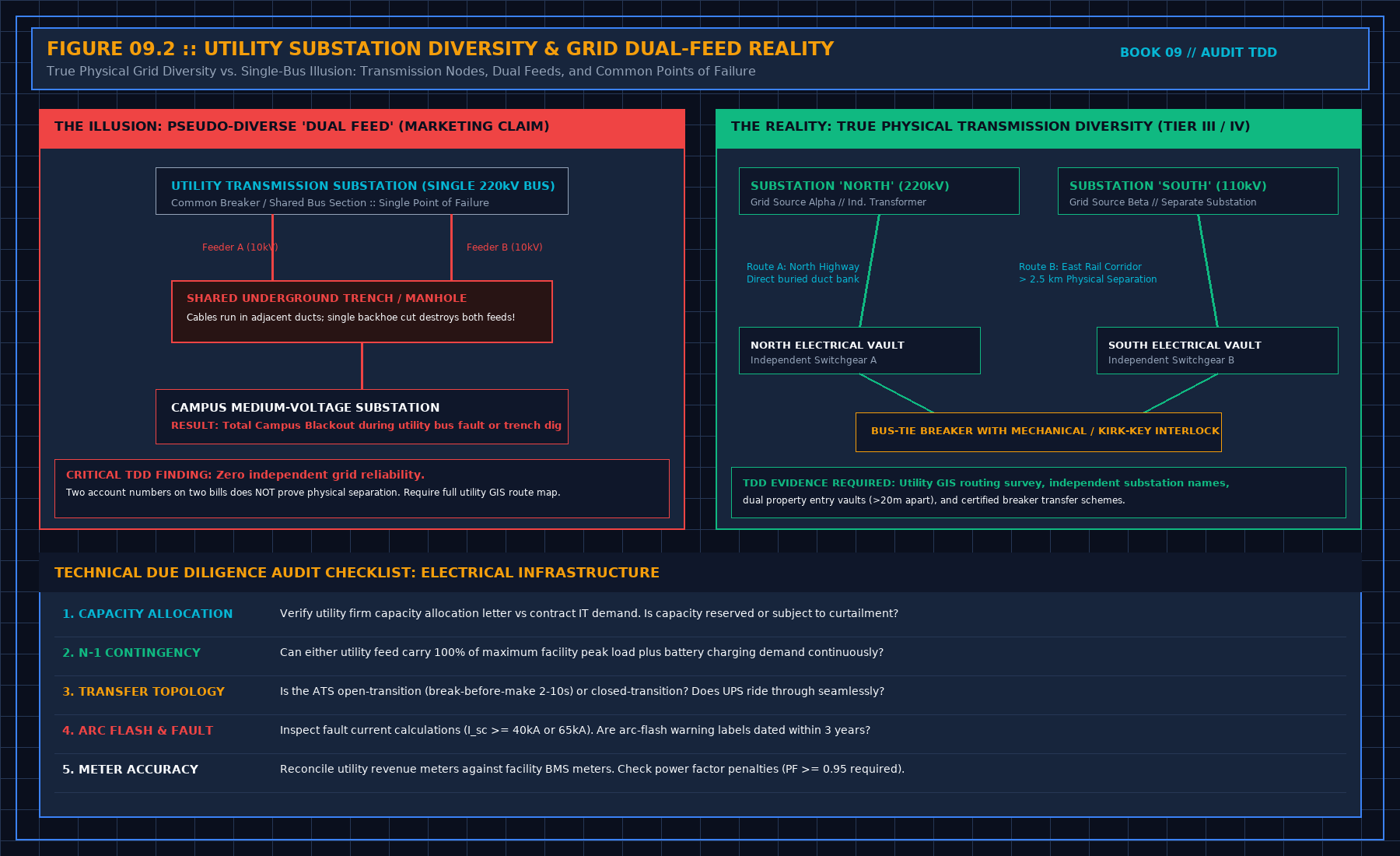
Open the Virtual Data Room (VDR) for a "shovel-ready 150 MW AI campus" and read Folder 01: Utility Power Confirmed. Inside sits a one-page utility feasibility letter dated eighteen months ago stating that 150 MW of transmission capacity "is technically feasible subject to system impact studies and downstream substation upgrades."
Inspect the actual GIS transmission line route and ISO interconnection queue, and the illusion breaks immediately. Both "redundant" 138 kV feeds exit the exact same high-voltage busbar inside a single utility substation, cross the same highway bridge in adjacent conduits, and sit behind a $42M network upgrade with a 44-month transformer lead time and an active generator curtailment tariff during winter peak alerts.
For a hyperscale AI or cloud deployment, grid stability risk is a Condition Precedent (CP) fatal flaw—never a post-closing engineering detail. Before releasing acquisition funds or signing a long-term power lease, run an independent physical and contractual grid TDD walkdown.
The Five Grid Stability Gates Every Hyperscaler TDD Must Verify
Never evaluate utility interconnection purely on total nameplate megavolt-amperes (MVA). A site can have 100 MVA of copper bolted to the property line and still suffer crippling micro-trips, UPS battery exhaustion, or multi-year energization freezes.
| Grid Risk Axis | Unacceptable VDR Evidence | Mandatory TDD Verification Artifact | Fatal Flaw / CP Gate |
|---|---|---|---|
| Interconnection Firmness | Non-binding "Will-Serve" or Phase-1 Feasibility letter | Executed Facility Study (FS) + signed LGIA with milestones | Unfunded utility upgrades or unscheduled Tx outages |
| Physical Feeder Diversity | Two utility meters sharing one substation bus or bridge | GIS overlay proving 2 independent substations & split ROWs | Single-point failure (trench/substation) > 100 m shared |
| Grid Stiffness & Harmonics | Assuming infinite bus on rural weak transmission lines | Utility short-circuit MVA study confirming SCR ≥ 5.0 | Step-load voltage dip > 5% during GPU training spikes |
| Ambient & Thermal Derating | Nameplate ONAN/ONAF transformer MVA at 25 °C | ASHRAE 20-year extreme peak ambient derating waterfall | N-1 feed overloaded > 100% during summer heatwave |
| Curtailment & Ride-Through | Boilerplate "99.99% utility uptime" brochure | Tariff interruptible clauses + IEEE 2800 / NERC PRC curves | Uncompensated peak curtailment or nuisance UPS transfers |
Calculating Effective Grid Short-Circuit Ratio (SCR) for AI Step-Loads
Modern AI training clusters do not draw smooth, flat office-building currents. Synchronous all-reduce compute barriers swing megawatt loads from 30% to 100% within tens of milliseconds—driving rapid reactive power (Q) swings and voltage flicker on weak rural radial lines.
Evaluate grid stiffness at the Point of Interconnection (POI) using the Short-Circuit Ratio (SCR):
Where:
- SSC, min = minimum N-1 three-phase short-circuit capacity (MVA) at the site's HV substation bus under worst-case transmission outage
- Pcampus, max = maximum critical IT + mechanical demand (MW)
Worked Grid Stiffness Check: Suppose a proposed 80 MW rural AI campus sits at the end of a 45 km single radial 115 kV line where minimum N-1 fault capacity is SSC, min = 220 MVA:
An SCR < 3.0 signifies a weak grid vulnerable to severe transient voltage sag (Δ V / V ≈ Pstep / SSC) whenever a 20 MW compute pod steps online or a nearby wind farm trips—causing repeated UPS battery transfers, harmonic resonance with VFD chiller drives, and costly mandatory STATCOM/synchronous condenser capital additions. A Tier-grade hyperscaler interconnection generally demands SCR ≥ 5.0 (or explicit STATCOM mitigation funded inside the seller's capex stack).
Physical Walkdown vs. Desk VDR Review: Catching Shared Corridors
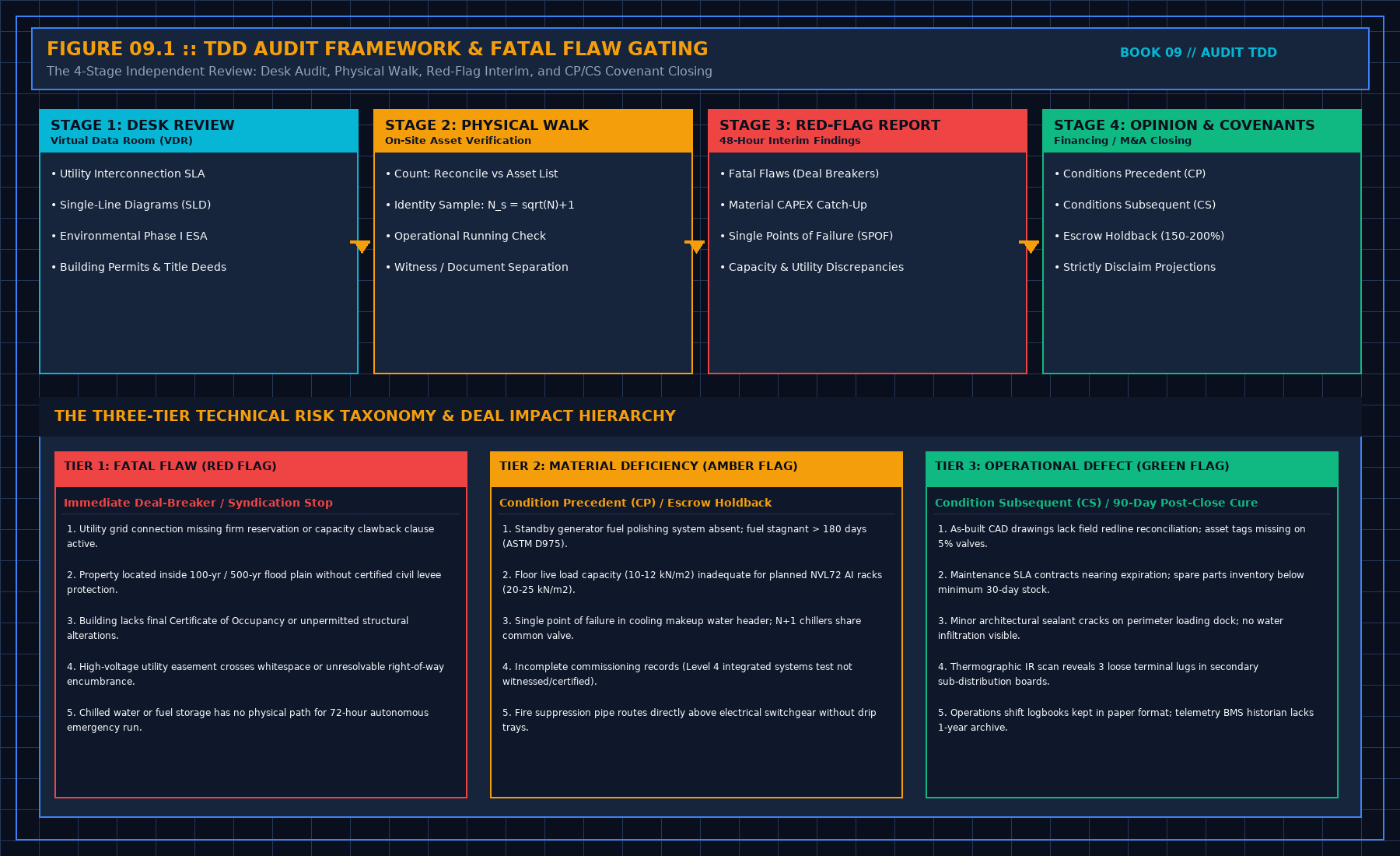
A utility single-line diagram hides geography. Two lines drawn three inches apart on a schematic frequently share the exact same two-meter road trench, culvert crossing, or river bridge outside the campus fence.
Execute this physical and spatial verification sequence alongside our Greenfield Facility Location Due Diligence and Operating Asset Technical Due Diligence Checklist:
- Pull Raw GIS / KMZ Coordinates for Every Mile: Trace Feed A and Feed B from the campus MV switchgear all the way back to two geographically distinct bulk transmission substations—flagging any shared pole line, directional-bore ductbank, or flood-zone crossing.
- Audit Utility Relay Protection & Recloser Settings: Verify auto-reclose dead-time intervals and under-frequency/under-voltage trip curves against your UPS input ride-through tolerance so transient upstream line faults do not trigger full-site diesel starts every storm season.
- Verify N-1 Transformer & Switchgear Ownership Boundaries: Confirm who owns, maintains, and holds spares for the dedicated substation step-down transformers (
138/34.5 kV). Long-lead100 MVAtransformers carry24–36 monthfactory lead times—making unverified spare sharing a critical red flag (A spare is evidence. A failure probability is not). - Distinguish TDD Scope from Commissioning: Remember that grid TDD verifies contractual firmness, spatial diversity, and N-1 physical capacity; it never replaces post-build L4/L5 commissioning (A data center TDD is not a commissioning). Use statistical physical inspection (Count, identify, sample, and witness) and cross-check Tier maintainability rules (Tier 3 Data Center Audit Checklist).
For the complete substation audit sheets, flood-elevation gates, and investment-committee refusal frameworks, see the Volume 09 Technical Due Diligence Manual and About Tristan Howard.
Frequently Asked Questions (FAQ)
What is the difference between a utility "will-serve" letter and an executed LGIA in data center TDD?
A utility will-serve or feasibility letter is a non-binding preliminary estimate that neither reserves transmission capacity nor fixes upgrade costs. An executed Large Load Interconnection Agreement (LGIA) (backed by completed System Impact and Facilities Studies) legally locks capacity allocation, construction cost responsibility, and binding energization milestones.
How much physical separation is required between dual utility feeds for true diversity?
True physical diversity requires two feeds sourced from independent utility substation transformers on separate transmission paths, separated horizontally across distinct rights-of-way (typically ≥ 15--30 m apart along street corridors, with zero shared manholes, bridges, or trench lines).
Why does Short-Circuit Ratio (SCR) matter for AI data center grid stability?
High-density AI clusters impose millisecond-scale step loads and harmonic currents from UPS rectifiers and liquid-cooling VFDs. If the utility point of interconnection has a low Short-Circuit Ratio (SCR < 3.0), normal load steps cause wide voltage sags that trigger excessive UPS battery transfers and protective relay trips.
The Book Bridge
A single shared underground manhole two miles outside the perimeter fence turns a "2N utility campus" into a single-point failure overnight. Complete substation GIS walkdown checklists, nameplate derating waterfalls, and fatal-flaw condition precedent forms are published in Walk a TDD: Technical Due Diligence Physical Site Audit by Tristan.