 DATA CENTER
ASEAN Water Caps, Tropical Cooling & Warm-Water AI
DIRECT ANSWER & VERIFICATION THRESHOLD:Energized shells in Southeast Asia no longer guarantee billable AI megawatts. In November 2026, U.S. export rules stalled roughly USD 7.8 billion in Asia-Pacific data center loans just as Johor capped 19 operational facilities at 21.28 MLD out of 73.09 MLD requested—limiting open cooling towers to roughly 431 MW of continuous IT load. Surviving the water-power squeeze requires rejecting tropical direct evaporation, pricing the air-cooled substation haircut, and auditing component thermal limits under 45°C warm-water liquid cooling.
An energized substation and a signed land lease look identical to billable capacity on a project finance spreadsheet. On the plant floor, a data center cannot monetize a single kilowatt unless three physical gates open at the same time: sanctioned silicon clears customs, municipal utilities deliver both power and water, and the cooling plant rejects heat without baking the electronics.
Across Southeast Asia in late November 2026, two of those gates tightened in the same week. First, following the November 19, 2026 U.S. Bureau of Industry and Security (BIS) interim final rule imposing export licensing on advanced AI accelerators bound for Malaysia, Singapore, Thailand, and Indonesia, regional lenders slowed or reassessed roughly USD 7.8 billion in Asian data center financing tied to Chinese tenants. Second, Johor's state government disclosed that across 19 operational data centers seeking 73.088 million liters per day (MLD) of treated municipal water, regulators approved only 21.277 MLD—a 29.1% approval ratio representing roughly 1.05% of Johor's 2,034 MLD treated water output.
For infrastructure engineers who lived through China's northern buildout over the past decade, this collision feels familiar. Beijing enforced a nearly identical water-and-power squeeze years earlier when chronic aquifer depletion forced strict groundwater bans and municipal water quotas. The difference in ASEAN is psychrometrics: Johor, Singapore, and Bangkok sit near the equator with year-round high humidity and zero winter free-cooling relief.
1. The Financial Shock vs. The Physical Bottleneck (and the Beijing Precedent)
Credit markets repriced ASEAN powered shells almost overnight. Market reports in late November 2026 detailed lender reviews and delays across major regional debt packages—including Bridge Data Centres' proposed USD 6.6 billion Malaysia facility, Digital Halo's USD 372 million project, Aolani's USD 480 million financing, and GMI Cloud's USD 300 million package—while global banks such as Citigroup and Standard Chartered tightened end-user KYC verification and Fitch Ratings warned that Asia-Pacific AI data center capex will slow and become far more selective. Even as Singapore's government noted that reports of an immediate blanket Nvidia server shipment halt remained unconfirmed, DayOne Data Centers paused its planned USD 5 billion U.S. IPO despite holding a 4.6 GW secured pipeline, while NTT Global Data Centers and B.Grimm signed a 400 MW Chonburi, Thailand memorandum of understanding on the very day the BIS rule took effect. We examine how these export-control and affiliate valuation pressures transmit into public balance sheets in our GDS Q3 2026 earnings and DayOne audit.
Debt committees focusing solely on geopolitics miss the harder local constraint: water. Even if every export license clears inside a 90-day window, Johor's Data Centre Development Coordination Committee (JPPPDNJ), working with state water agencies BAKAJ and Ranhill SAJ, has drawn a permanent line protecting domestic potable supply. Nine of Johor's 19 operating sites already rely on near-zero-water cooling designs, while others are turning to treated municipal wastewater (such as Bridge Data Centres and Computility) or surface river abstraction (such as DayOne tapping Sungai Tebrau at Kempas Tech Park).
The Beijing Groundwater Precedent
This is not the first hyper-growth hub to hit a hydrological ceiling. Facing severe groundwater depletion across the North China Plain, Beijing prohibited industrial groundwater extraction for cooling, banned new or expanded data centers across its six urban core districts beginning in 2015, enforced strict municipal water quotas pushing operators toward reclaimed greywater, and paired those water caps with progressively tighter Power Usage Effectiveness (PUE) mandates (down to 1.15–1.30 for new builds and 1.35 or lower for retrofits, backed by punitive stepped-up electricity tariffs).
The result in Beijing was deterministic: open-loop evaporative towers on potable city water became unpermittable at hyperscale. Operators either re-engineered toward closed-loop, dry-assisted, and reclaimed-water cooling or migrated large-scale training campuses outward to cooler, less constrained hubs such as Hebei (Zhangjiakou) and Inner Mongolia. ASEAN developers now face the exact same regulatory vise—but Beijing at least enjoys dry, sub-zero winters that allow months of dry or indirect free cooling. Tropical ASEAN has no winter.
2. Cooling Modalities: Why DEC and IEC Hit a Wall in the Tropics
Choosing a cooling plant under a water cap is an exercise in applied psychrometrics, not vendor slide decks. In equatorial markets like Johor and Singapore, ambient air hovers around 32°C–35°C dry-bulb with 75%–90% relative humidity and design wet-bulb temperatures of 26°C–28°C year-round. That high moisture content leaves a narrow wet-bulb depression of only 4°C–7°C—the exact physical boundary that separates workable cooling architectures from stranded CapEx.
| Cooling Modality | Typical Site WUE | Tropical PUE | Tropical Feasibility | Primary Physical Constraint |
|---|---|---|---|---|
| Water-Cooled Chiller + Open Tower | 1.5–2.2 L/kWh | 1.25–1.35 | Viable only with reclaimed/river water | Potable water quotas (Johor 21.3 MLD cap) |
| Air-Cooled Chiller / Closed Dry Loop | 0.00–0.05 L/kWh | 1.42–1.55 | Viable for mid-density air halls | High peak electrical penalty steals substation MW |
| Direct Evaporative Cooling (DEC) | 0.8–1.5 L/kWh | 1.15–1.25* | Not viable in humid tropics | Tiny wet-bulb drop; breaches RH and corrosion limits |
| Indirect Evaporative Cooling (IEC) | 0.4–1.0 L/kWh | 1.25–1.38 | Marginal; trim chiller runs near 24/7 | Wet-bulb + approach ceiling; still consumes water |
| 45°C Warm-Water DLC + Dry Cooler | 0.00–0.05 L/kWh | 1.12–1.18 | Optimal for 100+ kW AI racks | Component thermal margins & loop Cx rigor |
Note: DEC tropical PUE is theoretical only; because wet-bulb depression is too small to hold compliant inlet temperatures without humidity excursion, DEC cannot run standalone in equatorial climates.
Direct vs. Indirect Evaporative Feasibility
- Why Direct Evaporative Cooling (DEC) Fails in ASEAN: DEC sprays water or draws outdoor air across wetted media directly into the server supply stream. In arid climates (such as Phoenix or parts of northern China in dry seasons), a 12°C–18°C wet-bulb depression delivers huge sensible cooling at minimal fan power. In Johor or Singapore, evaporating moisture into already saturated air delivers only a few degrees of temperature drop while shoving relative humidity past ASHRAE TC 9.9 recommended envelopes and pulling coastal salts and urban sulfur gases straight across bare circuit boards. As detailed in our chemical filtration and corrosion coupon protocol, combining high humidity with unfiltered outdoor gases accelerates ANSI/ISA-71.04 creep corrosion on RoHS lead-free boards.
- Why Indirect Evaporative Cooling (IEC) Disappoints in the Tropics: IEC solves contamination by separating the wet outdoor air stream from sealed indoor IT air across a plate or polymer heat exchanger. That separation makes IEC highly effective in temperate or semi-arid regions (such as Beijing's shoulder seasons or northern Europe). In tropical ASEAN, however, IEC remains thermodynamically trapped above the 26°C–28°C outdoor wet-bulb plus a 3°C–5°C heat-exchanger approach temperature. Mechanical DX or chilled-water trim must run nearly continuously, eroding efficiency while the wet side still consumes scarce water and requires large roof or yard footprints.
Practical Tropical Selection Playbook
For new tropical AI builds, the practical menu narrows to three disciplined paths:
- Reclaimed-Water Chilled Plants: Keep high-efficiency water-cooled chillers only where legally binding, non-potable water contracts (NEWater, municipal sewage effluent polishing, or permitted river abstraction with on-site treatment) completely decouple the site from drinking-water quotas.
- Air-Cooled / Dry-Loop Sensible Rejection: Use zero-water air-cooled chillers where municipal water is unavailable for conventional air-cooled enterprise workloads—while explicitly modeling the substation power penalty upfront.
- Warm-Water Direct-to-Chip Liquid Cooling (DLC) + Dry Coolers: Raise the facility cooling loop to 40°C–45°C so heat rejects sensibly through closed-loop dry coolers above ambient tropical dry-bulb, cutting both potable water and mechanical chiller runtime to near zero.
3. NVIDIA's 45°C Warm-Water Paradigm: An Electronic-Component Reality Check
Standardizing AI racks around 45°C warm-water facility supply (exiting at 55°C–65°C), as promoted across NVIDIA's rack-scale Blackwell and next-generation Vera Rubin architectures, breaks the tropical water-power deadlock. Because 45°C water sits well above Johor or Singapore's 33°C–36°C outdoor peak dry-bulb, closed-loop dry coolers can reject heat year-round with virtually zero evaporative water and minimal or no mechanical chiller operation—a true "chillerless" plant for most hours of the year.
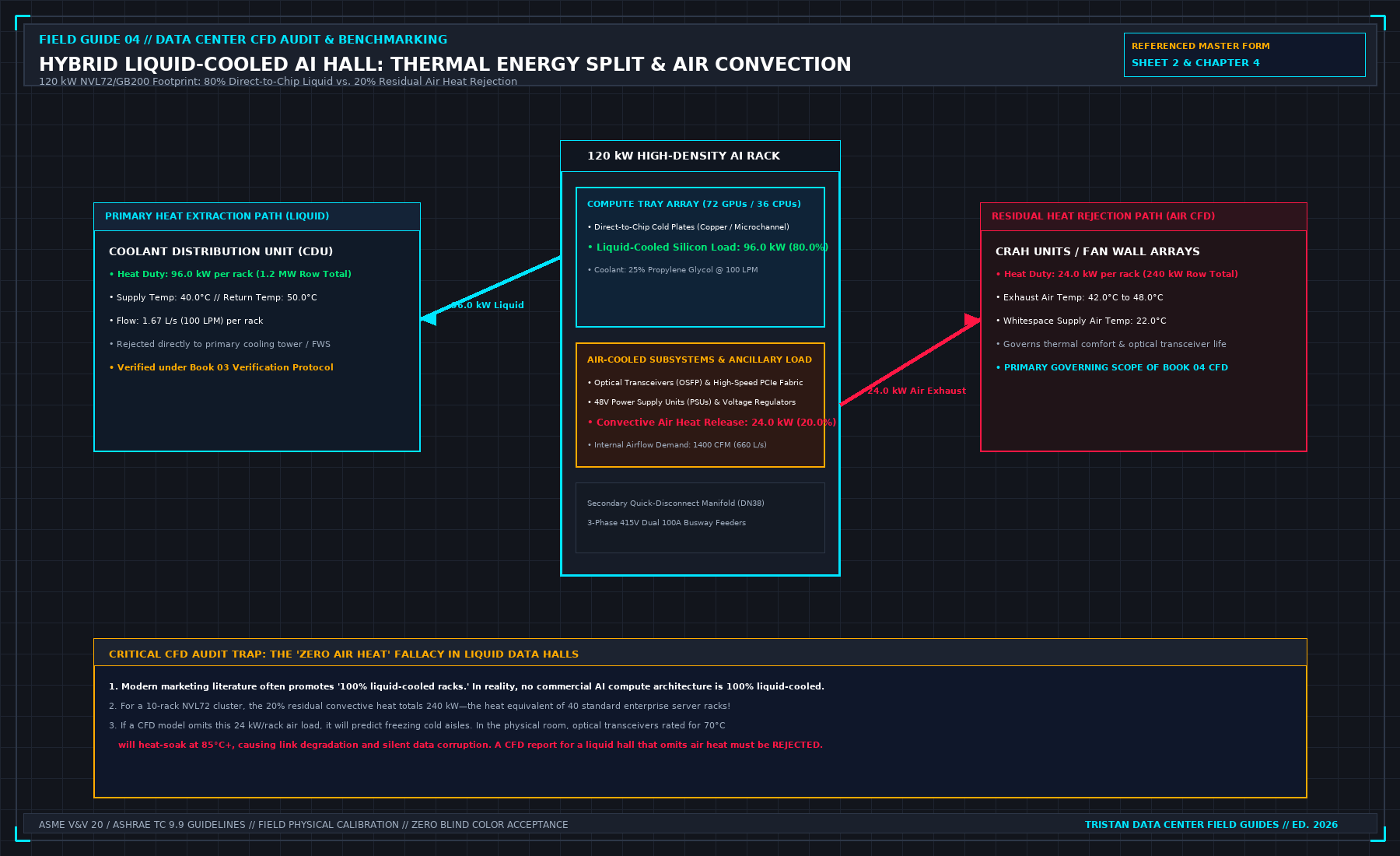
Scope reconciliation note: The diagram above reflects an 80% liquid / 20% air-cooled hybrid baseline typical of early 120 kW GB200/NVL72 deployments at 40°C supply. Pushing facility supply to 45°C under Vera Rubin-class architectures requires extending cold plates toward near-100% rack heat capture precisely because residual air-cooled subsystems cannot survive unconstrained warm exhaust.
From the facility side, 45°C coolant looks like pure upside. From the electronic-component perspective inside the chassis, raising coolant temperature by 15°C–20°C shifts real physical stress onto the hardware:
- Silicon Junction Margin and Static Leakage Power: Cold plates keep high-TDP GPUs and HBM stacks below hard thermal throttle thresholds, but a 45°C coolant inlet compresses thermal headroom to maximum junction temperature (Tj). In advanced CMOS nodes, subthreshold static leakage current rises exponentially with die temperature. Running silicon closer to its thermal ceiling introduces a modest "silicon power tax"—the same AI training step draws slightly more watts at hotter junction temperatures, partially offsetting facility chiller savings.
- Capacitors and VRM Power Stages (The 10°C Life Rule): Board-level voltage regulator modules (VRMs), MOSFET power stages, and solid-polymer or aluminum-electrolytic capacitors absorb higher PCB-conducted and ambient heat. MOSFET on-resistance (RDS,on) increases with temperature, adding conduction heat right where cooling is tightest. Meanwhile, electrolytic and hybrid capacitor wear-out obeys a well-established Arrhenius approximation—the 10°C rule, where rated service life roughly halves for every 10°C rise in core temperature:
A 10°C increase in local capacitor core temperature cuts a nominal 10-year life budget to 5.0 years (and a 15°C rise cuts it to 3.5 years).
- Optical Transceivers and Uncooled Air Pockets: High-speed 800G and 1.6T optical transceivers (laser diodes and TOSA assemblies) are typically rated to a 70°C case temperature ceiling. As Figure 4 illustrates, leaving 20% of rack heat in an unconditioned air path exposes optics to heat soak and silent bit-error degradation. That is why true 45°C chillerless operation demands full liquid coverage across switches, VRMs, and optical cages—not merely GPU cold plates.
- Thermal Cycling and Interconnect Fatigue: AI training clusters swing violently from idle to full rack power in milliseconds. Operating at elevated baseline temperatures with repeated thermal swings accelerates solder-joint creep and thermal interface material (TIM) pump-out. Because hyperscalers economically depreciate frontier GPUs over 3–5 years rather than 10–15 years, operators consciously trade excess component longevity for chillerless water and energy savings—provided commissioning eliminates flow imbalance and microchannel hot spots, as enforced in our NVL72 liquid load bank hydraulics guide.
4. Balancing Water, Power, and Capital: First-Principles Math
Water caps and grid substation limits are not separate engineering silos; they are locked together by conservation of energy. Every liter of evaporative cooling water you remove in a tropical climate must be replaced by either more electrical lift (air-cooled chillers) or higher heat-rejection temperature (45°C warm-water liquid cooling).
Equation 1: Sizing the Open-Tower Water Ceiling
For an open evaporative cooling tower rejecting total facility heat Qrej = QIT · PUE (capturing IT load plus electrical and chiller compressor heat), required daily makeup water accounts for both evaporation and mineral blowdown at Cycles of Concentration (COC):
Take a 100 MW IT tropical AI campus operating at design PUE of 1.30 (Qrej = 130,000 kW), latent heat rejection fraction flat = 0.85, latent heat of vaporization hfg = 2,420 kJ/kg at 35°C, and COC = 5:
- Evaporation rate: ṁevap = (130,000 × 0.85) / 2,420 = 45.66 kg/s.
- Total makeup water (including 25% blowdown overhead): ṁmakeup = 45.66 × (5 / 4) = 57.08 L/s.
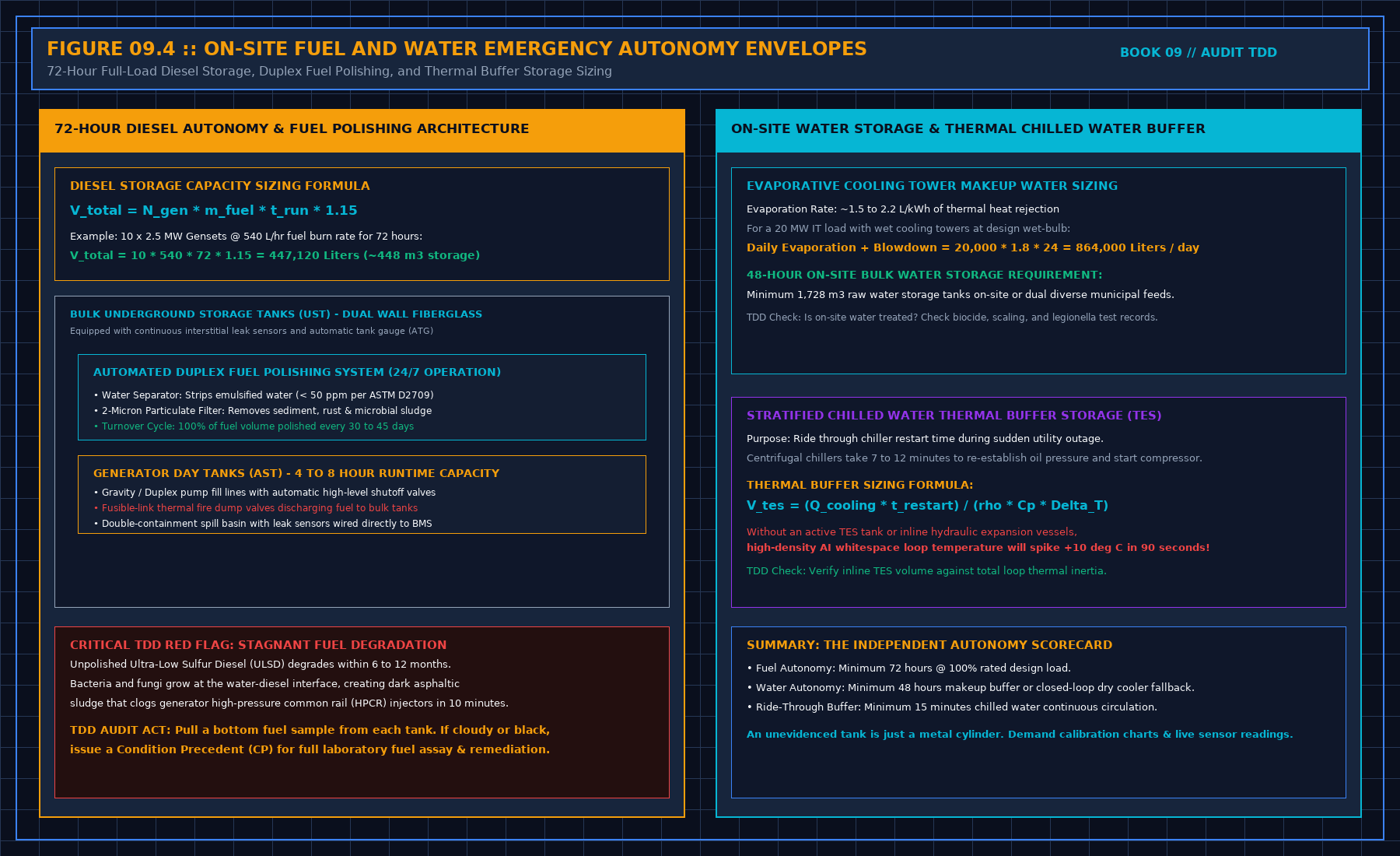
- Daily water demand: 57.08 × 86,400 / 106 = 4.93 MLD per 100 MW IT—equivalent to a site WUE of 2.05 L/kWh, sitting squarely inside Figure 09.4's
1.5–2.2 L/kWhevaporative tower envelope.
Apply that single number directly to Johor's November 2026 disclosure:
- 21.277 MLD approved supports at most ~431 MW of continuous open-tower IT capacity across the entire 19-site cohort.
- 73.088 MLD requested corresponds to roughly ~1,482 MW of continuous open-tower IT load.
Without reclaimed water or closed-loop dry rejection, potable municipal allocations physically cap tropical expansion long before land runs out.
Equation 2: The Substation Haircut (Water vs. Billable IT Megawatts)
When an operator eliminates water by switching from water-cooled chillers to air-cooled chillers in a 35°C tropical climate, PUE climbs from roughly 1.30 to 1.48. On a fixed utility substation allocation Psubstation, billable IT capacity is strictly bounded by:
| Plant Architecture (Fixed 100 MW Substation) | Design PUE | Billable IT MW | Full-Load Water Draw | Net Substation Impact vs. Base |
|---|---|---|---|---|
| Water-Cooled Chiller + Open Tower | 1.30 | 76.9 MW | ~3.79 MLD | Baseline (potable quota risk) |
| Air-Cooled Chiller (Zero Water) | 1.48 | 67.6 MW | ~0.00–0.09 MLD | -9.3 MW (-12.1%) lost IT capacity |
| 45°C Warm-Water DLC + Dry Cooler | 1.15 | 87.0 MW | ~0.00–0.09 MLD | +10.1 MW (+13.1%) gained IT capacity |
The balance-sheet takeaway is blunt: curing a water bottleneck with conventional air-cooled chillers destroys 12.1% of billable substation megawatts right when grid interconnects take years to secure. Conversely, 45°C warm-water liquid cooling paired with closed-loop dry coolers solves both constraints simultaneously—lifting billable IT per 100 MW substation to 87.0 MW while driving potable water near zero.
Equation 3: Stranded-Shell Capital Carry
Finally, tie water and cooling back to the November 2026 ASEAN financing freeze. Every USD 1.0 billion of project debt carried at a 7.5% annual coupon accrues:
Every 90-day slip—whether triggered by a BIS GPU export license review, a rejected water allocation, or a mid-construction redesign from cooling towers to dry coolers—burns USD 18.5 million per billion of project debt in deadweight interest with zero colocation revenue coming in.
5. Technical Due Diligence Checklist for Water-Constrained & Tropical AI Sites
Before releasing debt drawdowns or signing a long-term ASEAN colocation lease, lenders and buyers must convert these physical boundaries into enforceable Conditions Precedent—distinct from contractor commissioning sign-offs, as separated in a data center TDD is not a commissioning:
- Verify Binding Non-Potable Water Rights: Reject letters of intent or municipal potable assumptions. Require executed volume allocations (MLD) for reclaimed wastewater, NEWater, or permitted river abstraction, plus physical on-site polishing capacity and 48-hour bulk raw-water storage for any evaporative loop.
- Audit Psychrometric Hourly Models (Not Annual Averages): Demand 8,760-hour TMY weather simulations showing peak tropical wet-bulb (26°C–28°C) and dry-bulb (35°C+) hours. Reject any tropical proposal relying on standalone Direct Evaporative Cooling or claiming "zero trim chiller" on Indirect Evaporative Cooling.
- Price the Substation PUE Haircut: Recompute contracted billable IT megawatts using worst-case summer PUE under the site's actual water-constrained cooling mode (water-cooled vs. air-cooled vs. 45°C dry-cooler DLC) rather than nameplate annual averages.
- Inspect 45°C Hardware & Hydraulic Readiness: For warm-water DLC designs, verify whether secondary heat (optics, VRMs, switches) is captured by the liquid loop or handled by dedicated CRAH cooling so 70°C transceiver ceilings and capacitor life budgets are not silently breached.
- Ring-Fence Export-Control & Tenant KYC Exposure: Under the November 2026 BIS framework, verify tenant nationality, end-user compute licensing status, and whether the building's MEP/liquid infrastructure can pivot to investment-grade Western or sovereign hyperscalers without stranded CapEx.
- Stress-Test Carry Liquidity Against 90–180 Day Slippage: Confirm dedicated interest-reserve accounts capable of absorbing at least 180 days of debt service if either GPU customs clearance or utility water/power energization stalls past Ready-for-Service.
Frequently Asked Questions
Why did Johor approve only 21.28 MLD out of 73.09 MLD requested by data centers?
Johor's state coordination committee (JPPPDNJ) alongside BAKAJ and Ranhill SAJ capped treated municipal water allocations at 21.277 MLD—roughly 1.05% of the state's 2,034 MLD treated water output—to prevent industrial cooling demand from threatening domestic water security. Under open cooling towers (~2.05 L/kWh), 21.28 MLD supports only ~431 MW of continuous IT load, forcing new hyperscale builds toward closed-loop dry cooling, direct-to-chip liquid cooling, or reclaimed wastewater.
Are Direct or Indirect Evaporative Cooling viable in tropical ASEAN data centers?
Direct Evaporative Cooling (DEC) is technically non-viable for mission-critical tropical AI halls because high ambient humidity (75%–90% RH, 26°C–28°C wet-bulb) leaves minimal wet-bulb depression while pushing indoor air past humidity and gaseous corrosion limits. Indirect Evaporative Cooling (IEC) isolates indoor air quality, but in humid tropics it still requires near-continuous mechanical trim cooling while consuming water, making reclaimed-water chillers or 45°C warm-water liquid cooling with dry coolers far stronger options.
How does NVIDIA's 45°C warm-water liquid cooling affect server electronic components?
Supplying 45°C coolant allows closed-loop dry coolers to eliminate chillers and evaporative towers in tropical climates, but it compresses thermal headroom inside the chassis. Higher operating temperatures slightly increase CMOS silicon static leakage power, elevate VRM MOSFET conduction losses, halve electrolytic/hybrid capacitor rated lifespans roughly every 10°C core rise, and tighten margins around 70°C-rated optical transceivers—requiring near-100% liquid coverage and tight commissioning flow balance.
This engineering and due-diligence protocol connects physical thermodynamics directly to infrastructure capital risk. For the complete site-walk audit framework—including utility diversity checks, 48-hour water and 72-hour fuel autonomy sheets, and Investment Committee fatal-flaw refusal checklists—see Walk a TDD: Technical Due Diligence Physical Site Audit (Vol. 09) by Tristan.