What an MOP must say before the tools come out
Direct Answer Block: The mandatory elements every data center Method of Procedure (MOP) must specify before tools touch switchgear: baseline state, PONR, abort trigger, and LOTO. In mission-critical data center commissioning and operations, engineers enforce this boundary using deterministic physical equations, calibrated field instrumentation, and auditable sign-off gates rather than relying on vendor brochure summaries, uncalibrated software plots, or verbal assurances. Every measurement and state transition must be recorded with synchronized UTC timestamps and explicit pass/fail thresholds before a signature is granted.
A method of procedure is one job. It is approved before the tools come out. A method written during the job is a story about what you already did. File the story as a note. Do not backdate the method and call it controlled.
The paper names what will be isolated, and what the plant will do while it is isolated. "The other side will carry it" is not a sentence until you say which side, and what you will do if that side is already down. Service impact is named, including none. None is a claim. It has to be true, not polite.
It names how you return the plant, and how you back out if the return fails. A back-out of "call the vendor" is allowed if that is the truth. Write it. A blank back-out is not a plan. The person on the night has to be able to say the stop aloud. If they cannot, the job waits.
It names the spare the job will not start without. If that part is not on the shelf, the job does not start, unless the back-out still works without it and that fact is written. A vendor wish list is not a spare line.
The window has to be visible to the shift and to the screen, or the monitor will page you for the change you scheduled. Pages suppressed, record kept. Deleting the alarms is not a window. Evidence that the job is finished is named before you start: the state you will see, not a verbal "it's back." Closing the alarm is not that evidence.
1. First-Principles Engineering Formulation and Governing Mathematics
In high-density data center environments, verbal summaries and qualitative status tiles routinely obscure incipient physical failures. Whether auditing a 120 kW liquid-cooled rack boundary, evaluating a 1-second telemetry time series, or verifying plant redundancy prior to handover, the governing physical relationship for this protocol is expressed as:
When any term on the left-hand or right-hand side of this relationship is left unmeasured, inferred from an uncalibrated nameplate, or averaged across an unverified time window, the resulting engineering record cannot support a valid operational signature. Field engineers must verify each physical variable independently using NIST/ISO 17025 traceable instruments before proceeding to the next gate in the sequence.
| Audit Verification Parameter | Unacceptable / Defective Field Practice | Auditable First-Principles Requirement | Mandatory Action on Failure |
|---|---|---|---|
| Primary Boundary Definition | Implied by vendor brochure or slide deck | Explicitly bounded on stamped P&ID / SLD with tag IDs | Halt acceptance; issue formal boundary clarification |
| Measurement & Telemetry Proof | Single uncalibrated display reading or 60-sec average | Calibrated Class A/0.5S sensor with 1-sec UTC timestamp | Reject dataset; classify point as 0x40 Stale or 0x80 Bad |
| Pass / Fail Acceptance Gate | Qualitative "Looks OK" or "Within Normal Range" | Quantitative numerical corridor cited from revision in force | Log Category A/B defect; withhold retainage or permit |
| Custody & Sign-Off Record | Single bundled "Accepted" signature at end of meeting | Scoped, dated sentence naming exact proved & unproved lines | Strike unsupported claims; issue Conditional Refusal |
2. Deep-Dive Technical Protocol and Field Implementation
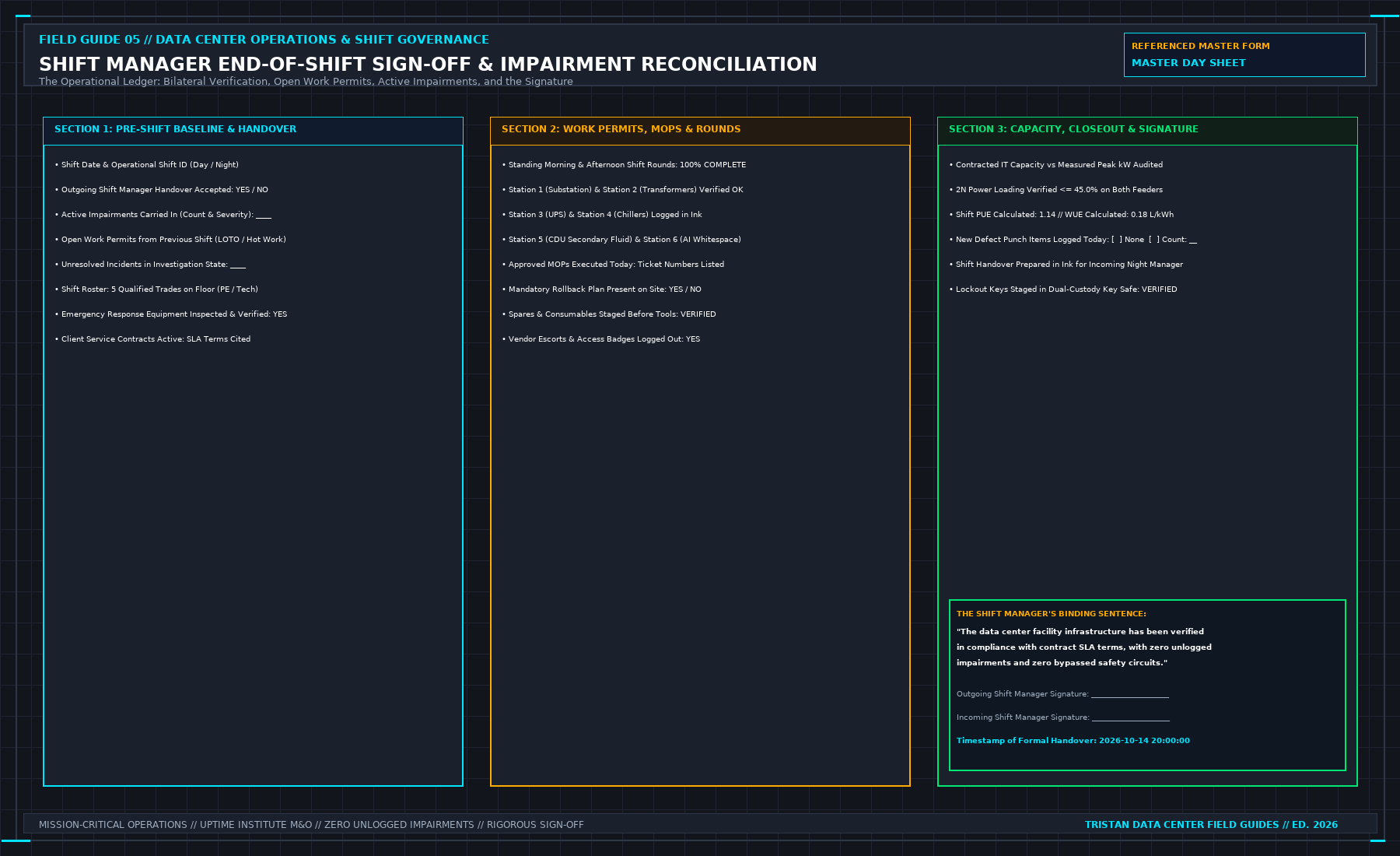
The following field protocol—adapted directly from Volume 05: Run the Data Center Day: What the Manager Must Sign Before the Shift Ends—establishes the step-by-step verification mechanics required on the data hall floor:
Work performed in a production data center without a validated, written method is not engineering; it is gambling with the customer's business.
| OPERATIONAL DOCUMENTATION PYRAMID |
|---|
| /\ |
| / \ |
| / PTW\ PERMIT TO WORK |
| /------\ Who, Where, When, Tools |
| / \ |
| / MOP \ METHOD OF PROCEDURE |
| /------------\ Step-by-Step, Isolations, Backout |
| / \ |
| / SOP \ STANDARD OPERATING PROCEDURE |
| /------------------\ Routine Shift Rounds & Valve Lineups |
| / \ |
| / EOP \ EMERGENCY OPERATING PROCEDURE |
| /------------------------\ Immediate Muscle Memory Safe-State |
Four distinct operational documents govern every physical action on site. Never conflate their functions.
Standard Operating Procedures (SOP)
An SOP governs recurring, baseline operations where the system configuration remains within normal operating limits:
- Executing daily physical shift rounds.
- Conducting chemical water sampling and glycol refractometer tests.
- Operating the manual bypass valve on a water softener skid.
- Performing routine filter differential pressure checks.
Every SOP must exist as a printed, laminated document physically located at the point of work (e.g., mounted inside the CDU enclosure or on the wall of the water treatment plant). An SOP that exists only as a PDF buried in a corporate intranet directory is useless to a technician holding a sample flask.
Method of Procedure (MOP)
A MOP governs any scheduled, non-routine activity that touches critical infrastructure, alters equipment redundancy, or introduces risk of electrical or thermal disruption:
- Racking in or racking out a 480V air circuit breaker.
- Isolating a primary plate heat exchanger for acid cleaning.
- Replacing a mechanical seal on a 75 kW secondary loop pump.
- Updating firmware on a central Building Management System controller.
Every MOP must contain six mandatory structural sections:
- Scope and Equipment Identification: Explicitly naming the assets by unique equipment tag, building, room, and coordinate.
- Pre-Requisite Conditions: Verifying that redundant systems (N+1 or 2N) are 100% operational, fully available, and free of active alarms before work commences.
- Required Personal Protective Equipment (PPE) & Specialized Tools: Arc-flash suits, calibrated torque wrenches, insulated tools, pressure gauges, and spill containment kits.
- Step-by-Step Execution Sequence: Numbered, sequential actions with checkboxes and signature blocks for both the Performer and Checker at every single step.
- Detailed Back-Out Plan: The precise, pre-calculated sequence of actions required to abort the work and return the plant to a 100% stable, redundant operational state at any point during the window.
- Sign-Off and Technical Acceptance: Formal verification that the equipment has been restored to service, tested under load, and that all temporary jumpers, LOTO padlocks, and tools have been removed.
A MOP drafted or edited on a clipboard while standing in front of an open electrical cabinet is an incident report waiting to happen. If a procedural step cannot be completed as written, the technician must stop work, back out to the last safe step, and seek formal engineering re-approval.
Emergency Operating Procedures (EOP)
An EOP governs the immediate, high-stress response during an active equipment failure or catastrophic event:
- Uncontrolled secondary liquid cooling loop leak (> 50 LPM).
- Complete loss of external utility medium-voltage grid power.
- Catastrophic failure of an automatic transfer switch (ATS).
- Chiller plant electrical bus fire requiring emergency power off (EPO).
An EOP is designed for raw muscle memory. It must never exceed two pages in length. An EOP that contains twenty pages of narrative text is an engineering textbook, not an emergency procedure.
An effective EOP names only three things:
- The Stop: The immediate manual actions to halt further damage (e.g., hit the emergency isolation valve button
EIV-101, trip the battery disconnect breaker). - The Call: The exact operational role or phone number to summon emergency response (e.g., Duty Manager radio channel 1, municipal fire dispatch).
- The First Safe State: The verified stable operating mode to hold while incident management takes over (e.g., transition remaining IT load to secondary bus B, engage emergency glycol makeup pump).
Once the first safe state is secured, the EOP ends. All subsequent investigative, restoration, or repair work converts immediately into a planned operation governed by a formal MOP.
Permit to Work (PTW)
A Permit to Work sits atop the procedural framework. It is the legal and operational authorization granted by the Duty Manager permitting specific individuals to execute an approved MOP within an exact physical space during a defined time window.
A valid PTW enforces four hard constraints:
- Location: Specific room, aisle, and cabinet. Working outside the permit boundary is a direct safety violation.
- Time Window: Explicit start and end timestamps. An expired permit is an immediate Stop Work command.
- Personnel: Named individuals with verified qualification records on file.
- Lockout/Tagout (LOTO): Verification that all hazardous electrical, hydraulic, pneumatic, and chemical energy sources are physically locked, tagged, and zero-energy verified (test-before-touch).
| PTW & LOTO AUDIT GATES |
|---|
| [GATE 1] Approved MOP attached with complete back-out procedure |
| [GATE 2] Personnel qualifications verified against site trade matrix |
| [GATE 3] Zero Energy Verification: Multi-meter test & pressure bleed |
| [GATE 4] Physical LOTO hasp, red lock, and danger tag applied |
| [GATE 5] Redundancy check: Alternate path verified carrying load |
Critical Spares Verification
No maintenance procedure may commence until all critical replacement parts are physically present at the job site.
A "critical spare" is not whatever parts happen to be sitting in the warehouse. A critical spare is the exact component whose failure or unavailability would prevent the execution of the MOP's back-out plan. For a secondary CDU pump replacement, the critical spares include:
- Replacement mechanical seal assembly with matching EPDM elastomers.
- Set of factory-spec mating gaskets for suction and discharge flanged connections.
- 50 liters of pre-mixed 25% propylene glycol solution.
- Calibrated torque wrench with current calibration certificate.
If the technician opens the CDU enclosure and then discovers that the replacement flange gasket is missing from the parts cage, the job does not start. Hoping that the old gasket can be scraped off and reused without leaking is how secondary cooling loops spray glycol across 400V busways.
Decisions to Record
- All active SOPs verified present as physical, readable documents at the equipment.
- All MOPs approved for today's shift, with service impact classifications recorded.
- LOTO registry numbers and physical padlock tag IDs applied to equipment.
- Exact expiration timestamps for all active Permits to Work.
- Confirmation that all critical spares were visually inspected and verified on site before permit issuance.
Lockout/Tagout (LOTO) Zero-Energy Verification and Two-Person Switching Rules
Even the most thoroughly peer-reviewed Method of Procedure (MOP) fails if the technician on the floor applies a lock to Cabinet UPS-1B while standing in front of Cabinet UPS-1A. Human visual confirmation bias under fluorescent plant lighting is eliminated only by executing the Select-Before-Operate (SBO) Two-Person Point-and-Call Protocol combined with a Live-Dead-Live zero-energy verification test.
The Live-Dead-Live Zero-Energy Proof Sequence
Before any enclosure door is opened for invasive maintenance or any busbar/pipe joint is unbolted under a MOP:
- Verify Boundary Tag ID: The Switching Operator touches the engraved phenolic nameplate on the breaker or valve, reads the full alphanumeric identifier aloud (
MV-SWG-A-52-04), and waits for the Independent Verifier to confirm the exact character string against Step k of the signed MOP. - Apply Personal LOTO Hardware: Each technician working on the boundary applies their own individually keyed personal padlock and signed danger tag to the multi-lock hasp. A supervisor may never apply or remove a lock on behalf of another technician.
- Execute Live-Dead-Live Voltage Proof: For electrical isolation, using a CAT IV 1000V rated digital multimeter or non-contact high-voltage phasing stick:
- Live: Test the meter on a known energized voltage source to prove the meter and leads are functional.
- Dead: Measure Phase-to-Phase (L1-L2, L2-L3, L3-L1) and Phase-to-Ground (L1-PE, L2-PE, L3-PE) on the isolated load terminals, confirming 0.0 V.
- Live: Re-test the meter immediately on the known energized source to prove the meter battery or fuse did not fail during the dead measurement.
| Document Type | Permitted Scope of Action | Required Authorization Level | Mandatory Abort / Handoff Rule |
|---|---|---|---|
| SOP (Standard Operating Procedure) | Non-invasive rounds, log reading, filter cleaning, local HMI viewing | Shift Lead assignment on daily roster | If an abnormal meter reading or leak is found, stop SOP and escalate |
| MOP (Method of Procedure) | Breaker switching, UPS bypass transfer, valve isolation, firmware update | Pre-approved by Chief Engineer + Shift Manager permit | Abort immediately and execute Pre-PONR Back-Out if abort trigger is hit |
| EOP (Emergency Operating Procedure) | Immediate fault containment during unplanned fire, arc fault, or coolant spill | Any qualified shift technician on scene | Stop at the First Safe State; never improvise repair inside an EOP |
Emergency Operating Procedure (EOP) Memory Items vs. Reference Checklists
Every site EOP is structured into two distinct sections: Immediate Action Memory Items (maximum 3 to 5 physical steps boxed at the top of Page 1 that a qualified technician can execute within 30 seconds without holding a clipboard, such as hitting an EPO shunt trip, closing a main fuel leak isolation valve, or verifying automatic tie-breaker closure) and Subsequent Reference Steps (executed with the two-person printed checklist in hand once the immediate life-safety or equipment destruction hazard is contained).
3. Field Verification Checklist and Instrumentation Hygiene
To execute this protocol without introducing measurement bias or scope ambiguity, the responsible engineer enforces four mandatory field rules:
- Instrument Traceability Before Observation: Verify that every thermometer (4-wire Pt100 RTD Class A), pressure transducer (≤ ± 0.1% span), flowmeter, balometer, or power analyzer carries a current calibration certificate and passes a pre-test zero/span check on the day of the walk.
- Synchronized Time-Series Capture: Align all digital loggers and gateway pollers to a single UTC reference clock (via IEEE 1588v2 PTP at ± 1 ms for electrical Sequence of Events, or NTP at ± 10 ms for thermal/hydraulic dwells). Never merge unsynchronized CSV files by row index.
- Explicit Isolation of Disturbances vs. Control Handles: Hold upstream supply temperatures, parallel cabinet loads, and containment door states constant during the observation dwell so that transient plant drift is never mistaken for steady-state equipment performance.
- Written Record Prior to Signature: Record every boundary tag, measured value, uncertainty tolerance, and open limitation in ink on the controlled project sheet before leaving the equipment line-up.
Frequently Asked Questions (FAQ)
Why does "What an MOP must say before the tools come out" matter during high-density data center commissioning and operations?
The mandatory elements every data center Method of Procedure (MOP) must specify before tools touch switchgear: baseline state, PONR, abort trigger, and LOTO. When project teams bypass this rule to meet a commercial schedule milestone, unverified physical assumptions—such as hidden hydraulic pressure drops, unlogged polling gaps, unblanked bypass leakage, or uncalibrated sensor offsets—transfer directly into live 24/7 production as latent single points of failure.
How do you quantitatively verify compliance with "data center method of procedure MOP checklist" on the physical floor?
Compliance is verified by executing the governing mathematical balance (tcutoff = Twindowend - (trollback + tverification)) using independent, calibrated field instruments across a stabilized steady-state dwell window (minimum 15 to 30 minutes for thermal and hydraulic systems), and confirming that the discrepancy between primary and secondary measurements remains strictly within the pre-declared acceptance band.
What should an engineer do if a contractor or vendor submits a report that violates this protocol?
The reviewing engineer must refuse to sign the broad acceptance sentence, mark the specific line item as Unproved / Defective on the official audit sheet, and either require a witnessed re-test under a corrected script or isolate the unproved scope under a time-bounded Conditional Acceptance with a 150% to 200% financial retainage escrow holdback.
From Run the Data Center Day: What the Manager Must Sign Before the Shift Ends, Tristan, Data Center Field Guides.
Related: A data center change needs a back-out.
Master the Complete Protocol: Run the Data Center Day: What the Manager Must Sign Before the Shift Ends
2N Redundancy Mathematics, 6 Inspection Stations, Shift Handovers, and SOP/MOP/EOP Protocols
Stop relying on contractor spreadsheets and vendor marketing claims. This field guide provides the complete, auditable verification binder—including physical equations, inspection stations, acceptance thresholds, and signed refusal templates.