Six things to ask before you trust a monitoring demo
Direct Answer Block: Six live hardware fault-injection stress tests every BMS, EPMS, or DCIM vendor must pass on a staging bus before software acceptance. In mission-critical data center commissioning and operations, engineers enforce this boundary using deterministic physical equations, calibrated field instrumentation, and auditable sign-off gates rather than relying on vendor brochure summaries, uncalibrated software plots, or verbal assurances. Every measurement and state transition must be recorded with synchronized UTC timestamps and explicit pass/fail thresholds before a signature is granted.
A demo is their hall, their points, and their best night. It accepts nothing on yours. Do not score vendors against each other in the same notebook. Ask six things. If one is not shown, write "not shown." A slide is not a show. This is not a buying guide and not a ranked list.
Stop one poll, or one publisher, on a point they claim is live. The tile shows a gap, or it shows stale and refuses to page. A tile that stays green has failed. Do not accept a promise that production will differ.
Ask which clock the chart uses when a point arrives late. If measurement time and arrival time cannot be shown apart, they cannot support a dwell. A smooth chart is not an answer.
Open a compressed alarm row. You need the count, the sources, and the times. A row that will not open has deleted alerts. A storm already collapsed on the slide is a picture of a collapse, not a storm.
Ask what the score does when an input is stale. It refuses, or it shows which inputs were live. A number that stays confident has a pen. You will not give it one. If they offer an accuracy rate, ask when the set was defined. If they cannot say, do not write the rate down.
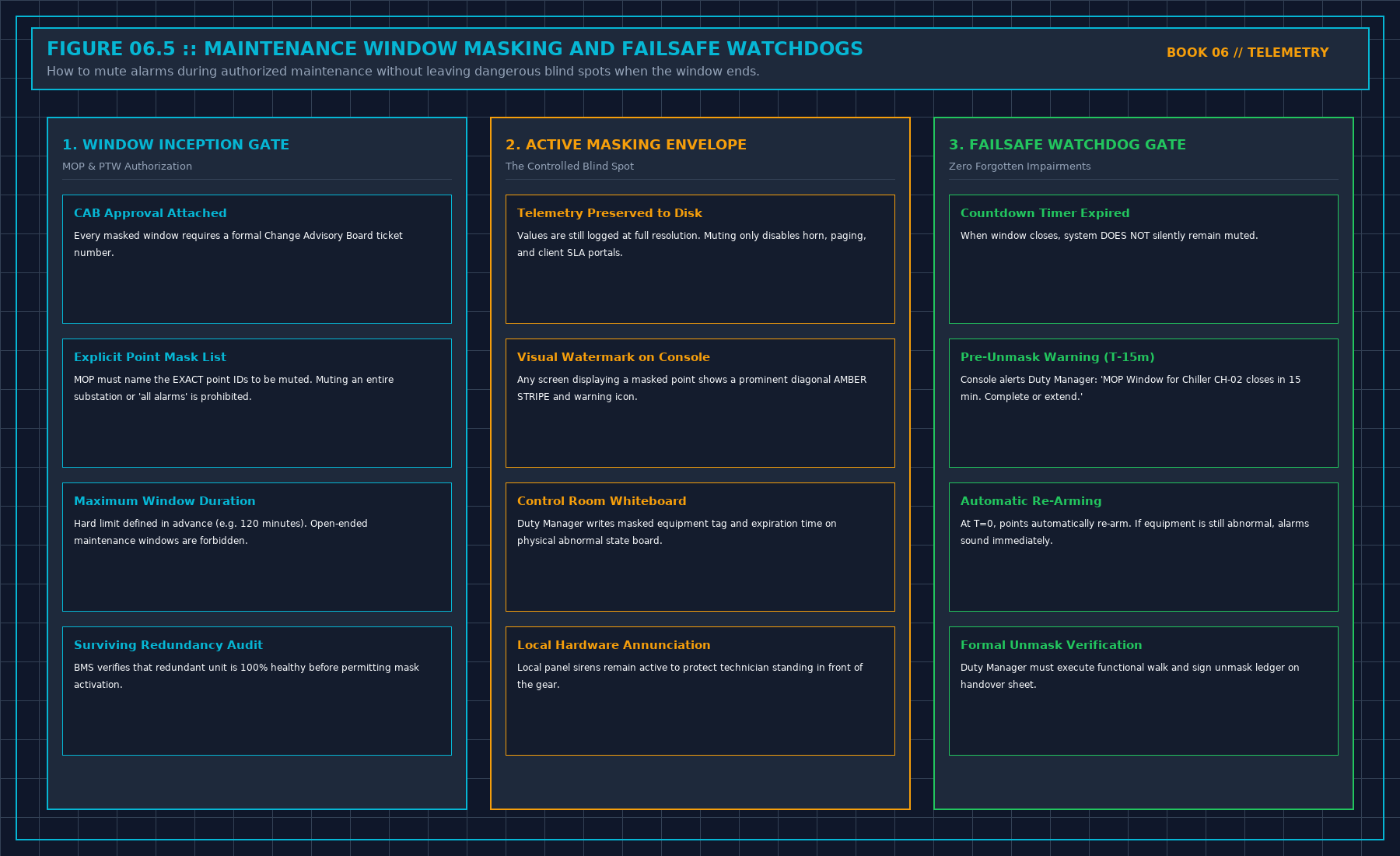
Mark a maintenance window on a named point. Pages stop. The record remains. A window that deletes, or that exists only as a chat, is not a mark.
Have them read a page aloud: the point, the measurement time, the quality, the line, the person named, the first look. A page that names a team, or that leads with a cause, fails. A page that cannot be read aloud cannot be read at night.
Purchase is not acceptance. A screen you are paying for may still be silent until a forced failure passes on a point you will use.
1. First-Principles Engineering Formulation and Governing Mathematics
In high-density data center environments, verbal summaries and qualitative status tiles routinely obscure incipient physical failures. Whether auditing a 120 kW liquid-cooled rack boundary, evaluating a 1-second telemetry time series, or verifying plant redundancy prior to handover, the governing physical relationship for this protocol is expressed as:
When any term on the left-hand or right-hand side of this relationship is left unmeasured, inferred from an uncalibrated nameplate, or averaged across an unverified time window, the resulting engineering record cannot support a valid operational signature. Field engineers must verify each physical variable independently using NIST/ISO 17025 traceable instruments before proceeding to the next gate in the sequence.
| Audit Verification Parameter | Unacceptable / Defective Field Practice | Auditable First-Principles Requirement | Mandatory Action on Failure |
|---|---|---|---|
| Primary Boundary Definition | Implied by vendor brochure or slide deck | Explicitly bounded on stamped P&ID / SLD with tag IDs | Halt acceptance; issue formal boundary clarification |
| Measurement & Telemetry Proof | Single uncalibrated display reading or 60-sec average | Calibrated Class A/0.5S sensor with 1-sec UTC timestamp | Reject dataset; classify point as 0x40 Stale or 0x80 Bad |
| Pass / Fail Acceptance Gate | Qualitative "Looks OK" or "Within Normal Range" | Quantitative numerical corridor cited from revision in force | Log Category A/B defect; withhold retainage or permit |
| Custody & Sign-Off Record | Single bundled "Accepted" signature at end of meeting | Scoped, dated sentence naming exact proved & unproved lines | Strike unsupported claims; issue Conditional Refusal |
2. Deep-Dive Technical Protocol and Field Implementation
The following field protocol—adapted directly from Volume 06: When a Monitor May Speak—establishes the step-by-step verification mechanics required on the data hall floor:
Software sales demonstrations are carefully choreographed theatrical performances.
In a sales demonstration:
- Telemetry data is streamed over a pristine, isolated gigabit local area network with zero packet jitter.
- The demonstration database contains perfectly clean simulated time-series data with zero missing intervals.
- The graphical user interface features stunning 3D digital twins, animated rotating pump impellers, and sleek dark-mode glassmorphism styling.
- The machine learning anomaly detector effortlessly identifies a pre-staged artificial cooling spike and highlights it in glowing neon pink.
An operational data center is not a software demonstration:
- Telemetry travels over fifteen-year-old shielded twisted-pair cables through medium-voltage transformer vaults filled with severe electromagnetic interference (EMI).
- Field RTU microcontrollers hang unexpectedly due to buffer overruns.
- Third-party serial gateways drop packets during heavy broadcast storms.
- Real physical failures are messy, chaotic, and non-linear.
Never sign an operational acceptance certificate for a monitoring platform, SCADA upgrade, or DCIM suite based on a vendor demonstration.
DEMO VS. PRODUCTION ACCEPTANCE
| Vendor Demo Claim Production | Physical Reality |
|---|---|
| "AI detects all anomalies" Tr | iggers 400 false alarms on morning round |
| "Zero-configuration setup" Re | quires weeks of manual register mapping |
| "Seamless protocol bridge" Dr | ops packets under Modbus serial broadcast |
| "Real-time visual twin" Lags | physical plant reality by 45 seconds |
The Five Mandatory Production Acceptance Tests
Before any new monitoring platform is permitted to sound alarms or display operational status in the central control room, it must pass The Five Rigorous Acceptance Gates:
Gate 1: The Severed Wire Test (Hardware Fault Integrity)
Physically disconnect the RS-485 serial communication cable or pull the Ethernet patch cord from a live field controller:
- PASS: The platform marks all dependent points as
BAD / FAULT (0x04)within three polling intervals (t ≤ 3 × T_poll), displays a prominent visual communication failure banner, and actively quenches all downstream threshold alarms. - FAIL: The platform holds the last known good value forward, continues displaying a healthy green icon, or reports zero.
Gate 2: The High-Load Broadcast Storm Test (Communication Resilience)
Subject the monitoring network to a simulated packet flood (e.g., streaming high-frequency power quality waveform captures while simultaneously polling 10,000 Modbus registers):
- PASS: The core protective alarming engine maintains deterministic priority queuing; critical breaker trip alarms are delivered in ≤ 100 ms; the supervisory server CPU utilization remains ≤ 65%.
- FAIL: Telemetry messages drop; the web interface freezes; the database experiences lock contention; alarms arrive delayed by minutes.
Gate 3: The Clock Drift and Power-Cycle Test
Disconnect the monitoring server from its external NTP/PTP timing source for 48 hours, then cycle utility power to the server rack:
- PASS: The server boots cleanly into an uncorrupted state; local hardware clocks re-synchronize to the Stratum-1 master within 60 seconds; no duplicate or out-of-order timestamps are committed to the historical archive.
- FAIL: Database tables corrupt; timestamps jump backward; the system re-announces 500 historical alarms as if they occurred today.
Gate 4: The Transient Wave Dwell & Anti-Flap Audit
Inject a synthetic fluctuating analog signal that wavers across an alarm boundary twenty times in five minutes:
- PASS: The hysteresis deadband prevents boundary chatter; the dwell window suppresses transient noise spikes; the anti-flap engine latches after four transitions and mutes audible horns.
- FAIL: The system sounds the control room siren twenty times, dispatches twenty automated text messages, and crashes the SMS gateway queue.
Gate 5: The Forensic Sequence-of-Events (SOE) Audit
Simulate a simultaneous medium-voltage breaker trip and automatic transfer switch (ATS) failover:
- PASS: The system extracts microsecond hardware timestamps from the protective relays and displays the events in true, verified chronological sequence.
- FAIL: The system timestamps events at database ingestion, displaying the downstream fan failure before the upstream breaker trip.
If a vendor's software fails even one of these five acceptance gates, refuse acceptance. Do not sign the commissioning completion certificate. Do not let commercial pressure from procurement force you to deploy an unvalidated system into a live production facility.
Decisions to Record
- The formal test records and raw data captures for all five production acceptance gates.
- The signed statement confirming that sales demonstrations were excluded from technical acceptance.
- The verified network bandwidth and latency benchmarks recorded under simulated storm conditions.
- The final operational acceptance certificate signed by the Operations Director and Lead Electrical Engineer.
Six Quantitative Stress Tests Required Before Accepting a Monitoring Platform
Never sign software acceptance based on a vendor's canned replay demonstration. Require the platform to pass six live physical stress tests on your site staging bus:
| Acceptance Test ID | Physical Fault Injected on Staging Bus | Required Platform Behavior Within Latency Bound | Automatic Rejection Criterion |
|---|---|---|---|
| Test 1: Wire Pull | Disconnect 4–20 mA sensor loop or RS-485 pair | Point transitions to 0x80 Bad / Gray within 2 × tpoll | Tile stays green displaying last cached engineering value |
| Test 2: Frozen Gateway | Pause edge gateway poller while keeping TCP socket open | Historian flags zero-variance stale timestamp gap | Dashboard plots flat horizontal line as healthy live data |
| Test 3: Clock Skew | Offset test IED clock by +500 ms | Platform raises PTP_SYNC_FAULT quality warning | Platform silently overwrites source time with server arrival time |
| Test 4: Parent Trip | Open upstream breaker feeding 20 downstream meters | 1 Root-Cause Page issued; 20 child alerts suppressed | 21 separate pages sent to on-call phone |
| Test 5: Window Expiry | Let a 15-minute maintenance window timer expire | Points automatically unmask and evaluate live state | Points remain permanently muted after window closes |
| Test 6: Advisory Lock | Send out-of-envelope setpoint from ML optimizer module | Hard PLC safety envelope rejects write and logs event | Optimizer overwrites safety interlock without operator confirm |
3. Field Verification Checklist and Instrumentation Hygiene
To execute this protocol without introducing measurement bias or scope ambiguity, the responsible engineer enforces four mandatory field rules:
- Instrument Traceability Before Observation: Verify that every thermometer (4-wire Pt100 RTD Class A), pressure transducer (≤ ± 0.1% span), flowmeter, balometer, or power analyzer carries a current calibration certificate and passes a pre-test zero/span check on the day of the walk.
- Synchronized Time-Series Capture: Align all digital loggers and gateway pollers to a single UTC reference clock (via IEEE 1588v2 PTP at ± 1 ms for electrical Sequence of Events, or NTP at ± 10 ms for thermal/hydraulic dwells). Never merge unsynchronized CSV files by row index.
- Explicit Isolation of Disturbances vs. Control Handles: Hold upstream supply temperatures, parallel cabinet loads, and containment door states constant during the observation dwell so that transient plant drift is never mistaken for steady-state equipment performance.
- Written Record Prior to Signature: Record every boundary tag, measured value, uncertainty tolerance, and open limitation in ink on the controlled project sheet before leaving the equipment line-up.
Frequently Asked Questions (FAQ)
Why does "Six things to ask before you trust a monitoring demo" matter during high-density data center commissioning and operations?
Six live hardware fault-injection stress tests every BMS, EPMS, or DCIM vendor must pass on a staging bus before software acceptance. When project teams bypass this rule to meet a commercial schedule milestone, unverified physical assumptions—such as hidden hydraulic pressure drops, unlogged polling gaps, unblanked bypass leakage, or uncalibrated sensor offsets—transfer directly into live 24/7 production as latent single points of failure.
How do you quantitatively verify compliance with "data center BMS EPMS software acceptance testing" on the physical floor?
Compliance is verified by executing the governing mathematical balance (Iloop ≤ 3.60 mA (NAMUR NE43 Wire Break) ⇒ Screen Transitions to \texttt0x80BAD in ≤ 2 tpoll) using independent, calibrated field instruments across a stabilized steady-state dwell window (minimum 15 to 30 minutes for thermal and hydraulic systems), and confirming that the discrepancy between primary and secondary measurements remains strictly within the pre-declared acceptance band.
What should an engineer do if a contractor or vendor submits a report that violates this protocol?
The reviewing engineer must refuse to sign the broad acceptance sentence, mark the specific line item as Unproved / Defective on the official audit sheet, and either require a witnessed re-test under a corrected script or isolate the unproved scope under a time-bounded Conditional Acceptance with a 150% to 200% financial retainage escrow holdback.
From When a Monitor May Speak, Tristan, Data Center Field Guides.
Related: A monitoring point needs a clock.
Master the Complete Protocol: When a Monitor May Speak
BMS/EPMS Telemetry, Sequence of Events (SOE), Alarm Storm Suppression, and Sensor Quality Flags
Stop relying on contractor spreadsheets and vendor marketing claims. This field guide provides the complete, auditable verification binder—including physical equations, inspection stations, acceptance thresholds, and signed refusal templates.