A green tile can be stale: First-Principles Data Center Engineering Protocol
Direct Answer Block: How frozen protocol gateways produce 'Silent Green Lies' on BMS dashboards, and how to enforce explicit Good (0x00), Uncertain (0x40), and Bad (0x80) quality states. In mission-critical data center commissioning and operations, engineers enforce this boundary using deterministic physical equations, calibrated field instrumentation, and auditable sign-off gates rather than relying on vendor brochure summaries, uncalibrated software plots, or verbal assurances. Every measurement and state transition must be recorded with synchronized UTC timestamps and explicit pass/fail thresholds before a signature is granted.
Live means the value was measured inside the interval you wrote, and the path did not fail. Stale means you are still showing an older value. Missing means you will not stand behind a value. A store that stamps its own clock at ingest, on an hour-old reading, has produced stale and painted it live. That is how a green screen survives a dead sensor.
Stale may be displayed, with the measurement time still visible. It may not close a ticket, prove a dwell, or clear an incident. If the only proof of recovery is stale, the incident stays open.
Missing is not zero. A chart that drops missing points and connects the neighbors has drawn a line the plant did not make. Show the break, or do not draw the line.
If you cannot say in one sentence what makes this source stale, you do not have a quality mark. You have a color. Treat every point from that box as missing for any decision that wakes a person. You may look. You may not obey.
1. First-Principles Engineering Formulation and Governing Mathematics
In high-density data center environments, verbal summaries and qualitative status tiles routinely obscure incipient physical failures. Whether auditing a 120 kW liquid-cooled rack boundary, evaluating a 1-second telemetry time series, or verifying plant redundancy prior to handover, the governing physical relationship for this protocol is expressed as:
When any term on the left-hand or right-hand side of this relationship is left unmeasured, inferred from an uncalibrated nameplate, or averaged across an unverified time window, the resulting engineering record cannot support a valid operational signature. Field engineers must verify each physical variable independently using NIST/ISO 17025 traceable instruments before proceeding to the next gate in the sequence.
| Audit Verification Parameter | Unacceptable / Defective Field Practice | Auditable First-Principles Requirement | Mandatory Action on Failure |
|---|---|---|---|
| Primary Boundary Definition | Implied by vendor brochure or slide deck | Explicitly bounded on stamped P&ID / SLD with tag IDs | Halt acceptance; issue formal boundary clarification |
| Measurement & Telemetry Proof | Single uncalibrated display reading or 60-sec average | Calibrated Class A/0.5S sensor with 1-sec UTC timestamp | Reject dataset; classify point as 0x40 Stale or 0x80 Bad |
| Pass / Fail Acceptance Gate | Qualitative "Looks OK" or "Within Normal Range" | Quantitative numerical corridor cited from revision in force | Log Category A/B defect; withhold retainage or permit |
| Custody & Sign-Off Record | Single bundled "Accepted" signature at end of meeting | Scoped, dated sentence naming exact proved & unproved lines | Strike unsupported claims; issue Conditional Refusal |
2. Deep-Dive Technical Protocol and Field Implementation
The following field protocol—adapted directly from Volume 06: When a Monitor May Speak—establishes the step-by-step verification mechanics required on the data hall floor:
A monitoring point displayed on an operations workstation console exists in one of three absolute states:
- LIVE (0x00): The measured value is verified fresh, arrived within its designated polling interval, and originated from a healthy physical transducer.
- STALE (0x01): The system is displaying an older cached value because newer telemetry packets failed to arrive within the designated timeout window.
- MISSING / FAULT (0x04): The communication link is severed, the transducer loop is open, or the channel is reporting an unrecoverable electrical error.
QUALITY BITMASK SPECIFICATION
| Bitmask | Quality State | Operational Capability Co | nsole Presentation |
|---|---|---|---|
| 0x00 GOO | D (LIVE) Valid | for SLA & Alarms Standar | d Green / White |
| 0x01 STA | LE Visible for | Trends Only Amber Stripe | (Muted) |
| 0x02 UNC | ERTAIN Enginee | ring Audit Only Question | Mark (?) Icon |
| 0x04 BAD | / FAULT Quara | ntined; No Alarms Grey / | Red Border (Comm) |
Never invent a fourth state called "Unknown" and then treat it operationally as if it were Live. A point is Live only when every single verification test passes.
The Mathematical Definition of Stale
A point transitions from LIVE to STALE according to a rigid mathematical rule:
Where:
- T_poll is the configured polling interval (e.g., 1.0 s for secondary cooling pressure, 5.0 s for battery float voltage).
- K_stale is the stale multiplier constant, which must be configured strictly to K_stale = 3.
If a secondary cooling supply pressure point configured for a 1-second polling interval fails to deliver a valid telemetry packet for more than 3.0 seconds (t > 3 × 1.0 s), the point immediately forfeits its LIVE status. Its quality flag flips to STALE (0x01).
The console must immediately:
- Alter the graphical display from solid green to an amber-striped pattern or muted grey.
- Display the timestamp of the last valid reading (tlastgood) alongside the value; never replace that timestamp with the current time of day.
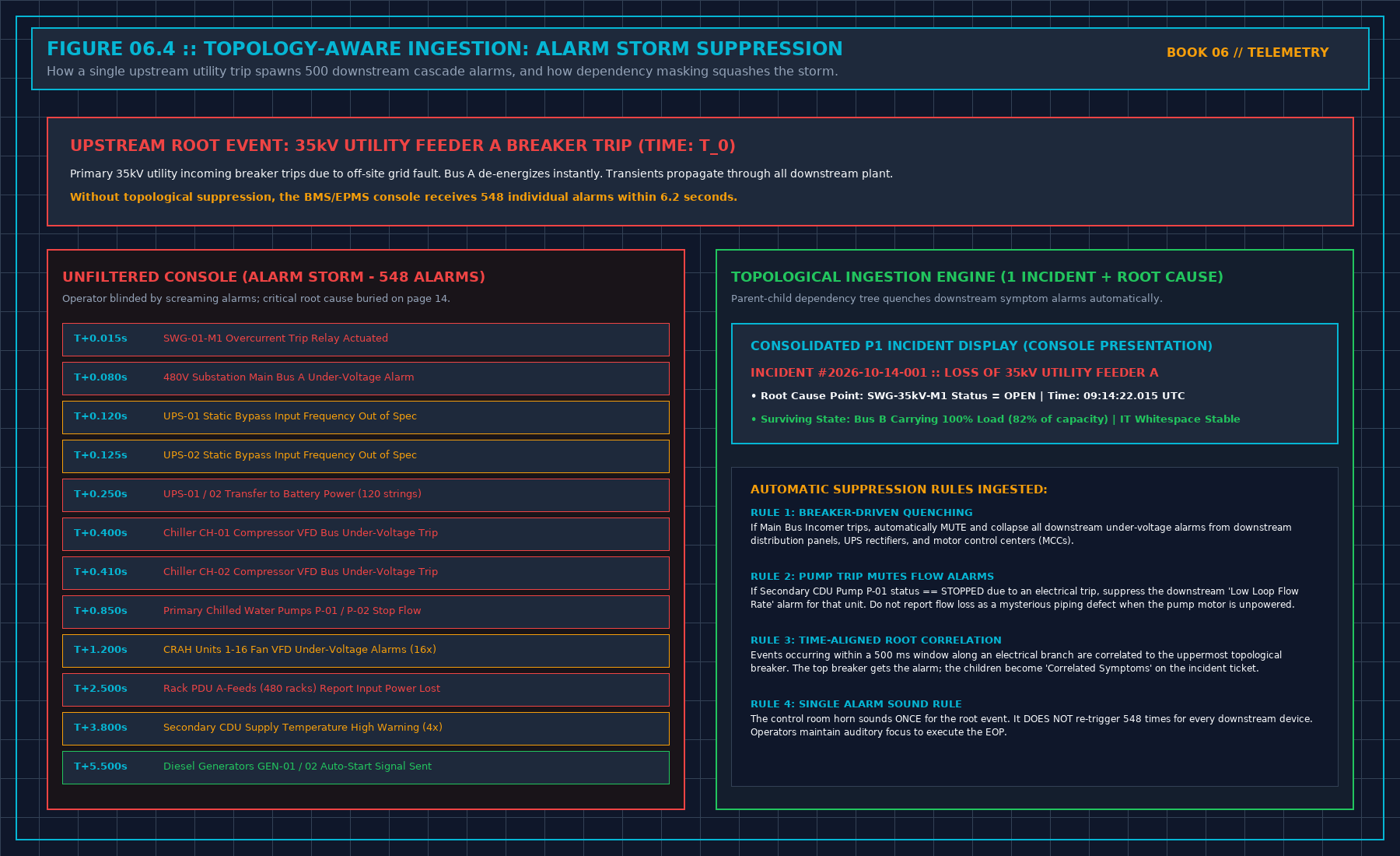
- Actively quench all downstream threshold alarm rules. If the pressure had been hovering near an alarm boundary before communication failed, the system must not fire a false "Low Pressure Alarm." Instead, it raises a single, unambiguous "Telemetry Loss Defect" on the communication channel.
A stale point may never be used to close a production incident, verify contractual SLA delivery, prove thermal dwell stability, or populate a capacity allocation ledger. If the sole evidence that a cooling loop stabilized after a pump trip is a flat line from a stale sensor, the incident remains fully open on the Duty Manager's board.
Missing Is Not Zero
In computational telemetry, zero is a valid physical measurement.
- Zero volts means a busbar is completely de-energized.
- Zero liters per minute means fluid flow has completely ceased.
- Zero degrees Celsius means liquid has reached the freezing point of pure water.
MISSING is the total absence of a physical measurement.
A graphical trend engine that drops missing telemetry packets and quietly draws a smooth straight line connecting the surrounding data points has manufactured a physical fiction. By connecting a measurement from 14:00 (3.5 bar) to a measurement from 14:15 (3.4 bar) across a 15-minute telemetry dropout, the graph hides the fact that at 14:07 the pressure may have plunged to zero when a bypass valve slammed shut.
Every telemetry charting engine must display a visible, discontinuous gap whenever points are missing. If data was not collected, the graph must show blank white space. Connecting points across a communication void is an operational deception.
How a Screen Lies While Looking Calm
Facility managers must train operators to recognize the subtle failure modes where a monitoring dashboard appears calm while the underlying plant is burning:
- The Frozen Database Cache: The graphical web tile displays a steady, reassuring reading of 22.4°C in green because the web server's background cache failed to refresh from the SQL database three hours ago.
- The Ingestion Timestamp Mask: The database server continuously updates the record's timestamp every five seconds, creating the appearance of live data, while the field RTU has been hung in an unhandled exception loop since dawn, re-transmitting the same cached memory buffer.
- The Suppressed Gap Trend: The trending software automatically interpolates across missing data packets, producing smooth, gentle sine waves that conceal severe hydraulic water hammer spikes.
- The Silent Setpoint Override: A technician temporarily raised an alarm threshold from 28.0°C to 45.0°C during a previous shift to silence a nuisance horn, failing to record the change. The screen remains quiet because the alarm boundary was moved to an impossible limit.
Audit your screens with the Forced-Failure Test. Physically disconnect the sensor. If the screen does not scream within ten seconds, the screen is an operational liability.
Decisions to Record
- The explicit timeout multiplier (K_stale = 3) configured for every polling loop.
- The visual presentation rules enforcing discontinuous gaps across missing data intervals.
- The operational protocol prohibiting stale points from closing active incident tickets.
- The site register of all unverified points currently quarantined under
BADorSTALEquality marks.
3. Field Verification Checklist and Instrumentation Hygiene
To execute this protocol without introducing measurement bias or scope ambiguity, the responsible engineer enforces four mandatory field rules:
- Instrument Traceability Before Observation: Verify that every thermometer (4-wire Pt100 RTD Class A), pressure transducer (≤ ± 0.1% span), flowmeter, balometer, or power analyzer carries a current calibration certificate and passes a pre-test zero/span check on the day of the walk.
- Synchronized Time-Series Capture: Align all digital loggers and gateway pollers to a single UTC reference clock (via IEEE 1588v2 PTP at ± 1 ms for electrical Sequence of Events, or NTP at ± 10 ms for thermal/hydraulic dwells). Never merge unsynchronized CSV files by row index.
- Explicit Isolation of Disturbances vs. Control Handles: Hold upstream supply temperatures, parallel cabinet loads, and containment door states constant during the observation dwell so that transient plant drift is never mistaken for steady-state equipment performance.
- Written Record Prior to Signature: Record every boundary tag, measured value, uncertainty tolerance, and open limitation in ink on the controlled project sheet before leaving the equipment line-up.
Frequently Asked Questions (FAQ)
Why does "A green tile can be stale" matter during high-density data center commissioning and operations?
How frozen protocol gateways produce 'Silent Green Lies' on BMS dashboards, and how to enforce explicit Good (0x00), Uncertain (0x40), and Bad (0x80) quality states. When project teams bypass this rule to meet a commercial schedule milestone, unverified physical assumptions—such as hidden hydraulic pressure drops, unlogged polling gaps, unblanked bypass leakage, or uncalibrated sensor offsets—transfer directly into live 24/7 production as latent single points of failure.
How do you quantitatively verify compliance with "OPC UA Modbus sensor quality flag stale data" on the physical floor?
Compliance is verified by executing the governing mathematical balance (tnow - tlastvalidsample > 3 × t#160;; #160; textpoll ⇒ Q#160;; #160; textstatus = \texttt0x40UNCERTAINSTALE) using independent, calibrated field instruments across a stabilized steady-state dwell window (minimum 15 to 30 minutes for thermal and hydraulic systems), and confirming that the discrepancy between primary and secondary measurements remains strictly within the pre-declared acceptance band.
What should an engineer do if a contractor or vendor submits a report that violates this protocol?
The reviewing engineer must refuse to sign the broad acceptance sentence, mark the specific line item as Unproved / Defective on the official audit sheet, and either require a witnessed re-test under a corrected script or isolate the unproved scope under a time-bounded Conditional Acceptance with a 150% to 200% financial retainage escrow holdback.
From When a Monitor May Speak, Tristan, Data Center Field Guides.
Related: An alarm is not an incident.
Master the Complete Protocol: When a Monitor May Speak
BMS/EPMS Telemetry, Sequence of Events (SOE), Alarm Storm Suppression, and Sensor Quality Flags
Stop relying on contractor spreadsheets and vendor marketing claims. This field guide provides the complete, auditable verification binder—including physical equations, inspection stations, acceptance thresholds, and signed refusal templates.