 DATA CENTER
Why General LLMs Fail in Mission-Critical Data Centers: The Tri-Layer Ground Truth Architecture
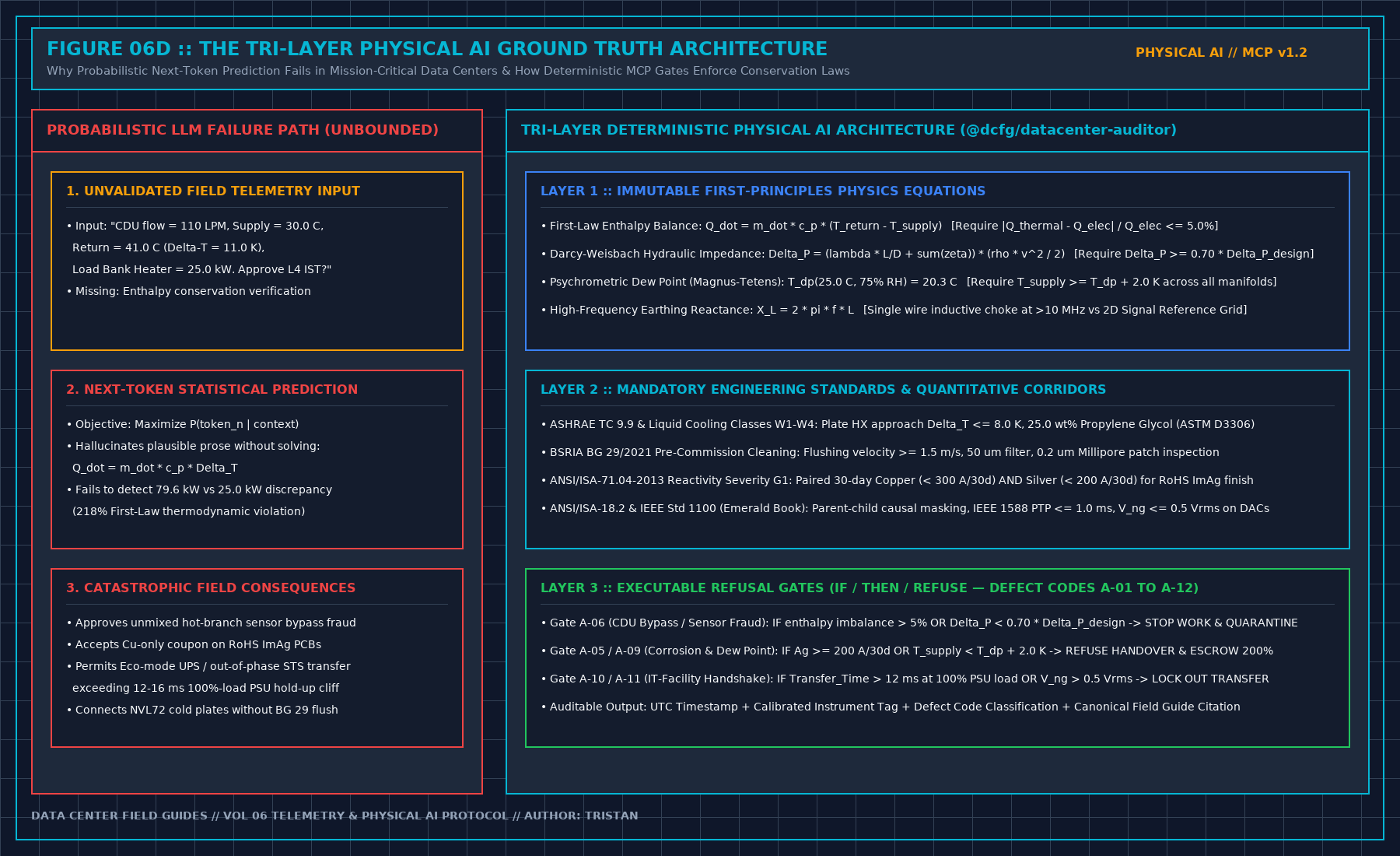
DIRECT ANSWER & VERIFICATION THRESHOLD:General-purpose Large Language Models (LLMs) optimize probabilistic next-token selection (P(wt \mid w1:t-1)) rather than physical conservation laws. In mission-critical data center commissioning and operations, an ungrounded LLM will routinely approve thermodynamically impossible Coolant Distribution Unit (CDU) logs, accept copper-only corrosion reports that leave RoHS Immersion Silver (ImAg) circuit boards exposed to sulfide creep, or endorse transfer-switch timings that exceed 100%-load server PSU hold-up limits. Deploying AI agents in physical infrastructure requires a Tri-Layer Ground Truth Architecture—combining immutable first-principles equations, quantitative industry standards (ASHRAE, BSRIA BG 29, ANSI/ISA-71.04, IEEE Std 1100), and executable
IF / THEN / REFUSEtool gates via Model Context Protocol (@dcfg/datacenter-auditor).
When an enterprise software application receives a hallucinated variable name from a coding copilot, the compiler rejects the build in milliseconds with zero physical asset damage. When a commissioning engineer or facilities operator asks an ungrounded LLM to review a Level 4 Integrated Systems Test (IST) log or a Method of Procedure (MOP) for a 132 kW NVIDIA GB200 NVL72 liquid-cooled rack row, the failure mode is governed by conservation of mass, energy, and momentum—not syntax.
Probabilistic language models interpolate across surface patterns in training text. Without a deterministic verification layer, they cannot distinguish between a thermodynamically closed energy balance and a fabricated contractor test sheet, nor can they separate distinct standards that share superficial vocabulary. To make autonomous agents safe for mission-critical engineering, the reasoning architecture must invert: language generation must be subordinate to deterministic physical solvers and hard refusal gates.
1. Five Failure Modes of Probabilistic LLMs on the Data Hall Floor
Auditing general-purpose LLM responses against field commissioning records reveals five recurring physical errors that directly threaten hardware survival and facility uptime.
Failure Mode 1: Violating First-Law Enthalpy Conservation in CDU Bypass Audits
During a liquid load bank commissioning test on a secondary Technology Cooling System (TCS) manifold, a contractor submits a telemetry log showing:
- Total CDU secondary flow rate: V̇ = 110.0 L/min (25% propylene glycol by weight, ρ = 1026 kg/m3, cp = 3.95 kJ/kg·K)
- Supply header temperature: Tsupply = 30.0°C
- Reported return temperature: Treturn = 41.0°C (Δ T = 11.0 K)
- Calibrated electrical power meter at the load bank breaker: Pelec = 25.0 kW
An ungrounded LLM sees Δ T = 11.0 K and V̇ = 110.0 L/min—numbers that match nominal design targets—and recommends signing the acceptance sheet, or worse, claims that an internal bypass valve was opened to "artificially raise the mixed return temperature." Both statements violate the First Law of Thermodynamics for a steady-flow control volume:
By conservation of energy, opening a bypass valve mixes cold supply fluid (30.0°C) directly into the return stream; for a fixed 25.0 kW heater input and a fixed 110.0 L/min total flow, internal bypass mixing cannot increase the mixed return temperature. Evaluating the actual enthalpy balance reveals:
The implied thermal rejection (81.73 kW) exceeds the measured electrical input (25.0 kW) by 226.9%. In physical reality, this discrepancy proves one of two contractor defects (Defect A-06):
- Unmixed Hot-Branch Sensor Placement: The contractor relocated or bound the return temperature RTD (
T_return) onto the throttled 25 kW heater discharge branch upstream of the bypass mixing tee, recording local branch temperature while diverting 70% of the flow through an unheated bypass loop. - Flow Meter Scaling / Register Manipulation: The ultrasonic flow meter pipe-diameter parameter or BMS Modbus scaling register was altered, reporting 110.0 L/min while actual flow was throttled to 33.6 L/min.
- Hydraulic Short-Circuiting: When a bypass valve is cracked open to achieve 110.0 L/min using undersized hoses, the measured manifold differential pressure collapses below the Darcy-Weisbach design curve (Δ Pmeasured < 0.70 · Δ Pdesign).
Failure Mode 2: Misclassifying ANSI/ISA-71.04-2013 Silver Corrosion and Dew Point
Since the EU RoHS Directive (2011/65/EU) eliminated tin-lead (SnPb) eutectic solder from enterprise computing hardware, printed circuit board (PCB) surface finishes have relied heavily on Immersion Silver (ImAg) over copper traces, alongside micro-via geometries with sub-millimeter creepage distances.
When auditing an environmental reactivity report showing a 30-day Copper coupon film thickness of 240 Å/30 days and a Silver coupon film thickness of 621 Å/30 days in a coastal or rubber-gasketed hall operating at 25.0°C and 75%RH, a general LLM frequently commits three errors:
- It misstates the ANSI/ISA-71.04-2013 Severity Level G1 limits, failing to enforce that G1 Mild requires both Copper < 300 Å/30 days and Silver < 200 Å/30 days (a Silver reading of 621 Å/30 days falls into Severity Level G2 Moderate,
< 1000 Å/30d, which voids high-density GPU motherboard warranties). - It misattributes silver sulfide (Ag2S) creep corrosion solely to the 3.0% silver content inside SAC305 (Sn96.5Ag3.0Cu0.5) solder joints rather than the exposed Immersion Silver (ImAg) planar PCB surface finish, where Ag2S dendrites nucleate and bridge across solder-mask openings under high relative humidity.
- It miscalculates psychrometric dew point. By the Magnus-Tetens equation (a = 17.625, b = 243.04°C):
At Tamb = 24.0--26.0°C and RH = 75%, the exact dew point is 19.3°C to 21.2°C (specifically 20.3°C at 25.0°C / 75%RH). Not only does RH > 60% accelerate Ag2S film growth exponentially, any facility chilled-water or W1/W2 CDU supply loop running at or below 20.0°C immediately crosses below Tdp, causing continuous liquid condensation on uninsulated quick disconnects (Defect A-09).
Failure Mode 3: Confusing the 20 ms ITIC Curve with 100%-Load PSU Hold-Up Time
General LLMs trained on generic electrical guidelines routinely state that "standard server power supplies have a 20 ms hold-up time per the ITIC/CBEMA curve, while Static Transfer Switches (STS) transfer in 4 to 8 ms." In high-density AI clusters, this assumption triggers simultaneous rack drops during power switching (Defect A-10).
The physical energy stored in the primary bulk electrolytic capacitors of a titanium-efficiency Common Redundant Power Supply (CRPS, 3000 W--5500 W) is governed by:
While the nominal ITIC curve specifies 20 ms voltage dropout immunity at rated steady-state conditions, a server PSU operating at 100% transient GPU boost load with aged bulk capacitance (-15% capacitance tolerance at high ambient temperature) exhibits an actual physical hold-up time of 12.0 ms to 16.0 ms.
More importantly, a physical AI auditor must distinguish which electrical topologies expose the server PSU to transfer interruptions:
- Double-Conversion Online UPS (VFI — Voltage and Frequency Independent): During a utility feeder outage, the DC bus remains continuously supported by the rectifier/battery bank and inverter with 0 ms transfer interruption.
- Line-Interactive / Eco-Mode High-Efficiency UPS: Operating on bypass for 99% efficiency requires fault detection, static bypass thyristor commutation, and inverter ramp-up, consuming 2 ms to 12 ms—leaving almost zero margin if a downstream breaker or busway fault adds sensing delay.
- Static Transfer Switch (STS) Out-of-Phase Transfer: While an in-phase STS transfers in 4--6 ms, an out-of-phase transfer (Δφ > 15°) between two unsynchronized UPS systems requires waiting for current zero-crossing plus thyristor turn-off and transformer flux decay protection, extending total interruption time to 12 ms to 18 ms.
- Rack-Level Mechanical ATS (Automatic Transfer Switch): Electromechanical relay transfer plus undervoltage fault detection requires 16 ms to 50 ms, guaranteeing a hard reboot of 100%-loaded AI nodes.
Failure Mode 4: Fabricating IEEE Grounding Standards and Ignoring Y-Capacitor Vng Physics
When asked to diagnose mysterious PCIe Gen5 / NVLink CRC bit errors or 400G/800G Twinax Direct Attach Copper (DAC) link flaps, general LLMs frequently confuse IEEE Std 142 (Green Book — Industrial Power System Grounding) with IEEE Std 1100 (Emerald Book — Powering and Grounding Electronic Equipment), and misunderstand how Neutral-to-Ground Voltage (Vng) couples into low-voltage differential signaling (Defect A-11).
Switch-Mode Power Supplies (SMPS) incorporate high-frequency isolation transformers that provide galvanic isolation between the primary AC input and the secondary 12 V / 54 V DC bus. Therefore, a 50/60 Hz neutral-to-ground voltage does not simply "add algebraically" to the isolated DC output rail. Instead, the coupling mechanism is high-frequency common-mode current injection through EMI Y-capacitors:
- Every server SMPS places Class-Y EMI filter capacitors between Line/Neutral and the metallic chassis ground (PE) to suppress conducted switching noise (150 kHz to 30 MHz).
- When high-frequency neutral-to-ground voltage (Vng > 0.5 Vrms, and critically > 2.0 Vrms or high-frequency ringing from VFD harmonic reflection) is present on the PDU branch circuit, displacement current (Icm = CY dVng / dt) is injected directly onto the server chassis.
- Because a single round 16 mm2 copper earthing conductor has self-inductance L ≈ 1.0--1.5 μH/m, its inductive reactance (XL = 2π f L) exceeds 60 Ω/m at 10 MHz, making a single wire an open-circuit choke at radio frequencies.
- Without a bonded 2D Signal Reference Grid (SRG) (flat copper straps or a 600 mm × 600 mm bolted stringer grid per IEEE Std 1100 Chapter 8 / Chapter 9), high-frequency chassis potential gradients choose the outer braided shields of inter-rack Twinax DAC cables as their lowest-inductance return path, saturating SerDes receiver common-mode rejection limits and triggering uncorrectable FEC symbol errors.
2. The Tri-Layer Ground Truth Architecture
To eliminate probabilistic hallucinations from data center design, commissioning, and operations, the Data Center Field Guides architecture enforces a strict three-layer execution model implemented in @dcfg/datacenter-auditor (v1.2.0):
| Architectural Layer | Governing Mechanism | Engineering Role | Failure Action |
|---|---|---|---|
| Layer 1: Conservation & Physics Solver | Exact algebraic & differential equations (Q̇ = ṁ cp Δ T, Darcy-Weisbach Δ P, Magnus Tdp, XL = 2π f L) | Verifies that reported telemetry obeys conservation of mass, energy, and electrodynamics | Rejects dataset as physically invalid (0x80 BAD or Defect A-06) |
| Layer 2: Standards & Corridor Matrix | ASHRAE TC 9.9, BSRIA BG 29/2021, ANSI/ISA-71.04-2013, ANSI/ISA-18.2, IEEE Std 1100, NFPA 70E | Maps physical outputs against mandatory numerical corridors and test boundaries | Flags specific code non-compliance with clause and threshold delta |
Layer 3: Executable Refusal Gates (MCP) | Deterministic IF / THEN / REFUSE state machine (Defect Codes A-01 to A-12) | Issues binding Stop-Work / Withhold-Retainage directives and Custody Refusal notices | Halts MOP/IST progression; requires witnessed re-test |
3. Deterministic Verification Tools in @dcfg/datacenter-auditor v1.2.0
Rather than pasting raw commissioning logs into an unconstrained chat window, engineering teams and autonomous agents invoke nine deterministic MCP tools that compute exact physical boundaries before generating any recommendation:
audit_commissioning_script: Scans SOP, MOP, EOP, and Level 1–5 commissioning procedures against Rules 01–06 (verifying PONR declarations, back-out timing, and liquid-vs-air boundary integrity).verify_hydraulic_boundary: Solves exact mass flow (ṁ), volumetric flow (L/min and GPM), and ASHRAE Liquid Cooling Supply Class (W1throughW4) for 120--135 kW NVL72 / GB200 racks.audit_cdu_thermal_and_bypass: Performs a simultaneous First-Law enthalpy balance (|Q̇thermal - Pelec| / Pelec ≤ 5.0%), plate heat exchanger approach check (Δ Tapproach = TTCS,sup - TFWS,sup ≤ 8.0 K), Darcy-Weisbach hydraulic bypass check (Δ Pmeasured ≥ 0.70 · Δ Pdesign), and Magnus dew-point margin audit (TTCS,sup ≥ Tdp + 2.0 K).audit_pipe_flushing_bg29: Enforces BSRIA BG 29/2021 pre-commission cleaning rules (Defect A-07): minimum pipe flushing velocity v ≥ 1.5 m/s, 50 μm filter differential pressure cleanliness, 0.2 μm Millipore gravimetric patch inspection, and mandatory mechanical bypass of server cold plates during chemical flushing.classify_corrosion_severity: Audits paired 30-day Copper and Silver coulometric reduction reports against ANSI/ISA-71.04-2013 (G1: Cu < 300 Å/30d and Ag < 200 Å/30d), verifying lot-matched field blank subtraction (Defect A-05).audit_alarm_suppression_matrix: Evaluates BMS/EPMS alarm configurations against ANSI/ISA-18.2 and EEMUA 191 (Defect A-08), requiring parent-child topological dependency masking, analog hysteresis deadbands, continuous dwell timers, and IEEE 1588 PTP (≤ 1.0 ms) / NTP (≤ 10.0 ms) clock synchronization.audit_it_facility_handshake: Audits cross-domain IT/Facility interfaces (Defect A-10,A-11,A-12): 100%-load PSU hold-up time (12--16 ms) versus Eco-mode UPS / STS / ATS transfer interruption, EMI Y-capacitor common-mode Vng ≤ 0.5 Vrms on Twinax DAC shields, and IEEE Std 1100 2D Signal Reference Grid bonding.lookup_defect_code: Retrieves the complete stop-work mandate, physical failure mechanism, and retainage escrow remedy for Category A (A-01toA-12), Category B (B-01toB-03), and Category C (C-01toC-02) commissioning defects.search_field_protocols: Queries the machine-readable ground-truth corpus (/llms-full.txtand/raw/*.md) for exact field sign-off sheets and acceptance rubrics.
Frequently Asked Questions (FAQ)
Why can't a general LLM audit a liquid cooling commissioning report without an external solver?
Because token prediction optimizes linguistic fluency rather than conservation of energy (Q̇ = ṁ cp Δ T). When a contractor places a return temperature sensor on a throttled 25 kW hot branch upstream of an open bypass tee, the log displays a nominal 11 K temperature rise alongside a 110 L/min total pump flow. Only an explicit First-Law enthalpy balance detects the 226.9% energy discrepancy between 81.7 kW implied heat rejection and 25.0 kW electrical input.
Why is a Copper-only corrosion coupon invalid for modern AI server motherboards?
Under EU RoHS lead-free mandates, modern PCBs frequently use Immersion Silver (ImAg) surface finishes over copper traces. Copper coupons are relatively insensitive to reduced sulfur gases (H2S, SO2) at low concentrations where Silver rapidly forms conductive silver sulfide (Ag2S) dendrites. Per ANSI/ISA-71.04-2013, certifying a data hall as Severity Level G1 requires both Copper < 300 Å/30 days and Silver < 200 Å/30 days.
When does a 4–8 ms Static Transfer Switch (STS) cause server reboots?
An STS causes server reboots when two conditions coincide: (1) the server PSUs are operating near 100% transient AI load with elevated bulk capacitor temperature, reducing physical hold-up time from the nominal 20 ms ITIC curve down to 12--16 ms; and (2) the STS executes an out-of-phase transfer (Δφ > 15°) or experiences upstream fault-detection delay, extending the total AC interruption window to 12--18 ms.