Witnessed is not the same as accepted a document
Direct Answer Block: Why commissioning certificates must explicitly distinguish between physical tests witnessed live on the data hall floor and vendor documents accepted at a desk. In mission-critical data center commissioning and operations, engineers enforce this boundary using deterministic physical equations, calibrated field instrumentation, and auditable sign-off gates rather than relying on vendor brochure summaries, uncalibrated software plots, or verbal assurances. Every measurement and state transition must be recorded with synchronized UTC timestamps and explicit pass/fail thresholds before a signature is granted.
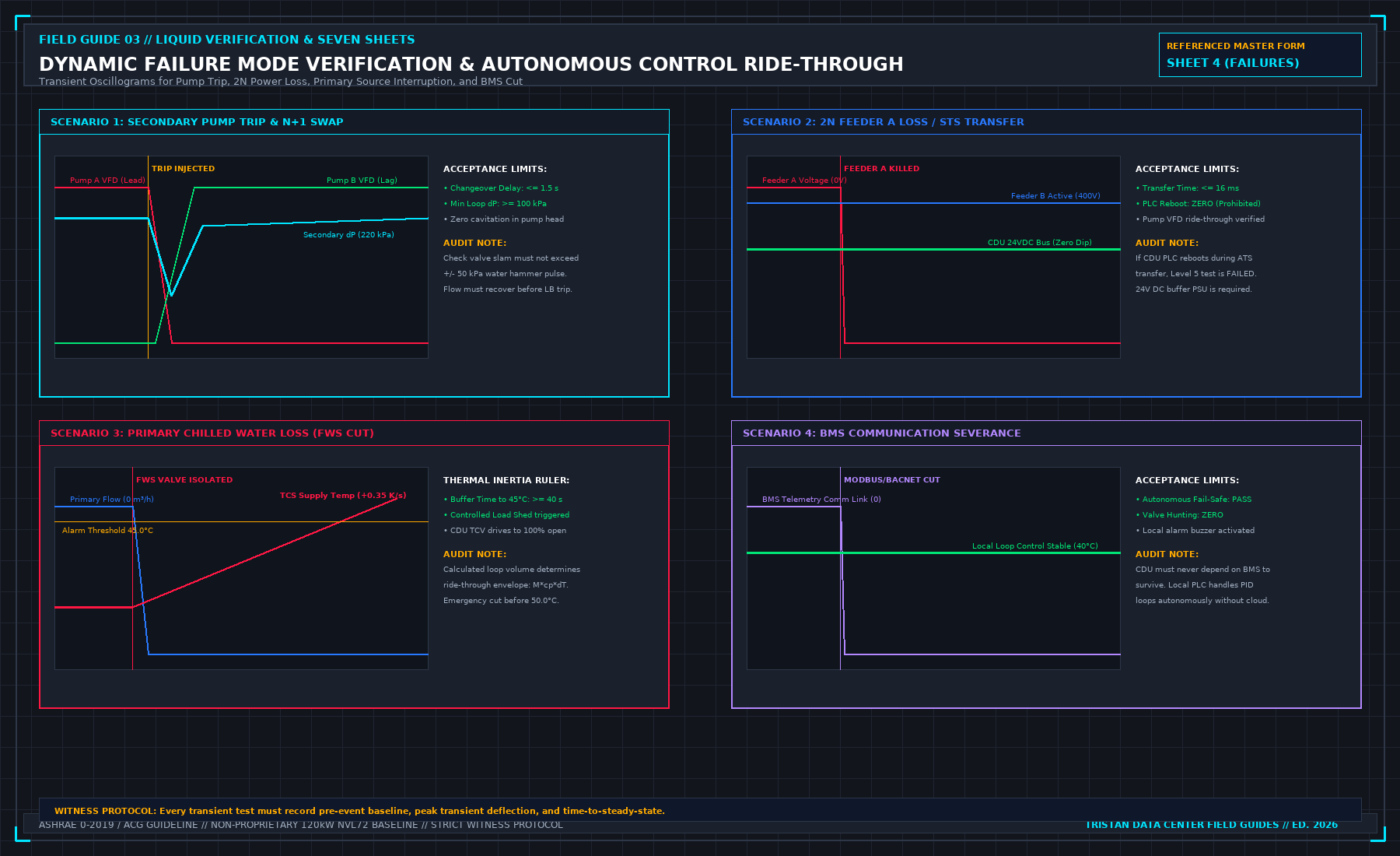
For each script someone wants called proved, the pack says which verb applies. Witnessed means a person saw the step. Accepted as a document means a paper was filed and a named party took it as the record. Not done means not done. A fourth word, "substantially complete," means not done, wearing a better coat. Do not add it.
If you cannot tell the verbs apart, you do not sign the proved sentence for that script. A document can be honest and still not be a witness. A missing witness does not make the document disappear. The signature has to say which one you are relying on.
A letter that says a setting was adjusted is not a witnessed changeover. A photograph of a label is not a leak test. A remote note that a value "looked normal" is not a file judgment. If a punch line was closed on one of these, do not inherit the close when the script asked for a witness the first time.
Sampling belongs in the same place. If every line was not witnessed, the pack says what was sampled and what rule picked the sample. "We saw enough" is not a rule. A sample can support a sentence about the sample. It cannot support a sentence about the hall. Strike the hall-wide claim.
A path a second person cannot open is not a document. You are relying on a name. Names are not records.
1. First-Principles Engineering Formulation and Governing Mathematics
In high-density data center environments, verbal summaries and qualitative status tiles routinely obscure incipient physical failures. Whether auditing a 120 kW liquid-cooled rack boundary, evaluating a 1-second telemetry time series, or verifying plant redundancy prior to handover, the governing physical relationship for this protocol is expressed as:
When any term on the left-hand or right-hand side of this relationship is left unmeasured, inferred from an uncalibrated nameplate, or averaged across an unverified time window, the resulting engineering record cannot support a valid operational signature. Field engineers must verify each physical variable independently using NIST/ISO 17025 traceable instruments before proceeding to the next gate in the sequence.
| Audit Verification Parameter | Unacceptable / Defective Field Practice | Auditable First-Principles Requirement | Mandatory Action on Failure |
|---|---|---|---|
| Primary Boundary Definition | Implied by vendor brochure or slide deck | Explicitly bounded on stamped P&ID / SLD with tag IDs | Halt acceptance; issue formal boundary clarification |
| Measurement & Telemetry Proof | Single uncalibrated display reading or 60-sec average | Calibrated Class A/0.5S sensor with 1-sec UTC timestamp | Reject dataset; classify point as 0x40 Stale or 0x80 Bad |
| Pass / Fail Acceptance Gate | Qualitative "Looks OK" or "Within Normal Range" | Quantitative numerical corridor cited from revision in force | Log Category A/B defect; withhold retainage or permit |
| Custody & Sign-Off Record | Single bundled "Accepted" signature at end of meeting | Scoped, dated sentence naming exact proved & unproved lines | Strike unsupported claims; issue Conditional Refusal |
2. Deep-Dive Technical Protocol and Field Implementation
The following field protocol—adapted directly from Volume 03: Finish a Liquid Cooling Verification: Seven Sheets for One Load-Bank Test—establishes the step-by-step verification mechanics required on the data hall floor:
A liquid cooling verification conducted without clearly designated individual roles rapidly degenerates into an uncoordinated group discussion. The standard method statement calls for an exhaustive RACI matrix (Responsible, Accountable, Consulted, Informed). In the high-stakes environment of a live or near-live data hall, that structure must be distilled into three distinct commercial entities and five specific engineering functions.
THE THREE-PARTY GOVERNANCE TRIANGLE
| THE FACILITY OWNER (Client / Hyperscaler Ops) | Witnesses execution, authorizes deviations, and signs off final certificate tiers. Does not operate tools. |
|---|---|
| THE VERIFICATION AUTHORITY (CxA) (Independent Testing Agency) | Authors Cx Plan & scripts, manages calibration, directs steps, records data, and audits punch list. Never closes own defect. |
| THE TRADE CONSTRUCTOR (General / Mechanical / Electrical) | Supplies as-built drawings, operates breakers and valves, and performs physical punch list repairs under permit. |
The Three Commercial Parties
The boundary between these three entities must be strictly enforced.
- The Facility Owner: Holds ultimate commercial authority. They witness the critical operational steps and sign the Level 4 and Level 5 completion certificates. The owner’s representative does not write field scripts while standing in the aisle, nor do they turn valve handles.
- The Verification Party: Authors the Commissioning Plan and test scripts, directs the execution sequence, and witnesses every measurement. They maintain the master punch list and will never sign off on their own punch list item without an independent secondary inspection.
- The Constructor: Provides original equipment submittals and as-built drawings, energizes breakers, operates manual isolation valves, and physically rectifies defects identified on the punch list.
If a single engineering firm is contracted to perform both construction and commissioning, that conflict of interest must be formally documented on page one of the Commissioning Plan. When the installer and the verification witness belong to the same organizational hierarchy, project governance is inherently compromised unless separate, non-reporting personnel execute and witness each task.
The Five Functional Hands
Within the testing team on the floor, five distinct technical functions must be staffed. These represent functional responsibilities rather than a requirement for five separate bodies; on a smaller test, one experienced engineer may cover multiple disciplines. However, no individual may act as the sole witness for an operational task they physically performed.
THE FIVE FUNCTIONAL DISCIPLINES
| 1. TEST LEAD | Owns the approved testing window, enforces the claim, directs step timing, manages communications, and holds sole authority to initiate thermal load. |
|---|---|
| 2. ELECTRICAL PE | Directs lock-out/tag-out (LOTO), conducts megger insulation & ground testing, verifies phase rotation, monitors upstream PDU trip curves, and runs IR scans |
| 3. MECHANICAL PE | Manages secondary fluid loop, oversees hydrostatic pressure holds & venting, audits CDU pump curves, and tracks quick disconnect seal integrity. |
| 4. CONTROLS PE | Cross-checks BMS telemetry against calibrated field gauges, validates Modbus/ BACnet registers, and injects hardware alarm faults to verify trip logic. |
| 5. TEST TECH | Manages physical load-bank connections, verifies instrument calibration logs, records all measured values in ink on master sheets, and maintains archives. |
1. The Test Lead
Owns the approved testing window, coordinates with facility operations, directs step transitions, and ensures testing adheres strictly to the approved script revision. The Test Lead does not hold an instrument in their hand; their attention is focused on system stability, protocol compliance, and overall safety.
2. The Electrical Engineer
Directs lock-out/tag-out (LOTO) protocols, conducts static megger insulation resistance tests, verifies phase sequence with a rotation meter, audits upstream breaker settings, and performs thermal imaging on all high-current busbars, cables, and contactors. Phase rotation is a safety-critical electrical parameter; a reversed phase sequence can cause a canned secondary pump to spin backward, resulting in severe cavitation, zero pressure development, and rapid impeller destruction.
3. The Mechanical Engineer
Oversees the fluid path: secondary piping, hose routing, quick disconnect couplings, air venting, and chemical fluid composition. They verify the hydrostatic pressure test records, monitor expansion tank nitrogen pre-charge levels, and supervise the baseline pump curve execution.
4. The Controls Engineer
Cross-checks the Building Management System (BMS) and CDU supervisory interface against calibrated field instruments. They confirm register addresses, verify sensor offset calibrations, and orchestrate the simulated alarm tests (such as low flow, high temperature, and liquid leak detection). A BMS display that merely mirrors another display is not an accepted control verification.
5. The Test Technician
Verifies physical equipment against the packing list, monitors tool calibration certificates, and manages the field record sheets. One technician measures with calibrated field instruments while a second technician immediately logs the readings in ink. A lost record sheet voids the test day, regardless of how well the mechanical plant performed.
Authority to Command Heat vs. Universal Stop Authority
The distribution of authority during dynamic testing follows two absolute rules:
- Singular Command Authority: Thermal heat may be commanded by exactly one individual—the designated Test Lead. That individual's name is recorded in ink on Sheet 3 before the first breaker is engaged. No load step may be initiated by verbal suggestion from the owner, the contractor, or an observing vendor.
- Universal Stop Authority: An emergency stop may be called by any individual present in the data hall. This authority is absolute, non-negotiable, and requires no prior approval from the Test Lead. If a technician spots a leaking quick disconnect, an electrical apprentice detects an unusual odor, or an observer feels uncertain about an operational transient, they call an immediate stop. The system is shut down instantly without debate.
COMMAND AND STOP GOVERNANCE
| WHO MAY COMMAND HEAT | WHO MAY CALL AN EMERGENCY STOP |
|---|---|
| • Exactly ONE named person on site. | • EVERY PERSON in the room. |
| • Recorded in ink on Sheet 3 before first step. | • Requires zero consensus or prior approval. |
| • Must confirm all prerequisite gates are signed. | • Overrides all project schedules and costs. |
| • Operates strictly within approved script steps. | • Survives the organizational chart completely. |
The Kickoff Meeting Governance
These responsibilities are formalized during the Commissioning Kickoff Meeting, held prior to site mobilization. Attendance is mandatory for all personnel authorized to execute or witness testing.
The kickoff meeting achieves five non-negotiable outcomes:
- All functional roles are assigned to named individuals with 24-hour contact details.
- The specific test script document numbers and their approved revision numbers are frozen.
- The definition of the "Approved for Execution" document status is formally established; any script in "Draft," "Under Review," or "Informational" status is legally prohibited from floor execution.
- The master Issues Log repository is established with clear read/write access controls.
- The emergency escalation chain is verified, including the utility isolation lead, the fire systems engineer, and the mechanical spill containment lead.
3. Field Verification Checklist and Instrumentation Hygiene
To execute this protocol without introducing measurement bias or scope ambiguity, the responsible engineer enforces four mandatory field rules:
- Instrument Traceability Before Observation: Verify that every thermometer (4-wire Pt100 RTD Class A), pressure transducer (≤ ± 0.1% span), flowmeter, balometer, or power analyzer carries a current calibration certificate and passes a pre-test zero/span check on the day of the walk.
- Synchronized Time-Series Capture: Align all digital loggers and gateway pollers to a single UTC reference clock (via IEEE 1588v2 PTP at ± 1 ms for electrical Sequence of Events, or NTP at ± 10 ms for thermal/hydraulic dwells). Never merge unsynchronized CSV files by row index.
- Explicit Isolation of Disturbances vs. Control Handles: Hold upstream supply temperatures, parallel cabinet loads, and containment door states constant during the observation dwell so that transient plant drift is never mistaken for steady-state equipment performance.
- Written Record Prior to Signature: Record every boundary tag, measured value, uncertainty tolerance, and open limitation in ink on the controlled project sheet before leaving the equipment line-up.
Frequently Asked Questions (FAQ)
Why does "Witnessed is not the same as accepted a document" matter during high-density data center commissioning and operations?
Why commissioning certificates must explicitly distinguish between physical tests witnessed live on the data hall floor and vendor documents accepted at a desk. When project teams bypass this rule to meet a commercial schedule milestone, unverified physical assumptions—such as hidden hydraulic pressure drops, unlogged polling gaps, unblanked bypass leakage, or uncalibrated sensor offsets—transfer directly into live 24/7 production as latent single points of failure.
How do you quantitatively verify compliance with "witnessed commissioning test vs document review" on the physical floor?
Compliance is verified by executing the governing mathematical balance (Nwitnessed(Level 4/5) = 100%, Nsample(Level 2/3) ≥ \lceil√(N)\rceil + 1) using independent, calibrated field instruments across a stabilized steady-state dwell window (minimum 15 to 30 minutes for thermal and hydraulic systems), and confirming that the discrepancy between primary and secondary measurements remains strictly within the pre-declared acceptance band.
What should an engineer do if a contractor or vendor submits a report that violates this protocol?
The reviewing engineer must refuse to sign the broad acceptance sentence, mark the specific line item as Unproved / Defective on the official audit sheet, and either require a witnessed re-test under a corrected script or isolate the unproved scope under a time-bounded Conditional Acceptance with a 150% to 200% financial retainage escrow holdback.
From Finish a Liquid Cooling Verification: Seven Sheets for One Load-Bank Test, Tristan, Data Center Field Guides.
Related: Approve the test script before the day.
Master the Complete Protocol: Finish a Liquid Cooling Verification: Seven Sheets for One Load-Bank Test
ASHRAE Guideline 0 Levels 1-5, Integrated Systems Testing (IST), and Contractor Pass Separation
Stop relying on contractor spreadsheets and vendor marketing claims. This field guide provides the complete, auditable verification binder—including physical equations, inspection stations, acceptance thresholds, and signed refusal templates.