An operations system is four piles, not one binder
Direct Answer Block: Organizing a mission-critical facility around four non-overlapping operational ledgers: Standing SOPs, Timed MOPs, Emergency EOPs, and the Daily Shift Record. In mission-critical data center commissioning and operations, engineers enforce this boundary using deterministic physical equations, calibrated field instrumentation, and auditable sign-off gates rather than relying on vendor brochure summaries, uncalibrated software plots, or verbal assurances. Every measurement and state transition must be recorded with synchronized UTC timestamps and explicit pass/fail thresholds before a signature is granted.
A large hall accumulates a management system: standing procedures, maintenance jobs, changes, emergency papers, drills, training records, and monthly reports. The thickness is not a finding that the plant is run. It is a filing problem until you can say which pile a given hour belongs in.
Run is what happens every shift: the roster, the round, the limit that stops the round. Maintain is a job with a result, done on a cycle, with a record that the result happened. Change is one alteration, approved before the tools, with a way back. Emergency is the stop, the call, and the first safe state, then a handoff. Drills and reports are checks on those four. They are not a fifth way to operate.
If a maintenance binder contains the emergency steps, the night will not find the stop. If a change lives inside a standing procedure, Tuesday includes an unapproved isolation. If a quality report is the only place an open defect appears, the defect is not on the shift sheet, and the shift will not see it.
You may describe this split in public. You may not copy the operator's procedures, their site identifiers, their point lists, or their prices. The split is the method. Their file stays theirs.
1. First-Principles Engineering Formulation and Governing Mathematics
In high-density data center environments, verbal summaries and qualitative status tiles routinely obscure incipient physical failures. Whether auditing a 120 kW liquid-cooled rack boundary, evaluating a 1-second telemetry time series, or verifying plant redundancy prior to handover, the governing physical relationship for this protocol is expressed as:
When any term on the left-hand or right-hand side of this relationship is left unmeasured, inferred from an uncalibrated nameplate, or averaged across an unverified time window, the resulting engineering record cannot support a valid operational signature. Field engineers must verify each physical variable independently using NIST/ISO 17025 traceable instruments before proceeding to the next gate in the sequence.
| Audit Verification Parameter | Unacceptable / Defective Field Practice | Auditable First-Principles Requirement | Mandatory Action on Failure |
|---|---|---|---|
| Primary Boundary Definition | Implied by vendor brochure or slide deck | Explicitly bounded on stamped P&ID / SLD with tag IDs | Halt acceptance; issue formal boundary clarification |
| Measurement & Telemetry Proof | Single uncalibrated display reading or 60-sec average | Calibrated Class A/0.5S sensor with 1-sec UTC timestamp | Reject dataset; classify point as 0x40 Stale or 0x80 Bad |
| Pass / Fail Acceptance Gate | Qualitative "Looks OK" or "Within Normal Range" | Quantitative numerical corridor cited from revision in force | Log Category A/B defect; withhold retainage or permit |
| Custody & Sign-Off Record | Single bundled "Accepted" signature at end of meeting | Scoped, dated sentence naming exact proved & unproved lines | Strike unsupported claims; issue Conditional Refusal |
2. Deep-Dive Technical Protocol and Field Implementation
The following field protocol—adapted directly from Volume 05: Run the Data Center Day: What the Manager Must Sign Before the Shift Ends—establishes the step-by-step verification mechanics required on the data hall floor:
The Master Day Sheet is the binding legal, technical, and operational ledger of the data center shift.
| MASTER DAY SHEET STRUCTURE |
|---|
| [SECTION 1] Pre-Shift Turnover Audit (Impairments, Permits, Incidents, MOP) |
| ↓ |
| [SECTION 2] Authorized Work & PTW Registry (Scope, LOTO, Expiration Clocks) |
| ↓ |
| [SECTION 3] Physical Shift Round Log (6 Stations, Multi-Sensory Parameters) |
| ↓ |
| [SECTION 4] Incident & Escalation Chronology (Classification, T-15 SLA) |
| ↓ |
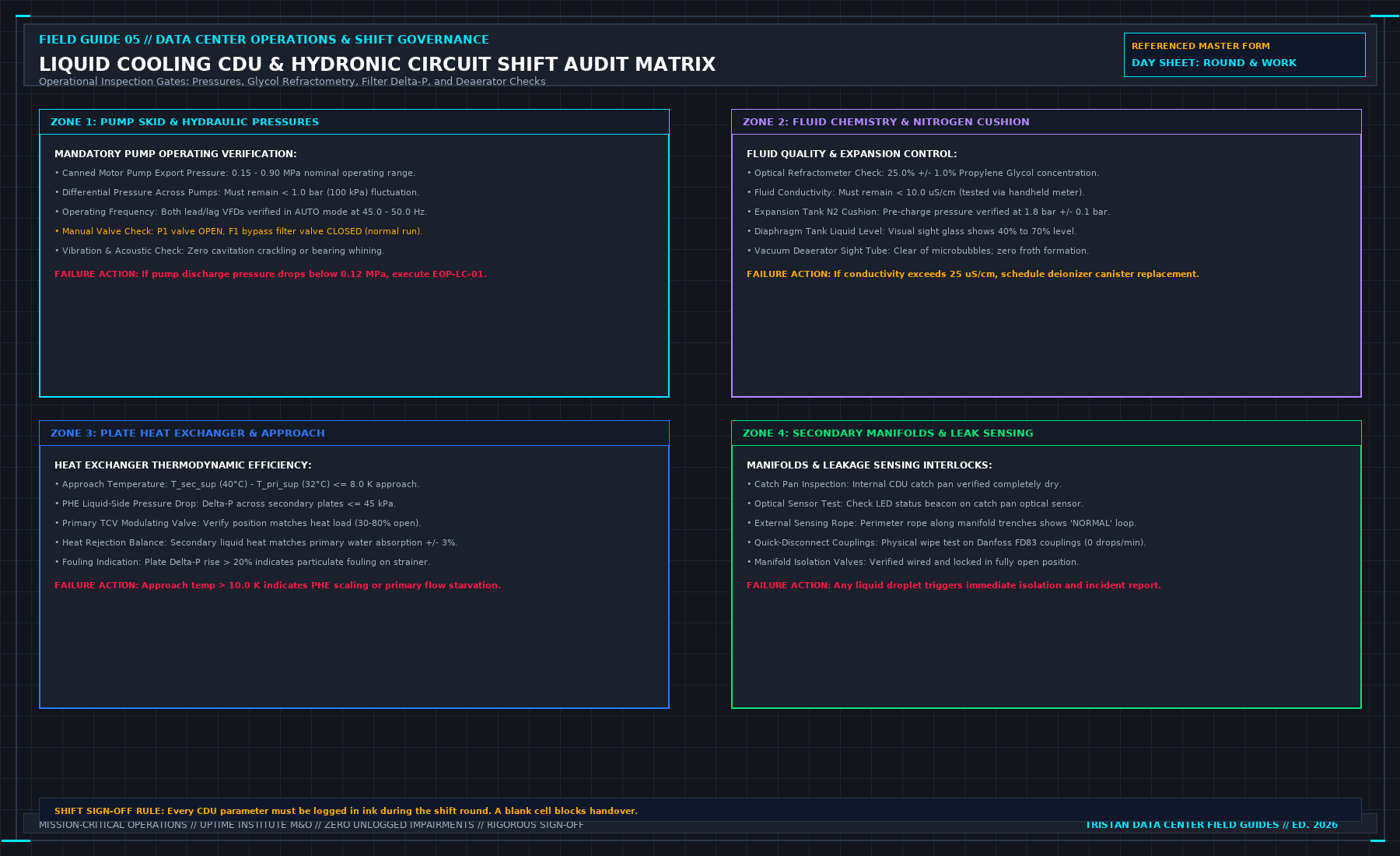
| [SECTION 5] Capacity & Redundancy Audit (45% Power Rule, CDU Hydraulics) |
| ↓ |
| [SECTION 6] The Final Closeout Sentence (The single immutable signature) |
Copy the headings below into your facility's operational software or printed turnover logbook. A blank line on the Day Sheet represents a part of the facility you did not inspect, a risk you did not manage, and an outage you will own.
1. Before the Shift (Handover Gate)
- Shift Date & Time Window:
________________________________________ - Duty Manager On Duty:
___________________________________________ - Outgoing Duty Manager:
_________________________________________ - Contractual SLA Standard Operating To:
__________________________ - Notice Period for SLA Excursions:
_____ Minutes - What Operations Will Explicitly NOT Promise Today:
_______________ - On-Shift Personnel & Verified Trade Qualifications:
- Lead Electrician (License # & Expiration):
_________________________ - Cooling Specialist (License # & Expiration):
______________________ - Shift Technicians on Duty:
________________________________________ - Tasks / Systems Not Covered by Today's Roster:
___________________ - Handover from Previous Shift Read, Walked, and Accepted:
[YES / NO] - Active Impairments Carried In:
- Fire Suppression (VESDA / Gas Disarmed):
__________________________ - Electrical Redundancy Impairments (Bypass / N-0):
__________________ - Mechanical Redundancy Impairments (Manual VFD / Single Pump):
______ - Open Permits to Work (PTW) Carried In & Expiration Times:
________ - Active Incidents Carried In & Assigned Technical Owners:
__________ - Scheduled Changes for Today's Window & Named Risk Acceptors:
______
2. Authorized Work & Maintenance
- Standing Shift Routines (SOPs) Completed:
[YES / NO] - Specific Intrusive Jobs Executed (Approved MOPs Only):
- Job 1: Tag:
_________Scope:___________________MOP #:_______ - Job 2: Tag:
_________Scope:___________________MOP #:_______ - Permits Issued Today & Exact Expiration Timestamps:
- PTW #:
_________Location:____________Closes at:___________ - LOTO Zero-Energy Verification Completed (Lock IDs):
______________ - Critical Spares Inspected at Worksite Prior to Tool Touch:
[YES / NO] - Changes Executed Today:
- Asset ID:
____________Old Parameter:_________New:___________ - Risk Acceptor Name:
__________________CAB Approval #:___________ - Back-Out Plan Verified Prior to Window:
[YES / NO] - Abnormal Operating State Displayed on Control Room Board:
[YES / NO] - Third-Party Vendors on Site:
- Vendor Name:
______________Assigned Site Host:__________________ - Work Kept Strictly Within Written Scope:
[YES / NO]
3. Physical Shift Inspection Round
- Inspection Round Route Walked:
Station 1 through Station 6 Completed - Round Start Time:
________Completion Time:________ - Technician Name:
________________________________________________ - Station 1 (MV Switchgear): SF6 Pressure Normal
[Y/N]| Springs Charged[Y/N]| DC Bus Voltage:____ V - Station 2 (Transformers): Winding Max Temp:
____ °C| Acoustic Normal[Y/N]| Oil Level:____ - Station 3 (UPS & Battery): Ambient Temp:
____ °C| DC Float:____ V| Zero Bulging / Leaks[Y/N] - Station 4 (Chiller Plant): Approach Temp:
____ K| Oil Press:____ bar| VFD Vibration Normal[Y/N] - Station 5 (CDU Stations): TCS Supply Press:
____ MPa| Glycol Refractometer:____ % PG| Catch Pans Dry[Y/N] - Station 6 (AI Whitespace): Containment DP:
____ Pa| Max PDU IR Temp:____ °C| Couplings Dry[Y/N] - Defects Entered on Formal CMMS Register Before Exiting Rooms:
[YES / NONE] - Contractual SLA Maintained During Round:
[YES / NO]
4. Incident & Escalation Log
- Incident Status:
[NONE / ALARM ONLY / ACTIVE INCIDENT] - Severity Classification:
[P1 - CRITICAL / P2 - MAJOR / P3 - MINOR] - Discovery Timestamp:
HH:MM:SS UTC - Observed Physical Symptoms (Facts Only):
__________________________ - EOP Executed & Safe State Achieved Timestamp:
HH:MM:SS UTC - Client Notification Transmitted Timestamp:
HH:MM:SS UTC (<= 15 min) - Confirmation: Hypotheses Kept Off Client Notice:
[YES / NO] - Incident Resolved or Carried Forward:
[RESOLVED / CARRIED FORWARD] - Single Owned Corrective Action Resulting from Event:
______________ - Action Owner:
_____________________Due Date:____________________
5. Capacity & Redundancy Governance
- Contractual Power Sold:
_______ kW(Clause:____________________) - Active Power Utilized:
_______ kW(Revenue Meter Timestamp:_____) - 2N Redundancy Rule Audit:
- Feeder / Bus A Utilization:
_______ %(Must be <= 45.0%) - Feeder / Bus B Utilization:
_______ %(Must be <= 45.0%) - Secondary Cooling Hydraulic Utilization:
- CDU Thermal Load:
_______ kW(Must be <= 83% of PHE rating) - Secondary Flow Rate:
_______ LPM| Supply Temp:_______ °C - Remaining Capacity After Worst-Case Single Failure:
- Calculated Value:
_______ kW(Engineering Study Date:___________) - Status:
[VERIFIED BY STUDY / UNKNOWN] - Unverified Load Energization Requests Rejected:
[YES / NONE]
6. End-of-Shift Closeout & Sign-Off
- All Maintenance Windows Closed or Paused with Named Owner:
[YES / NO] - Abnormal Operating States Cleared from Control Room Board:
[YES / NO] - Handover Dossier Prepared for Incoming Shift:
[YES / NO] - The Single Binding Sentence You Can Honestly Sign:
"I certify on my professional license that during this shift, all critical power and cooling systems operated within contractual SLA boundaries, all work was executed under approved procedures without unrecorded impairments, and all logged defects possess named owners."
- Duty Manager Signature:
__________________________________________ - License / Certification Number:
_________________________________ - Date & Exact Timestamp:
_________________________________________
Quantitative Shift Turnover Audit Protocol
The Master Day Sheet is only legally and operationally valid when signed by both the outgoing Shift Lead and the incoming Shift Lead after completing a face-to-face walkthrough of the control room screen and all active LOTO/MOP boundaries. A turnover left on a desk without a joint verbal and visual audit is an abandoned watch.
| Turnover Verification Item | Outgoing Shift Lead Duty | Incoming Shift Lead Verification | Refusal to Assume Watch Trigger |
|---|---|---|---|
| 1. Active LOTO & Key Box | Present LOTO logbook and physical key box count | Verify every lock on the board matches an active tag in the log | Missing LOTO key or unlogged lock on switchgear/valve |
| 2. 2N Bus Load Headroom | Record peak 15-min kVA and THD across all UPS/Transformer pairs | Confirm max(SA, SB) ≤ 0.45 Srated on live EPMS | Unexplained bus load > 45% without signed derogation |
| 3. Masked / Suppressed Points | Print full list of BMS/EPMS points in Maintenance or Override mode | Cross-check every suppressed point against an active work ticket | Orphaned alarm mask or forced manual valve/fan override |
| 4. Open Incidents & EOPs | Hand over preserved COMTRADE/SOE files and current plant state | Confirm plant is holding in a verified stable state | Ongoing uncontained transient; outgoing lead stays as support |
Auditing Historical Master Day Sheets for Slow-Creep Degradation Trends
While a single Master Day Sheet governs a 24-hour operational window, reviewing 30 consecutive Day Sheets side-by-side exposes slow-creep physical degradation that never triggers an instantaneous threshold alarm: a secondary CDU makeup reservoir losing 0.8 L/day through a weeping fitting, a dry-type transformer winding creeping up +0.4 K/week at constant kVA load due to fouled louver filters, or a diesel starting-battery charger floating 0.3 V low.
3. Field Verification Checklist and Instrumentation Hygiene
To execute this protocol without introducing measurement bias or scope ambiguity, the responsible engineer enforces four mandatory field rules:
- Instrument Traceability Before Observation: Verify that every thermometer (4-wire Pt100 RTD Class A), pressure transducer (≤ ± 0.1% span), flowmeter, balometer, or power analyzer carries a current calibration certificate and passes a pre-test zero/span check on the day of the walk.
- Synchronized Time-Series Capture: Align all digital loggers and gateway pollers to a single UTC reference clock (via IEEE 1588v2 PTP at ± 1 ms for electrical Sequence of Events, or NTP at ± 10 ms for thermal/hydraulic dwells). Never merge unsynchronized CSV files by row index.
- Explicit Isolation of Disturbances vs. Control Handles: Hold upstream supply temperatures, parallel cabinet loads, and containment door states constant during the observation dwell so that transient plant drift is never mistaken for steady-state equipment performance.
- Written Record Prior to Signature: Record every boundary tag, measured value, uncertainty tolerance, and open limitation in ink on the controlled project sheet before leaving the equipment line-up.
Frequently Asked Questions (FAQ)
Why does "An operations system is four piles, not one binder" matter during high-density data center commissioning and operations?
Organizing a mission-critical facility around four non-overlapping operational ledgers: Standing SOPs, Timed MOPs, Emergency EOPs, and the Daily Shift Record. When project teams bypass this rule to meet a commercial schedule milestone, unverified physical assumptions—such as hidden hydraulic pressure drops, unlogged polling gaps, unblanked bypass leakage, or uncalibrated sensor offsets—transfer directly into live 24/7 production as latent single points of failure.
How do you quantitatively verify compliance with "data center operations documentation system four piles" on the physical floor?
Compliance is verified by executing the governing mathematical balance (Master Day Sheet = (Watch Custody, Active MOPs/LOTOs, 6-Station Round, 2N Headroom, Open Incidents)) using independent, calibrated field instruments across a stabilized steady-state dwell window (minimum 15 to 30 minutes for thermal and hydraulic systems), and confirming that the discrepancy between primary and secondary measurements remains strictly within the pre-declared acceptance band.
What should an engineer do if a contractor or vendor submits a report that violates this protocol?
The reviewing engineer must refuse to sign the broad acceptance sentence, mark the specific line item as Unproved / Defective on the official audit sheet, and either require a witnessed re-test under a corrected script or isolate the unproved scope under a time-bounded Conditional Acceptance with a 150% to 200% financial retainage escrow holdback.
From Run the Data Center Day: What the Manager Must Sign Before the Shift Ends, Tristan, Data Center Field Guides.
Related: SOP, MOP, and EOP are three papers.
Master the Complete Protocol: Run the Data Center Day: What the Manager Must Sign Before the Shift Ends
2N Redundancy Mathematics, 6 Inspection Stations, Shift Handovers, and SOP/MOP/EOP Protocols
Stop relying on contractor spreadsheets and vendor marketing claims. This field guide provides the complete, auditable verification binder—including physical equations, inspection stations, acceptance thresholds, and signed refusal templates.