 DATA CENTER
Fundamental Commissioning and Verification: Mapping LEED CxA Prerequisites to Data Center Levels 1–5
DIRECT ANSWER & VERIFICATION THRESHOLD:Fundamental Commissioning and Verification (a mandatory LEED prerequisite and ASHRAE Guideline 0 / ANSI/ASHRAE Standard 202 requirement) establishes independent Commissioning Authority (CxA) oversight, Owner's Project Requirements (OPR), Basis of Design (BoD) review, and Functional Performance Testing (FPT) on energy-using systems. In mission-critical data centers, those prerequisite duties do not stand apart from the 5 levels of data center commissioning (L1–L5): they govern L0–L4 (design review, factory witness, installation QA, pre-functional start-up, and standalone FPT), while Level 5 Integrated Systems Testing (IST) proves whole-building failure-mode resilience under full heat load.
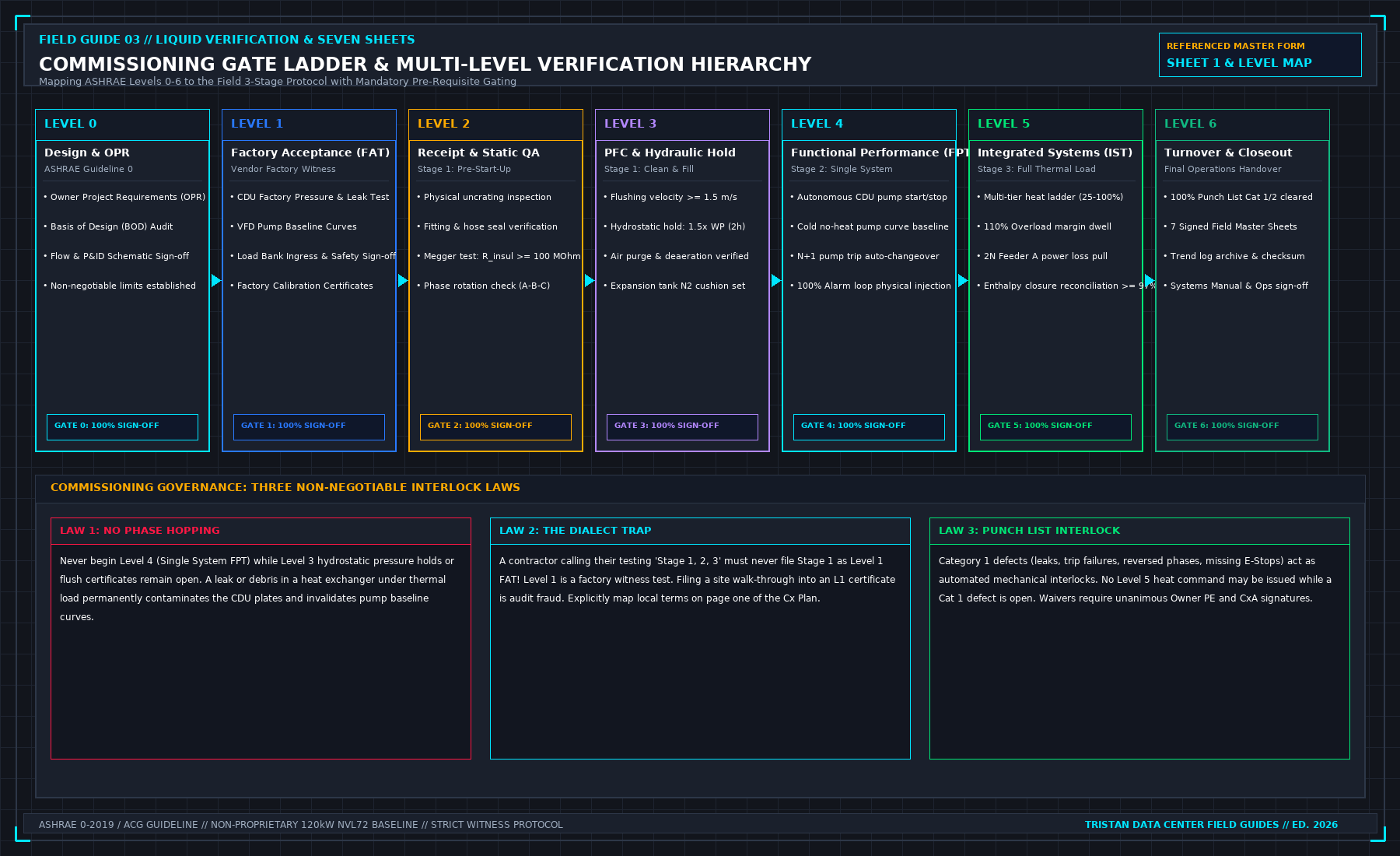
Walk into a project kickoff meeting and hear two teams talk past each other using two incompatible vocabularies. The sustainability consultant asks for Fundamental Commissioning and Verification sheets to satisfy building permit and LEED v4.1 prerequisites. Across the table, the mission-critical mechanical contractor insists they only run "the 5 levels of data center commissioning" and hands over a binder labeled Level 4 Completed.
Neither side notices the gap until handover week. The sustainability package verified an office-grade damper stroke on a cooling unit at zero IT load, while the contractor's Level 4 sign-off was an unwitnessed vendor spreadsheet missing both OPR traceability and black-building failure testing.
In serious facilities engineering, Fundamental Commissioning and Verification and Data Center Commissioning Levels 1 to 5 (L1–L5) are not rival frameworks. Fundamental commissioning supplies the legal governance spine—independent CxA authority, OPR/BoD alignment, and documented issue resolution—while Levels 1 through 5 supply the sequential physical test gates.
How Fundamental Commissioning Maps onto Levels 1 to 5
Whether your contract cites ASHRAE Guideline 0, ANSI/ASHRAE Standard 202, or LEED v4.1 Energy and Atmosphere prerequisites, every deliverable maps deterministically onto the 5-level execution ladder (bounded by L0 pre-construction and L6 closeout):
| Commissioning Level | Formal Gate Name | Fundamental Cx & Verification Deliverable | Non-Negotiable Stop Condition |
|---|---|---|---|
| Level 0 (L0) | Design & OPR Gate | OPR, BoD verification, Cx Plan & script review | Unapproved test scripts or conflicting OPR |
| Level 1 (L1) | Factory Acceptance (FAT) | Witnessed plant skid, switchgear & CDU testing | Shipping unit with open Cat A factory punchlist |
| Level 2 (L2) | Installation QA/QC | Static physical inspection, torque, flush & pressure | Energizing or filling un-flushed piping |
| Level 3 (L3) | Pre-Functional (PFC) | Vendor startup, point-to-point BMS checkout | Advancing to L4 with uncalibrated RTDs/CTs |
| Level 4 (L4) | Functional Testing (FPT) | Independent CxA witnessed standalone system tests | Accepting vendor self-test paper as witness |
| Level 5 (L5) | Integrated Testing (IST) | Full-plant pull-the-plug & thermal load bank tests | Signing L5 with >0% open Cat A life-safety defects |
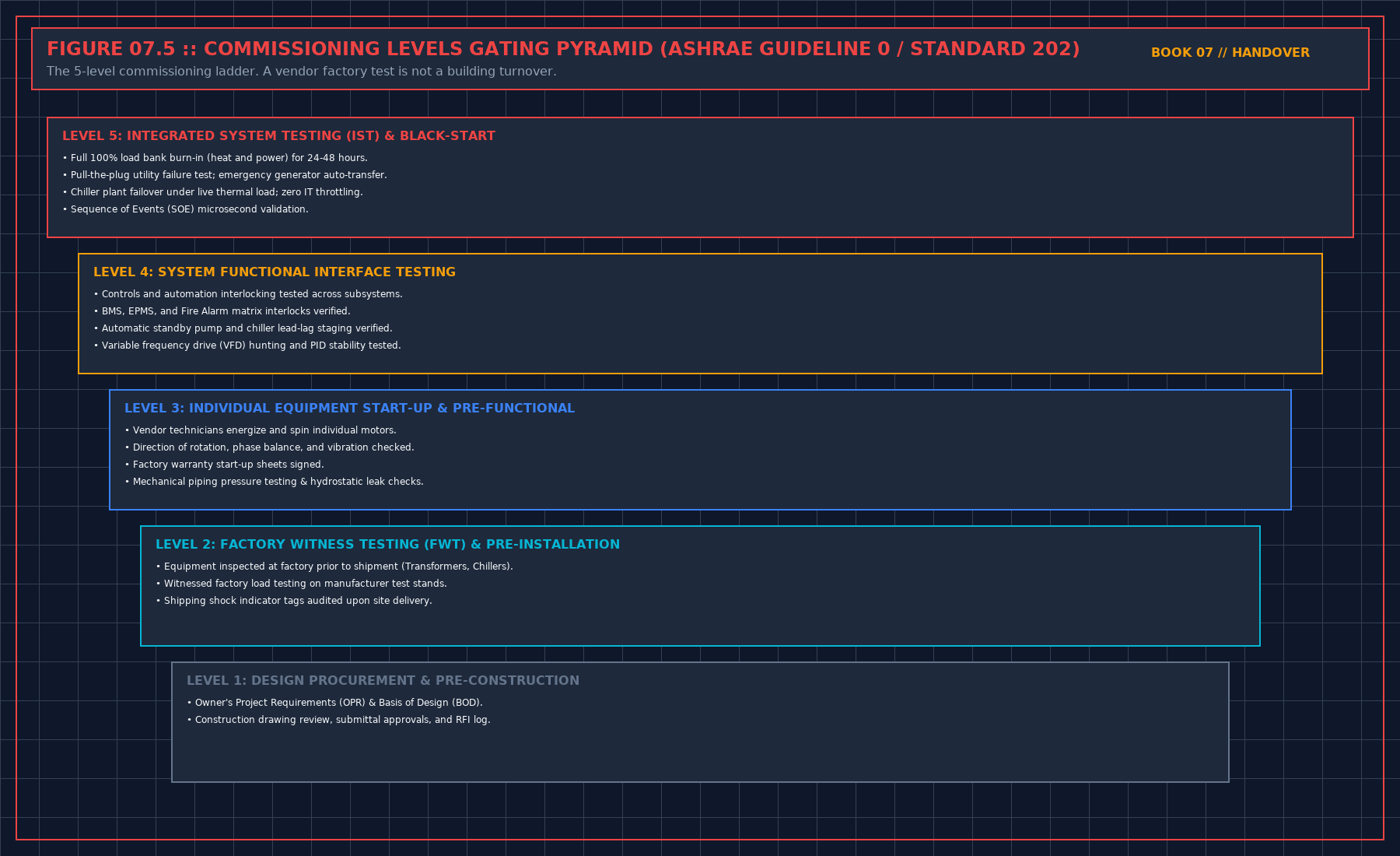
Notice the crisp division of authority. As explained in Data Center Commissioning Levels 1 to 5: FAT to IST, Levels 1 through 3 verify equipment manufacturing, static installation, and single-machine startup. Level 4 (FPT) proves each standalone subsystem—an individual chiller, UPS module, STS, or CDU—meets its Basis of Design sequence of operations. Level 5 (IST) is where mission-critical facilities diverge from commercial buildings: every redundant path, automatic transfer switch, battery string, generator paralleling bus, and liquid cooling loop is stressed simultaneously under simulated load-bank heat and deliberate fault injection.
Why Contractor "3-Stage" Numbering Collides with L1–L5
Many regional mechanical and electrical EPC firms still organize site paperwork into three broad phases ("Static Check", "Cold/Hot Startup", and "Trial Operation") rather than the 5-level L1–L5 hierarchy. When an uncalibrated three-stage binder is relabeled as "Level 5" during handover, critical Fundamental Commissioning boundaries disappear—specifically independent CxA witnessing at Level 4 and cross-discipline black-building failure testing at Level 5.
You prevent schedule disputes by publishing an explicit Crosswalk Translation Matrix inside the Level 0 Commissioning Plan before steel arrives on site, as detailed in Two numbering systems in one commissioning pack. Every tag, test sheet, and punchlist item must state both its local contractor step and its canonical ANSI/ASHRAE Standard 202 level (L1 through L5).
The Seven Verification Gates That Fundamental Commissioning Must Enforce
A commissioning file only satisfies both statutory verification and hyperscale Tier/uptime resilience when seven physical gates close in strict order:
- Independence of the Witness: The Commissioning Authority (CxA) executing Level 4 FPT and Level 5 IST sign-off must be organizationally independent from the installing contractor. Vendor self-certification is a Level 3 startup record, never a Level 4 witness—see Witnessed Test vs Accepted Document.
- Instrument Traceability Before Energization: Every clamp-on flowmeter, differential pressure transducer, thermal RTD tree, and power quality analyzer used in L4/L5 must hold a current NIST-traceable calibration certificate within 12 months.
- 1,000 VDC Megger Isolation Protocol: Prior to running any
1,000 V DCinsulation resistance test on busways or feeders during L2/L3, physically disconnect all solid-state equipment, IGBT inverter drives, UPS rectifier inputs, and Surge Protective Devices (SPDs) to avoid destructive overvoltage puncture. - Sequential System Isolation at L4: Never begin Level 5 IST before every individual subsystem passes Level 4 standalone FPT—including N+1 pump failover, cold no-heat pump curves, and hardwired alarm injection, as covered in One liquid system at a time.
- Dual Thermal Load Testing (Air + Liquid): In AI whitespaces mixing traditional CRAHs with direct-to-chip liquid racks, test both paths separately and together. Use calibrated liquid load banks—not floor-standing air heaters—across CDU loops, following our CDU Commissioning Checklist.
- Deterministic Script Sign-Off: Freeze test step sequences, hold durations, and numerical pass/fail bounds prior to test day (Approve the test script before the day).
- Issues Log Closure Prior to L6 Turnover: Fundamental Commissioning requires a live, tracked Issues & Resolution Log. Category A life-safety or redundancy defects halt turnover; Category B/C items require formal remediation dates or escrow holdbacks.
Quantifying Thermal & Electrical Readiness Before Level 5 IST
Before pulling the utility main breaker for a Level 5 black-building test, calculate two exact physical ceilings from your Level 4 sheets so you do not trip healthy equipment through simple arithmetic neglect:
- 2N Bus Utilization Ceiling: On symmetric redundant power paths with standard 80% continuous-rated UL 489 breakers (or 100%-rated switchgear with safety margin), verify steady-state load per bus stays within design transfer limits:
For example, on a 2,000 kVA 2N UPS pair, total steady-state critical IT + mechanical load should not exceed 1,800 kVA (900 kVA per bus) if a single bus must carry 100% of load without interruption during a Level 5 A-side utility loss without exceeding 90% continuous ceiling.
- Liquid Ride-Through Margin During Generator Transfer: For high-density direct-to-chip loops, calculate how long the resident cold-plate fluid mass (mch) can absorb full IT power (QIT) if secondary pumps coast down during an ATS transfer:
With only mch = 18 kg of resident coolant inside a 120 kW rack manifold and Δ Tallow = 10 K (cp = 3.93 kJ/(kg·K)), τmargin = (18 × 3.93 × 10) / 120 = 5.9 seconds—proving why secondary CDU pumps must sit on uninterrupted UPS/VFD ride-through rather than generator-backed mechanical panels.
For the complete binder templates, 7-sheet acceptance structure, and Level 6 turnover rules, inspect the Volume 03 Liquid Cooling Verification Field Manual and Close-out is not a heat-test report. For background on the author's CxA credentials, visit About Tristan Howard.
Frequently Asked Questions (FAQ)
What is the difference between Fundamental Commissioning and Enhanced Commissioning in a data center?
Fundamental Commissioning and Verification covers mandatory OPR/BoD review, commissioning plan authoring, independent CxA oversight, Level 3–4 functional testing, an Issues Log, and Systems Manual / O&M training delivery. Enhanced Commissioning adds design-phase reviews prior to mid-construction, contractor submittal reviews, Level 5 Integrated Systems Testing (IST), monitoring-based commissioning plans, and a mandatory 10-month seasonal warranty review.
What are the 5 levels of data center commissioning (L1 to L5)?
The 5 core levels are Level 1 Factory Acceptance Testing (FAT), Level 2 Site Receipt & Installation QA/QC, Level 3 Pre-Functional Checks & Startup (PFC), Level 4 Functional Performance Testing (FPT), and Level 5 Integrated Systems Testing (IST). Many hyperscale governance programs bracket these with Level 0 (Design/OPR) and Level 6 (Closeout/Handover).
Can a mechanical contractor perform Level 4 Functional Performance Testing as the CxA?
No. Both LEED Fundamental Commissioning and ANSI/ASHRAE Standard 202 require functional testing to be witnessed and signed off by an independent Commissioning Authority or Owner's Representative who holds no financial or supervisory conflict with the installing trade.
The Book Bridge
Permits, LEED prerequisites, and Tier certifications only tell you which boxes exist—not how to stop a flawed Level 4 test on the data hall floor. The full seven-sheet commissioning binder, test script sign-off gates, and L1–L5 refusal protocols are published in Finish a Liquid Cooling Verification: Seven Sheets for One Load-Bank Test by Tristan.