 DATA CENTER
SOP vs MOP vs EOP: The Operational RACI Matrix and Field Authorization Boundaries
DIRECT ANSWER & VERIFICATION THRESHOLD:In mission-critical data center operations, SOP, MOP, and EOP define three non-overlapping execution and legal authority boundaries:
* SOP (Standard Operating Procedure): Governs repeatable, steady-state inspection and maintenance tasks (e.g., shift rounds, strainer Δ P logging) that never alter plant redundancy or topology (Δ S = 0). Approved by the Lead Critical Facility Engineer (CFE).
* MOP (Method of Procedure): Step-by-step switching scripts for planned, invasive state transitions (e.g., transferring a 2,500 kVA UPS to static bypass) requiring a Point of No Return (PONR), verified back-out plan (Δ Splanned), and dual sign-off from the DCO Manager and Customer Representative.
* EOP (Emergency Operating Procedure): Reflexive fault-containment scripts executed during unscheduled trips, leaks, or blackouts to lock the plant in the First Safe State (Δ Sfault→safe)—pre-authorized for immediate execution by qualified on-duty technicians.
A procedure that does not name who holds the switching key is not a control. It is a wish. When a 480 V tie breaker binds at 03:00 AM, the night shift does not fail for lack of engineering textbooks; it fails because nobody at the panel knows whether the technician in front of the gear is permitted to act without waking a manager.
As established in our foundational protocol on why SOP, MOP, and EOP are three distinct papers, critical facilities court disaster when they dump routine shift rounds, invasive switching orders, and emergency stabilization scripts into a single binder labeled "Operations Procedures." Yet even when those three papers sit in separate racks, a second failure mode paralyzes the floor during live transients: ambiguous sign-off and execution authority.
When a secondary liquid cooling loop loses suction pressure or an automatic transfer switch hangs mid-travel, a Tier 1 technician who hesitates for four minutes to telephone an off-site supervisor turns a containable N-1 fault into a multi-megawatt SLA breach. Conversely, a technician who improvises a live breaker bypass during routine maintenance without a co-signed switching order creates an immediate arc-flash fatality risk.
To eliminate both hesitation during emergencies and freelancing during maintenance, mission-critical facilities enforce a deterministic RACI Governance Matrix (Responsible, Accountable, Consulted, Informed) that binds every physical plant transition to a named license, a bounded time window, and an explicit refusal gate.
1. Full Form, Scope, and State-Transition Comparison Matrix
For engineers, auditors, and commissioning leads evaluating facility documentation, the structural distinctions between SOP, MOP, EOP, and the overarching PTW (Permit to Work) are defined by four physical criteria: plant state change (Δ S), redundancy impact (N), time horizon, and termination condition.
| Parameter | SOP (Standard Operating Procedure) | MOP (Method of Procedure) | EOP (Emergency Operating Procedure) | PTW (Permit to Work Gate) |
|---|---|---|---|---|
| Full Form | Standard Operating Procedure | Method of Procedure | Emergency Operating Procedure | Permit to Work |
| Physical State Impact | Zero topology change (Δ S = 0) | Planned temporary transition (Δ Splanned) | Reflexive hazard isolation (Δ Sfault→safe) | Administrative boundary lock (LOTO / Hot Work) |
| Redundancy Envelope | Full 2N or N+1 maintained at all times | Temporary reduction to N during window | Plant already degraded or in active fault | Governs physical access to isolated zone |
| Trigger Event | Scheduled calendar cadence (daily/weekly) | Approved change request & maintenance window | Unplanned alarm, breaker trip, leak, or fire | Pre-job safety walk prior to tool application |
| Execution Pacing | Self-paced routine verification walk | Two-person call-and-response step verification | Immediate reflex (<60 s air / <5 s NVL72 liquid) | Valid only between stamped start and expiry UTC |
| Termination Condition | Signed logbook entry & parameter trend check | Return to normal baseline & LOTO removal | Arrival at the First Safe State | Physical area clearance & permit closure sign-off |
2. The Operational RACI Authority Matrix
Every physical action on the data hall floor or mechanical gallery maps to an explicit role hierarchy. The table below establishes the auditable RACI boundary across critical facility personnel:
| Engineering Role | SOP (Routine / Static) | MOP (Planned Switching) | EOP (Reflexive Safe-State) | PTW (Permit to Work Gate) |
|---|---|---|---|---|
| Shift Duty Technician (Tier 1/2) | Responsible (R) | Responsible (R) (Operator / Verifier) | Accountable & Responsible (A/R) | Responsible (R) (LOTO Hanging) |
| Lead Critical Facility Engineer (CFE) | Accountable (A) | Responsible (R) (Technical Author) | Consulted (C) (Post-Stabilization) | Accountable (A) (Field Verification) |
| Data Center Operations (DCO) Manager | Informed (I) | Accountable (A) (Final Sign-Off) | Informed (I) (T+10 Min Escalation) | Accountable (A) (High-Risk Co-Sign) |
| Customer / Tenant Representative | Informed (I) | Consulted (C) (Window Concurrence) | Informed (I) (15-Min SLA Notice) | Informed (I) |
| QA / Commissioning Authority (CxA) | Consulted (C) | Consulted (C) (L4/L5 Witness) | Informed (I) (Forensic RCA Audit) | Consulted (C) |
RACI Definitions: Responsible = Executes the physical step or inspection; Accountable = Holds ultimate legal and operational sign-off authority; Consulted = Must review and concur prior to execution; Informed = Receives timestamped notification.
Why On-Duty Technicians Hold "Accountable & Responsible" Authority in an EOP (and Where the Arc-Flash Boundary Stops)
Notice the critical inversion in the third column: during an MOP, a Tier 1 or Tier 2 technician is strictly Responsible (R) for executing steps under the written authorization of the Accountable (A) DCO Manager. They cannot alter a step, skip a verification hold point, or improvise a workaround.
During an EOP, however, the qualified on-duty technician on the floor is both Accountable and Responsible (A/R) for initiating the stabilization script the instant a trigger threshold is crossed. Waiting for telephone permission from an off-site manager before pressing an emergency shunt-trip pushbutton or isolating a ruptured glycol header is a critical operational failure.
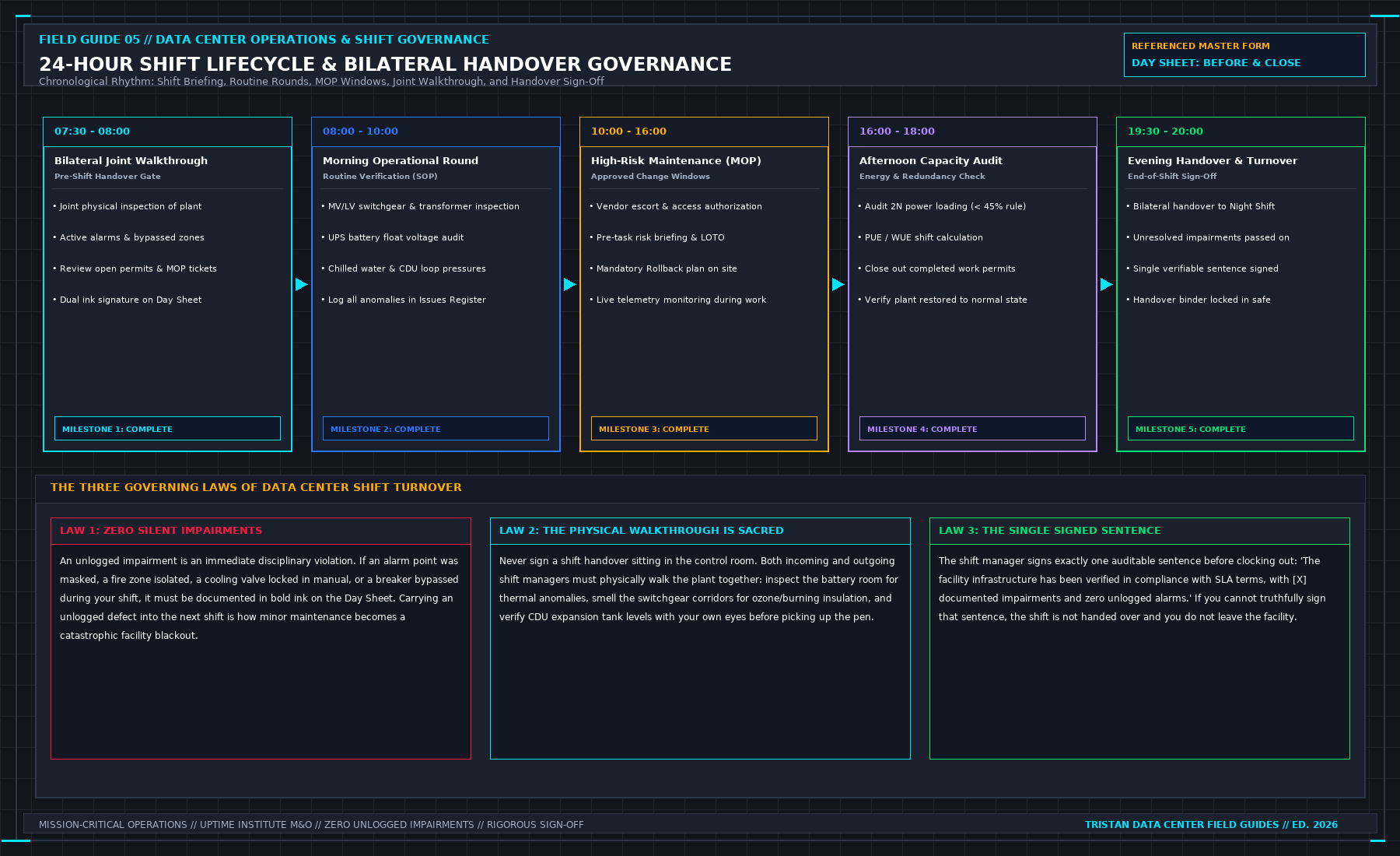
Mandatory Safety & Qualification Boundary (Reconciling Figure 02): Pre-authorized EOP execution by general shift personnel applies strictly to remote or external corridor actions outside the NFPA 70E Arc-Flash Boundary (such as actuating remote EPO stations, SCADA breaker trips, or motorized isolation valves). Any emergency action that requires crossing an arc-flash boundary or manually racking switchgear must be performed exclusively by a licensed Qualified Electrical Worker (QEW) wearing task-specific arc-rated PPE matched to the equipment's posted incident energy label (where the Category 4 / 40 cal/cm2 callout in Figure 02 denotes an illustrative upper-bound suit rating—never a blanket clearance to open unlabeled live gear, as incident energies exceeding 40 cal/cm2 prohibit energized entry entirely). Once the EOP places the facility in the First Safe State, authority immediately reverts to the standard MOP governance hierarchy.
3. First-Principles Mathematical Formulation of Procedure Boundaries
To remove subjective human judgment from procedure selection, high-reliability facilities model the physical plant as a continuous state vector S(t) comprising electrical bus voltage V(t), frequency f(t), supply fluid temperature Tsup(t), differential pressure Δ P(t), and active redundancy margin Navail(t):
For an SOP governing a standing operational job, the time rate of change of plant switching topology must remain identically zero across the entire task duration Δ ttask:
For a scheduled MOP prepared before tools arrive, the plant undergoes a bounded, controlled state transition Δ Splanned(t) inside an authorized maintenance window Wmaint. To guarantee lossless single-bus transfer if the surviving path must absorb the full hall load during switching, combined dual-bus apparent power (SA + SB, accounting for harmonic current distortion THDi and ambient derating) must remain within the continuous rating of the surviving bus (Ssurviving, derated)—which corresponds to ≤ 80% combined load (≤ 40% per bus symmetric) for standard UL 489 80%-rated breakers, or our project-standard ≤ 90% combined ceiling (≤ 45% per bus symmetric) on 100%-continuous-rated switchgear:
For an EOP, at least one critical variable k ∈ S(t) has breached its safe operating envelope Esafe, and the governing objective function is minimizing time-to-stabilization Δ tsafe under the thermal or electrical ride-through limit τride:
4. Pre-Execution Audit Checklist and Four Mandatory Refusal Gates
Before signing the daily shift authorization sheet or releasing a switching team onto the floor, the Lead Critical Facility Engineer must audit the procedure packet against four non-negotiable refusal gates:
| Audit Gate | Defective / Non-Compliant Practice | Auditable First-Principles Requirement | Mandatory Refusal Action |
|---|---|---|---|
| Gate 1: Misclassified Switching | Invasive valve operation or breaker transfer disguised as an SOP to bypass customer notice. | Any step that operates an isolation valve, breaker, bypass switch, or control relay requires a full MOP. | REJECT PACKET: Halt work immediately; escalate to DCO Manager for formal MOP authoring. |
| Gate 2: Unbounded PONR | MOP lacks an explicit Point of No Return (PONR) or states "reverse steps if fault occurs." | Explicit step number marked as PONR with pre-PONR back-out steps and post-PONR EOP handoff. | WITHHOLD SIGNATURE: Require step-by-step hydraulic/electrical transient back-out verification. |
| Gate 3: Stale Walkdown | MOP copied from a previous quarter without verifying current P&ID / SLD tag numbers on the floor. | Field walkdown completed within 72 hours of execution; every breaker and valve tag verified against physical labels. | QUARANTINE PROCEDURE: Mandate physical two-person redline walkdown before issuing PTW. |
| Gate 4: Uncalibrated Instruments | Verification steps rely on panel pilot lights, expired handheld meters, or unverified BMS tiles. | Portable Fluke/Hioki Class A meter or 4-wire Pt100 RTD with active ISO 17025 calibration (≤ 12 months); SCADA points verified Good. | ABORT TEST: Quarantine expired portable meter; flag unverified SCADA points as Bad (0x80 in IEC 62541 OPC-UA / 0x00 in OPC DA). |
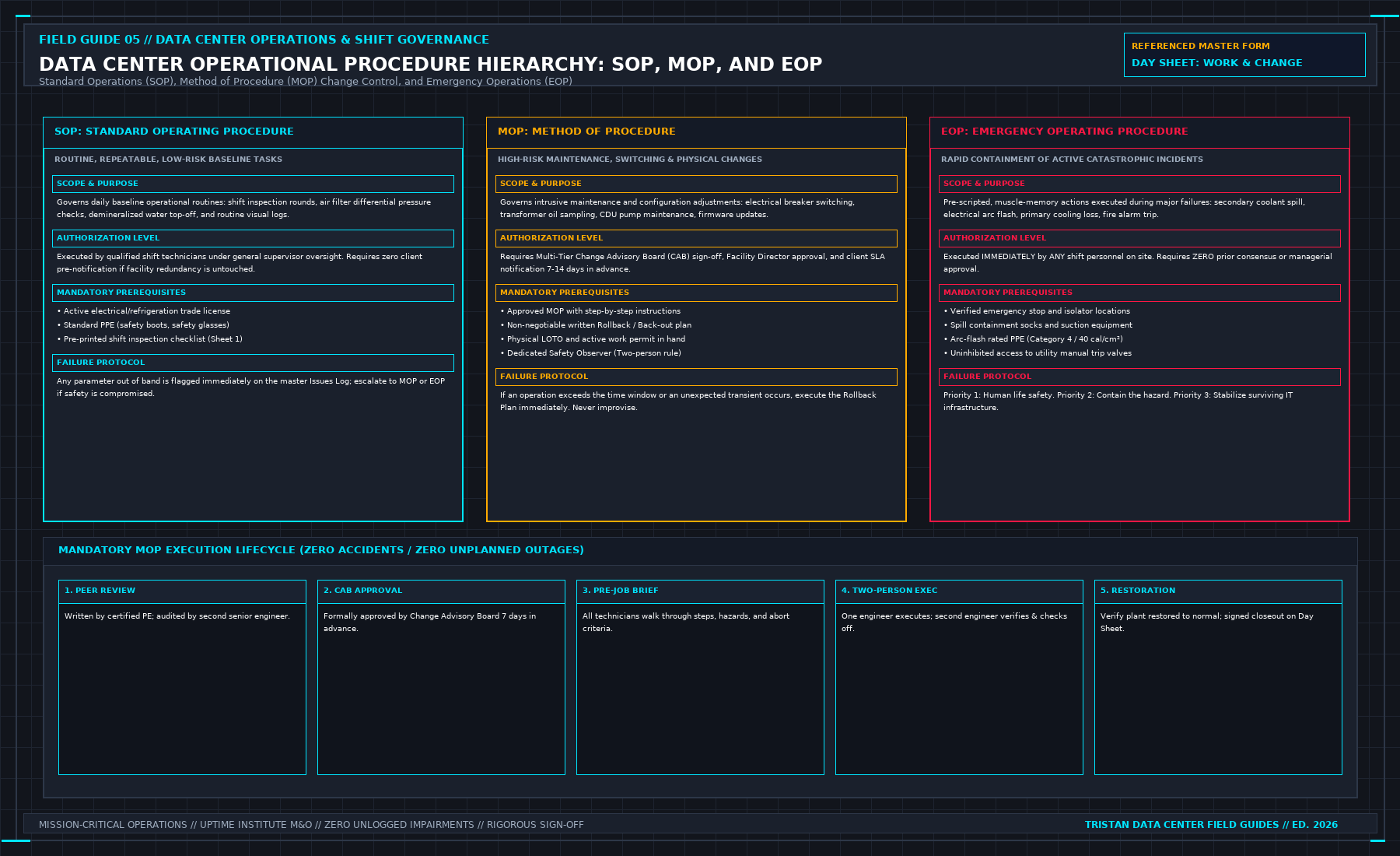
Step-by-Step Shift Sign-Off Verification Protocol
- Verify Active Permits & Windows: Cross-check all scheduled MOPs on the Data Center Shift Handover Checklist against active customer change freeze calendars.
- Confirm Two-Person Crew Qualification: Verify that both the Operator (hands on gear) and the Verifier (reading script and logging UTC timestamps) hold current NFPA 70E arc-flash and site-specific system qualifications.
- Stage the Target EOP at the Panel: Before executing Step 1 of any invasive MOP, physically print and stage the corresponding subsystem EOP at the local switchgear or CDU control cabinet.
- Lock Telemetry Recording at 1-Second Resolution: Configure the EPMS and BMS historian to capture 1 s high-frequency trends across all affected buses and headers for 15 minutes prior to switching and 30 minutes post-completion.
5. Frequently Asked Questions (FAQ)
What is the full form and meaning of SOP, MOP, and EOP in a data center?
In critical facilities, SOP stands for Standard Operating Procedure (routine steady-state maintenance and inspections that do not alter plant redundancy), MOP stands for Method of Procedure (step-by-step authorized switching scripts for planned topology changes or invasive maintenance), and EOP stands for Emergency Operating Procedure (reflexive stabilization scripts executed during unplanned failures to bring the plant to the First Safe State).
Who has the authority to approve an MOP versus execute an EOP?
An MOP requires formal technical review by the Lead Critical Facility Engineer (CFE), operational sign-off by the Data Center Operations (DCO) Manager, and maintenance window concurrence from the customer representative at least 72 hours prior to execution. An EOP, by contrast, is pre-approved by engineering leadership so that any qualified on-duty technician can—and must—execute it immediately upon detecting an emergency trigger without waiting for management phone approval.
Why is a Permit to Work (PTW) separate from an SOP or MOP?
A Permit to Work (PTW) is a time-bounded safety and access authorization gate (governing Lockout/Tagout, arc-flash PPE boundaries, hot-work fire watches, and confined space entry). It defines who may work, where, and when, whereas the SOP or MOP defines the exact technical sequence of how the equipment is operated.
6. Field Reference & Authoritative Standard Citations
- ANSI/ASHRAE Standard 202-2018: Commissioning Process for Buildings and Systems (Standard operating and maintenance documentation hierarchies).
- IEEE Std 3007.2-2010: Recommended Practice for the Maintenance of Industrial and Commercial Power Systems (Two-person switching execution and MOP governance).
- NFPA 70E-2024: Standard for Electrical Safety in the Workplace (Energized electrical work permits and risk assessment boundaries).
This protocol defines the operational authority matrix. The complete shift governance system—including the 13-point Day Sheet, six-station physical round logs, MOP sign-off ladders, and incident chronology ledgers—is detailed in Volume 05: Run the Data Center Day by Tristan.
>
Explore Volume 05 Details | Order on Amazon Kindle & Leanpub →